Research, ideas, and leadership for a more secure, peaceful world
Press Release
from Belfer Center for Science and International Affairs
Modeling Impacts of Food Security Initiatives in the Canadian Arctic
Arctic Initiative Fellow Sappho Gilbert’s Food Security Research Presented to Canadian Parliament
Published:
Sappho Gilbert
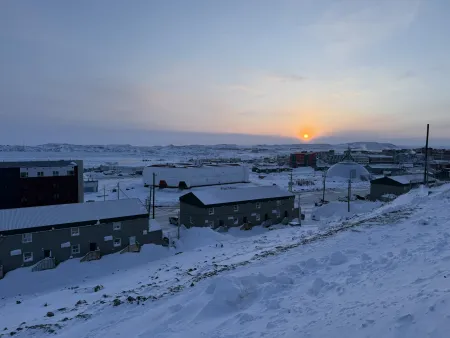
The city of Iqaluit, Nunavut, Canada, at sunset. March 2026.
Nunavut has the highest rate of food insecurity of any Canadian province or territory, affecting 56.4% of residents in 2025. Indigenous peoples are disproportionately at risk of being food insecure, due to factors such as the remoteness of their communities, socioeconomic inequities, the legacy of colonial policies, and climate change.
Food insecurity is a serious public health issue that has persisted in recent years despite various initiatives rolled out by the federal, provincial/territorial, and local governments.
Arctic Initiative Postdoctoral Research Fellow Sappho Gilbert has studied the relationship between community food insecurity and economic support in Nunavut. In recent years, she has been conducting research in partnership with Qajuqturvik Community Food Centre in Iqaluit, Nunavut’s capital and Canada’s northernmost city. In June 2026, Qajuqturvik Director Joseph Murdoch-Flowers presented results from their research together in his testimonies to Canadian Parliament at two Standing Committee meetings.
Watch a video or read a transcript of Joseph Murdoch-Flowers’ testimonies to Canadian Parliament:
Qajuqturvik serves the community of Iqaluit with multiple holistic programs that provide food access, food skills, and advocacy. Through its community meal program, the center cooks and serves 300 to 600 free meals per day, five days a week. In a city of 8,000 people, that means 3-8% of the population relies on the center to avoid going hungry.
Using Qajuqturvik’s daily free lunch statistics as an indicator of community food insecurity, Gilbert has modeled the relationship between various income and grocery supports and meal demand at Qajuqturvik. In a study co-authored with Gilbert's mentors at the Harvard T.H. Chan School of Public Health, Professors Chris Golden and Cindy Leung, the regional Qikiqtani Inuit Association's series of grocery vouchers to Elders throughout the COVID-19 pandemic were found to be associated with significant, weeklong decreases in daily meals accessed at Qajuqturvik. A subsequent analysis of monthly grocery vouchers funded by the Inuit Child First Initiative from November 2024 through March 2025 in Iqaluit revealed a similar, significant pattern: meals accessed at Qajuqturvik declined in the week of each distribution. Their findings suggest targeted grocery and income supports offer immediate relief, yet they also demonstrate such effects diminish quickly because the underlying causes of prevalent food insecurity remain unaddressed.
Sappho Gilbert
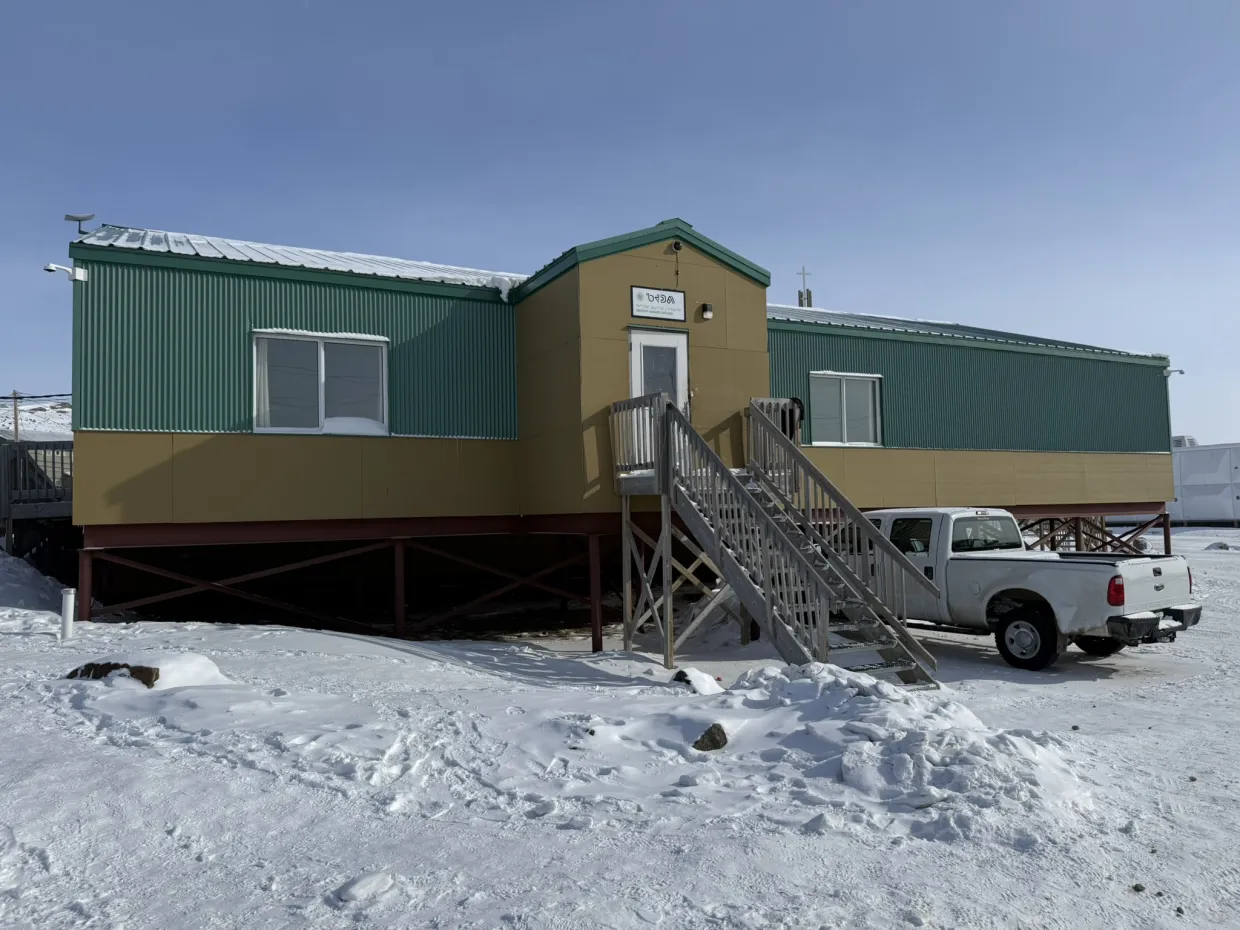
Qajuqturvik Community Food Centre in Iqaluit, Nunavut, Canada. March 2026.
“When money flows into community bank accounts, food in the city quickly becomes more available, resulting in a temporary drop in demand for our daily meal program,” explained Murdoch-Flowers in his testimony on June 9.
Gilbert’s research “supports the proposition that increasing people’s incomes leads to decreasing food insecurity,” said Murdoch-Flowers. Through their ongoing partnership, they continue to study the impacts of interventions on community food insecurity and poverty while also striving to inform sustainable, community-led policies and investments in the local food system.
“Policy must address multiple time horizons,” Gilbert emphasized. “As our research shows, income and grocery supports can help community members access food immediately and thereby temporarily ease the escalating pressure on community food programs like Qajuqturvik. At the same time, longer-term policy solutions must be guided by community expertise and priorities to further advance Inuit food sovereignty and health.”
Hanlon-Warren, Elizabeth. “Modeling Impacts of Food Security Initiatives in the Canadian Arctic.” Belfer Center for Science and International Affairs, August 3, 2026
Recommended citation
Hanlon-Warren, Elizabeth. “Modeling Impacts of Food Security Initiatives in the Canadian Arctic.” Belfer Center for Science and International Affairs, August 3, 2026