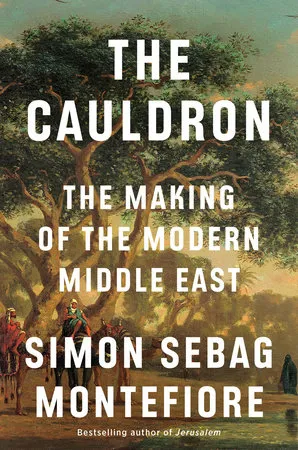
Simon Sebag Montefiore is one of Britain’s finest historians—a national treasure. In The Cauldron, he tackles a subject that lesser historians would not attempt: the making of the modern Middle East in all its bewildering complexity. The region is too large for a single national story, too diverse for a civilisational shorthand and too politically charged for comfortable detachment. Its history is usually broken into manageable pieces: the end of the Ottoman Empire, the creation of Israel, Arab nationalism, oil, political Islam and American intervention. Montefiore attempts something far more ambitious. In one sweeping narrative, he carries the reader from Morocco to Iran and from the capture of Riyadh in 1902 to the wars of 2026. The result is a remarkable feat: panoramic without becoming bloodless, learned without losing narrative momentum, and passionate without surrendering to partisanship.
Montefiore begins with a raid worthy of an epic. At dawn, the young Abdulaziz bin Abdul Rahman Al Saud and a few dozen warriors seize Riyadh, killing its Rashidi governor and restoring the fortunes of the House of Saud. What looks like a minor Arabian feud becomes the opening movement of a regional transformation. Riyadh, then a town of some 10,000 people, will become the capital of a state central to world politics. The scene displays Montefiore’s characteristic gifts: physical detail, dynastic memory, political theatre and a sharp eye for the moment when private daring becomes public history.
From there the canvas expands. Sultans, shahs, kings, presidents, colonial proconsuls, revolutionaries, generals, clerics and spies crowd the stage. The first act covers the imperial order between 1900 and 1945; the second follows the independent states through decolonisation, pan-Arabism, Cold War, Islamist revolution, American predominance and its erosion. The familiar landmarks are here—Sykes-Picot, Suez, the Six-Day War, the Iranian Revolution, the Gulf wars, 9/11, the Arab Spring, Islamic State and October 7—but Montefiore repeatedly changes the angle of vision. Palestine matters enormously, but it does not swallow the entire region. Morocco, Algeria, Sudan, Yemen, Türkiye, the Gulf monarchies and Iran occupy their proper place in the same interconnected story.
That breadth is the book’s greatest achievement. Montefiore rejects monocausal explanations. The modern Middle East was not simply “made” by European cartographers, though British and French power left profound and often poisonous legacies. Nor can everything be explained by oil, religion, nationalism or American interference. Local rulers possessed agency, ambition, armies and secret services; old dynasties proved surprisingly adaptable; sectarian identities could harden or soften according to political circumstance. Foreign empires intervened, but regional powers manipulated outsiders, planted agents, mounted coups and pursued imperial projects of their own. The cauldron is heated from within as well as without.
Espionage is central to his story—the original sin of the modern Middle East. Secret agreements, clandestine alliances and covert interventions help shape its states and borders; intelligence services then become instruments through which rulers preserve power, wage war and pursue their enemies. Sultan Abdulhamid II constructs the Yıldız intelligence apparatus to defend his threatened empire. Nasser builds the mukhabarat as both shield and instrument of power. The shah creates SAVAK; Israel develops Mossad; Jordan’s intelligence service helps keep its monarchy alive. French officers masquerade and conspire in Morocco, British operatives manage the palace revolution that installs Qaboos in Oman, while the KGB, CIA and regional services arm clients, spread disinformation and cultivate rulers. Montefiore shows how, in states where institutions are fragile and politics personal, intelligence chiefs can become kingmakers—and rulers can become prisoners of the information systems designed to protect them.
The 1953 overthrow of Iran’s Mohammad Mosaddegh receives especially intelligent treatment. Montefiore neither denies Operation AJAX nor allows the CIA to claim omnipotence. Kermit Roosevelt arrives to assist a struggle already driven by Iranian monarchists, soldiers, clerics and street forces; much of the American budget remains unspent. This is an important corrective to both imperial self-congratulation and anti-imperial mythology. Covert intervention matters enormously, but it succeeds or fails through local actors with their own purposes. The episode becomes a model for the book’s larger argument about the constant interplay between foreign intrigue and domestic agency.
Espionage also supplies some of the narrative’s sharpest set pieces. The Syrian capture and public hanging of Mossad’s Eli Cohen reveals both the reach and vulnerability of human intelligence. An Egyptian source warns Israel of attack, while his possible role as a double agent preserves the ambiguity at the heart of the trade. Mossad’s campaigns of assassination, Iran’s pursuit of dissidents, the abduction and murder of CIA Beirut station chief William Buckley, and the CIA’s post-9/11 black sites chart the moral corrosion that follows when secrecy becomes licence. Intelligence here is not ornamental cloak-and-dagger material. It shapes wars, sustains regimes and distorts decisions.
The writing is exuberant. Montefiore has an almost novelistic ability to introduce a ruler through the telling contradiction: an autocrat may also be a carpenter, opera enthusiast, wrestler or Sherlock Holmes devotee. He understands that personality matters in systems where power is intensely personal. His rulers and spies are not chess pieces labelled “West,” “Islam” or “nationalism,” but human beings shaped by family, vanity, fear, faith and appetite. The method makes a long and intricate book highly readable.
There are costs to such velocity. Even for a sympathetic reader, the sweep can be daunting: the parade of names, dynasties, agencies, militias and shifting alliances is sometimes dizzying. Specialists will dispute particular emphases or contemporary judgments. A narrative that runs almost to the instant of publication necessarily enters terrain where evidence remains incomplete and covert episodes remain contested. These are the inevitable hazards of such a sweeping narrative. The selectivity is the price of making the whole visible.
The Cauldron does not end in fatalism. Montefiore insists that simplification is the enemy of history and that the region’s violent ideologues do not exhaust its traditions. Alongside supremacy, grievance and holy war stand cosmopolitanism, coexistence and what he calls the toughness of hope. Peace requires rival peoples to hear one another’s narratives, a modest proposition that is also an immense political demand. In an age of instant certainty—and of intelligence routinely bent into propaganda—The Cauldron offers the more difficult virtues of knowledge, complexity and historical imagination. It is a magnificent, timely and humane book: an epic history equal to its subject.
Statements and views expressed in this commentary are solely those of the authors and do not imply endorsement by Harvard University, the Harvard Kennedy School, or the Belfer Center for Science and International Affairs.
Recommended citation
Walton, Calder. “Book Review: The Cauldron and the Making of the Modern Middle East.” October 15, 2026
Book Review: The Cauldron and the Making of the Modern Middle East