To compete and thrive in the 21st century, democracies, and the United States in particular, must develop new national security and economic strategies that address the geopolitics of information. In the 20th century, market capitalist democracies geared infrastructure, energy, trade, and even social policy to protect and advance that era’s key source of power—manufacturing. In this century, democracies must better account for information geopolitics across all dimensions of domestic policy and national strategy.
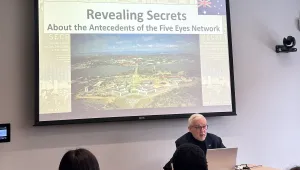
This new weekly seminar brings current and former practitioners from the intelligence community together with the Harvard community to discuss various intelligence-related topics in an informal setting. The discussion will be led by a different expert each week, who will address topics such as "Whistle Blowers, Traitors, and Spies in the Digital World," "Women in Intelligence," "The Ethics of Intelligence," and other themes relating to both the operational and practical aspects of intelligence, as well as it's role in national and international policy and decision making.
The lunch will take place in One Brattle Square Conference Room 350 (OB350), from 12:00-1:15 PM and is open to all Harvard faculty, fellow, students, and staff who are interested in expanding their knowledge and awareness of intelligence issues. No RSVP required. Lunch from Flour Bakery will be served!
Michael Gillen began his career at the Department of Defense (DoD) in 2000 as a computer programmer, working on various National Security Agency/Central Security Service (NSA/CSS) Signals Intelligence (SIGINT) data collection systems. In 2003, he transitioned into network analysis and focused on improving intelligence access to various adversaries around the world, including counterterrorism targets and a range of countries. Mr. Gillen’s most recent position was the Deputy Chief of Operations for the NSA Cybersecurity Operations (CSO) Group. In this role, he advises the Chief of CSO on all operational issues in the cybersecurity mission space, including target pursuit, countering foreign malicious cyber activity, and strategic cyber planning with whole-of-government coordination.
Mr. Gillen graduated from Truman State University in 2003 with a Bachelor of Science in Computer Science. In late 2006, he received a Master of Arts degree in International Security Studies from Georgetown University. He’s also taken a range of NSA/CSS internal courses on telecommunications, technology, and world affairs.