To compete and thrive in the 21st century, democracies, and the United States in particular, must develop new national security and economic strategies that address the geopolitics of information. In the 20th century, market capitalist democracies geared infrastructure, energy, trade, and even social policy to protect and advance that era’s key source of power—manufacturing. In this century, democracies must better account for information geopolitics across all dimensions of domestic policy and national strategy.
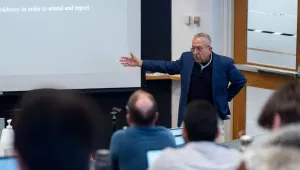
A seminar with Alexandra Stark, Research Fellow, Middle East Initiative and Ph.D. Candidate, Georgetown University.
Abstract
Military intervention in external civil wars tends to transform relatively localized conflicts into regional conflicts that are very difficult to resolve and therefore last longer, generate higher numbers of casualties from violence, and have massive humanitarian implications. My research seeks to build a more comprehensive understanding of the conditions under which states in the MENA region intervene in civil wars. This research highlights the dynamics of competition among regional powers as well as the relationship between the United States and its regional allies, and how both affect intervention decisions.
Speaker
Alexandra Stark
Alexandra Stark
- Former Pre-Doctoral Research Fellow, Middle East Initiative 2018-2019
Moderator
Tarek Masoud
Tarek Masoud
- Sultan Qaboos Bin Said of Oman Professor of International Relations, Harvard Kennedy School
- Faculty Director, Middle East Initiative
- Member of the Board, Belfer Center
For Event Information
Christopher Mawhorter
- Communications and Events Coordinator, Middle East Initiative