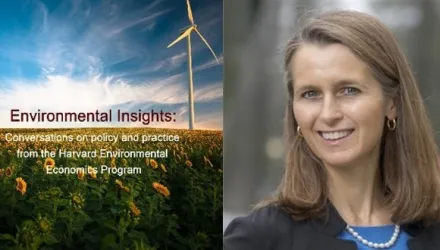
Speech - Harvard Project on Climate Agreements, Belfer Center
An Economist's Take on Climate Change: The Paris Agreement and the Post-2020 World
Overview
What is environmental economics? Is it just a contradiction in terms, or is it much more than that? Harvard Kennedy School Professor Robert Stavins explains that the causes of environmental problems are economic, and the consequences of environmental problems have important economic dimensions. Therefore, an economic perspective is essential for a full understanding of environmental threats, and can be exceptionally helpful for the design of solutions—public policies—that will be effective, economically sensible, and politically pragmatic. Such economic thinking is particularly important for the formulation of effective, sensible, and politically feasible climate change policies. The scientific nature of the problem leads to the economic dimensions of the problem, which in turn leads to the global geopolitics of climate change—underscoring the necessity of international cooperation to address this great challenge.
In this talk, Stavins will provided an economic perspective as he assesses the Paris Agreement, reached in December of 2015. He will review the previous 20 years of climate negotiations in order to place the Paris Agreement in its proper context. Drawing on research carried out by the Harvard Project on Climate Agreements, he will provide a detailed assessment of the new approach now being taken, looking both at the significant accomplishments of the Agreement, as well as the key challenges that remain. Particular attention will be given to the potential role of carbon pricing at the regional (EU), national, and sub-national levels, and the importance of international linkage among heterogeneous policies. Stavins will conclude with an examination of the institutional path ahead, both within the United Nations and outside of it.
Want to Read More?
The full text of this publication is available via the original publication source.
For more information on this publication:
Please contact
Harvard Project on Climate Agreements
For Academic Citation:
“An Economist's Take on Climate Change: The Paris Agreement and the Post-2020 World.” Video, May 11, 2016, posted by “Harvard Project on Climate Agreements, Belfer Center”.
- Recommended
- In the Spotlight
- Most Viewed
Recommended
Policy Brief
The Future of Carbon Offset Markets
Analysis & Opinions
- Foreign Policy
The Realist Case for the Non-Realist Biden
News
- Harvard Project on Climate Agreements
Joseph Aldy Shares his Thoughts on Incorporating Green Energy into an Economic Stimulus Package: Lessons Learned from the 2009 Recovery Act
In the Spotlight
Most Viewed
Policy Brief
- Quarterly Journal: International Security
The Future of U.S. Nuclear Policy: The Case for No First Use
Discussion Paper
- Belfer Center for Science and International Affairs, Harvard Kennedy School
Why the United States Should Spread Democracy
Overview
What is environmental economics? Is it just a contradiction in terms, or is it much more than that? Harvard Kennedy School Professor Robert Stavins explains that the causes of environmental problems are economic, and the consequences of environmental problems have important economic dimensions. Therefore, an economic perspective is essential for a full understanding of environmental threats, and can be exceptionally helpful for the design of solutions—public policies—that will be effective, economically sensible, and politically pragmatic. Such economic thinking is particularly important for the formulation of effective, sensible, and politically feasible climate change policies. The scientific nature of the problem leads to the economic dimensions of the problem, which in turn leads to the global geopolitics of climate change—underscoring the necessity of international cooperation to address this great challenge.
In this talk, Stavins will provided an economic perspective as he assesses the Paris Agreement, reached in December of 2015. He will review the previous 20 years of climate negotiations in order to place the Paris Agreement in its proper context. Drawing on research carried out by the Harvard Project on Climate Agreements, he will provide a detailed assessment of the new approach now being taken, looking both at the significant accomplishments of the Agreement, as well as the key challenges that remain. Particular attention will be given to the potential role of carbon pricing at the regional (EU), national, and sub-national levels, and the importance of international linkage among heterogeneous policies. Stavins will conclude with an examination of the institutional path ahead, both within the United Nations and outside of it.
Want to Read More?
The full text of this publication is available via the original publication source.- Recommended
- In the Spotlight
- Most Viewed
Recommended
Policy Brief
The Future of Carbon Offset Markets
Analysis & Opinions - Foreign Policy
The Realist Case for the Non-Realist Biden
News - Harvard Project on Climate Agreements
Joseph Aldy Shares his Thoughts on Incorporating Green Energy into an Economic Stimulus Package: Lessons Learned from the 2009 Recovery Act
In the Spotlight
Most Viewed
Policy Brief - Quarterly Journal: International Security
The Future of U.S. Nuclear Policy: The Case for No First Use
Discussion Paper - Belfer Center for Science and International Affairs, Harvard Kennedy School
Why the United States Should Spread Democracy