The governance system and underlying regulatory framework
A mix of international, regional, and national frameworks, instruments, and arrangements regulate the world’s ocean, including the Arctic Ocean. The United Nations Convention on the Law of the Sea (UNCLOS) is a key agreement in this system. Adopted in 1982, it sets out how countries should use and manage the ocean.
UNCLOS divides the ocean into different maritime zones. Some zones fall under the jurisdiction of coastal states. These include internal waters, territorial seas, contiguous zones, Exclusive Economic Zones, and continental shelves. They are called areas within national jurisdiction (AWNJ).
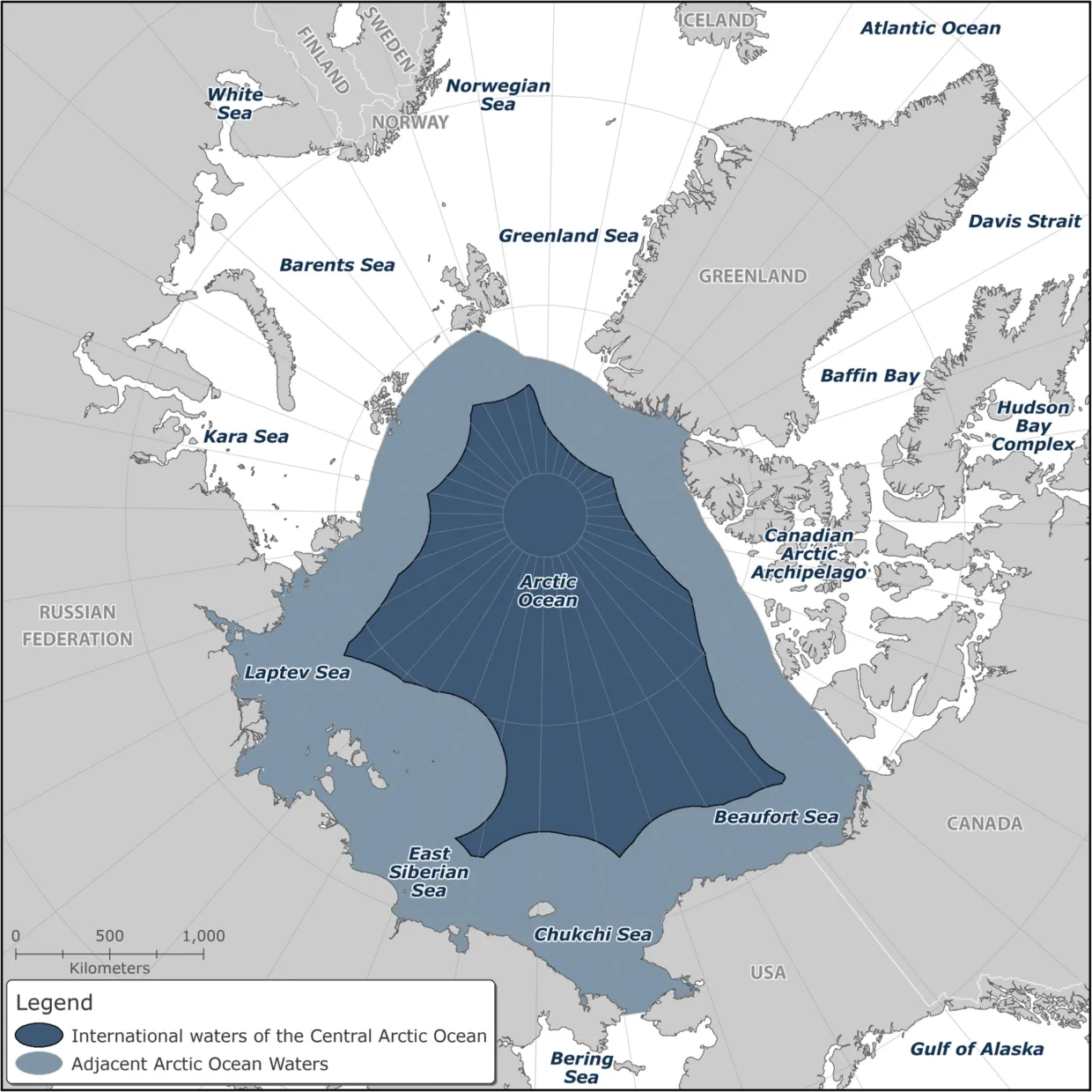
Some zones lie beyond the jurisdiction of states, such as the very center of the Arctic Ocean (Figure 1). These "areas beyond national jurisdiction" (ABNJ) include the international seabed and the high seas, meaning the water column above the seabed.
No one body or institution manages the high seas. Instead, all states have the right to exercise certain high seas freedoms as set forth in UNCLOS. These include, among others, the freedom to fish, navigate, and conduct scientific research. These freedoms come with caveats, including the general obligation to protect the marine environment.
There is no overarching framework for ocean governance, instead marine activities are regulated separately and by sectors, meaning that each sector and the corresponding activities are managed by a dedicated body or institution. For example, the International Seabed Authority (ISA) regulates mining on the international seabed; the International Maritime Organization (IMO) regulates shipping activities; and Regional Fisheries Management Organizations (RFMOs) regulate fishing activities. This sectoral focus contributes to human-centered management decisions that assess and value ecosystems for the services they provide to humans, not for their inherent value.
Why is the current human-centered approach to ocean management insufficient?
UNCLOS is primarily concerned with how states use the world’s ocean – for shipping, navigation, mining, research or other activities. To organize and regulate these uses, the ocean is divided into maritime zones with fixed boundaries, each with specific rights and obligations for states.
In reality, however, the ocean is a connected and constantly changing system. Many marine species migrate across vast distances or seasons. Their ranges shift as ocean conditions change regardless of geographic boundaries. Pollution and other human impacts also move freely across maritime zones. For example, marine microplastics, which largely originate from land-based sources, are now found in all areas of the ocean. They are distributed by currents, waves and surface winds crossing the legal boundaries that divide it.
This exposes the weaknesses of human-centered approach to ocean governance, which focuses on regulating how people use the ocean rather than managing and protecting the ocean as an interconnected ecosystem. As such, it has failed to protect the vast majority of the ocean.
As of 2026, only around 10.01% of the ocean is covered by Marine Protected Areas and other effective conservation measures (IUCN, 2026). In the high seas, which make up approximately 61% of the ocean, coverage is only about 1.45% (Protected Planet, 2026). Just 5% of the Arctic Ocean is protected and no part of its high seas area is covered by a Marine Protected Area. In contrast, about 20% of the Arctic’s terrestrial area is protected (CAFF/PAME, 2022).
Several factors have limited the protection of the high seas. First, states have diverging interests: some are focused on environmental protection, while others prioritize economic use of the ocean. Second, it is challenging to balance states’ right to exercise their high seas freedoms (e.g. the right to fish) with the obligation to protect and preserve marine ecosystems. Finally, no one body or institution has a clear mandate to establish cross-sectoral conservation measures in the high seas, such as Marine Protected Areas.
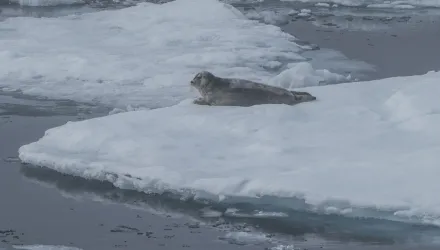
These challenges are particularly evident in the Arctic Ocean, which hosts rich and unique but fragile ecosystems, and where environmental change is especially pronounced. It is warming faster than any other ocean leading to the loss of sea ice. Many species depend on sea ice as a platform for hunting, breeding, and resting. Phytoplankton and algae growing beneath sea ice form the foundation of the Arctic Ocean food web. Furthermore, as sea ice recedes, human activities in the region and their side effects (e.g., pollution from maritime traffic, the introduction of non-native species) are increasing, creating additional pressures on these marine ecosystems.
Protecting marine biodiversity under these rapidly changing conditions requires governance and management systems that are designed with a sophisticated knowledge of how these marine ecosystems actually function. Ocean governance and management therefore need to become more dynamic and adaptive to both human pressures and environmental change.
What could an ecocentric approach to Arctic Ocean governance look like?
Learning to prioritize ecosystems and their intrinsic and relational value, rather than their economic value to people, will require a fundamental shift in the worldview underpinning today’s ocean governance and management system. Current ocean governance is largely static, sector-based, and human-centered. It is also closely tied to geographical boundaries. Within this framework, the primary objective of ocean management is to benefit states, their economies, and their citizens through the services marine ecosystems provide.
New approaches to ocean management increasingly seek to account for ecosystem connectivity and adaptation to environmental change. One example is dynamic ocean management in fisheries, where fishing activities are adjusted when fishers encounter or catch protected species as a by-product. With this approach they can also lower their environmental impact. However, these approaches generally remain sector-specific and are mainly applied within areas under national jurisdiction. Cross-sectoral and holistic approaches, particularly for the high seas, remain limited.
The ecosystem approach is one example of a more holistic model aiming to balance conservation and sustainable use of marine resources. It considers the complexity and interconnected relationship between people and the environment instead of focusing on a single species or sector alone. As such, the approach aims to overcome fragmented and sectoral governance and has become a key principle of ocean governance.
First endorsed under the Convention on Biological Diversity in the mid-1990s, the ecosystem approach has since been incorporated into several legal frameworks, including Agreement on the Conservation and Sustainable Use of Marine Biodiversity Beyond National Jurisdiction (BBNJ Agreement).
The BBNJ Agreement was adopted in 2023 and entered into force in January 2026. It is considered a milestone for the conservation and sustainable use of marine biodiversity in areas beyond national jurisdiction. Among other things, it aims to provide further guidance on the establishment of Marine Protected Areas.
The integration of the ecosystem approach into legal frameworks is an important step towards a more holistic and ecosystem-focused approach to ocean governance. However, in practice states often continue to prioritize short-term economic and political interests over ecosystem protection.
We need to learn how to respect ecosystems for their intrinsic value, not just for the benefits they provide to people. With this understanding, we need to design our approaches so they reflect the interconnected, complex, and dynamic nature of the environment, which we are a part of and which we influence through our actions. Achieving this shift will be challenging because anthropocentric perspectives are deeply ingrained in the ways marine ecosystems are governed and managed. Despite this challenge, there are some concrete steps that can be taken to support a transition towards a more ecocentric approach to ocean governance and management:
Incorporate multiple knowledge systems and strengthen the participation of underrepresented groups
One way of rethinking ocean governance is to learn from Indigenous Knowledge[SJ5.1] systems. Indigenous Peoples understand and relate to marine ecosystems differently from dominant Western perspectives. For example, species such as polar bears and whales are not valued solely as resources. They are closely connected to culture, identity, traditions, and ways of life. The Central Arctic Ocean Fisheries Agreement (CAOFA) illustrates how different knowledge systems can be brought together. Through its Joint Program for Scientific Research and Monitoring, the Agreement combines Western scientific research and Indigenous Knowledge to guide future conservation and management measures. Indigenous representatives participate in the meetings of the CAOFA’s bodies, such as the Scientific Coordinating Group as members of the Arctic State delegations. In this role, they contribute Indigenous Knowledge as a distinct source of information, helping to build a more holistic understanding of Arctic marine ecosystems, as recognized in the Agreement.
Similarly, the BBNJ Agreement emphasizes consultation with Indigenous Peoples and the need to secure their free, prior and informed consent in matters relating to the use of marine resources and the establishment of conservation measures. Furthermore, the agreement promotes precautionary and ecosystem-based approaches and recognizes the inherent value of biodiversity.
Consider cumulative impacts on ecosystems and ecosystem connectivity
Increasingly, Western scientific research examines how ecosystems function as interconnected wholes, including the combined impacts of past, present, and future human activities and climate change impacts. This understanding is also being incorporated into legal frameworks, which means that the consideration of cumulative impacts becomes increasingly an important principle.
For example, the BBNJ Agreement specifically emphasizes the need to consider cumulative and transboundary impacts when assessing whether activities in areas beyond national jurisdiction should proceed, be adapted, restricted or prohibited to protect marine ecosystems. The Agreement also identifies cumulative and transboundary impacts, and ecosystem connectivity as criteria when establishing area-based management tools, including Marine Protected Areas.
The framework of the Central Arctic Ocean Fisheries Agreement (CAOFA), particularly its Joint Program of Scientific Research and Monitoring, seeks to improve the understanding of the Central Arctic Ocean ecosystem, assess how climate-related changes affect it, and determine whether commercially viable fish stocks exist. The management of the area will then be developed on the basis of this information and the needs of the marine ecosystem. Additionally, it recognizes the interconnectedness of marine ecosystem and emphasizes the need to gather scientific information on the ecosystem characteristics of the marine areas that are adjacent and surrounding the Central Arctic Ocean.
Increase coordination across sectors
Despite its many virtues, the CAOFA remains a sectoral instrument – that is, it focuses solely on fisheries. Together with other regulations relevant to the Arctic Ocean, such as the Polar Code, which governs shipping activities in the polar regions, it largely maintains the existing sector-based governance structure.
In contrast, an objective of the BBNJ Agreement is to improve coordination and cooperation across sectors to strengthen the conservation and sustainable use of marine biodiversity beyond national jurisdiction. The Agreement also encourages broad participation by states, scientists, Indigenous Peoples, civil society organizations, and other groups in decision-making around new conservation measures.
Yet, many implementation details still need to be clarified by the Conference of the Parties (COP), the decision-making body composed of states that have ratified the BBNJ Agreement. Given the limited number of protected areas and broader cross-sectoral conservation measures currently in place in the high seas portion of the CAO, the BBNJ Agreement offers states an important opportunity to pursue ambitious action and support a more holistic and ecosystem-centered approach to Arctic Ocean governance.
Key takeaways
Marine biodiversity continues to decline due to climate change, pollution, and growing human activities, despite growing efforts to strengthen conservation and protection measures. Ocean governance continues to cater to human and state interests, placing broader ecosystem needs at risk.
We must change how we view our ocean to better protect it. Marine ecosystems are interconnected systems with intrinsic value, not merely resources for human use. Ocean governance must also become more adaptable. It must respond to environmental, socio-economic, and geopolitical uncertainty, especially due to climate change.
It is important to build on existing approaches that reflect a more ecosystem-centered view, such as the CAOFA and the BBNJ Agreement. Both promote holistic management and encourage cooperation among states, scientists, Indigenous Peoples, civil society, and other stakeholders. They also value combining different knowledge systems. Additionally, they stress precautionary and ecosystem-based decision-making.
However, both agreements are currently in a critical phase of implementation. To translate the principles of the agreements into practice, countries should:
- strengthen cooperation between sectors and institutions responsible for managing maritime activities, such as the International Maritime Organization (IMO) and the Conference of the Parties (COP) to the BBNJ Agreement;
- coordinate and share scientific research on the Central Arctic Ocean to avoid duplicating efforts. This could include incorporating information gathered under CAOFA into an environmental assessment under the BBNJ Agreement;
-
incorporate diverse worldviews into future approaches to Arctic Ocean governance by creating leadership roles for Indigenous representatives who hold a deep understanding of marine ecosystems and biodiversity.
Both agreements represent opportunities to move toward ecocentric ocean management. Realizing these opportunities depends on the willingness and ambition of the Parties and non-Parties.
Acknowledgements
I would like to extend my sincere gratitude to the Arctic Initiative’s Dr. Jennifer Spence, David Balton, Margaret Williams, and Elizabeth Hanlon-Warren for their invaluable comments, insightful suggestions, and for sharing their expertise throughout the drafting of this explainer.