Rethinking War in the Arctic
Recently, the word “war” has entered discussions about security in the Arctic (Bennett, 2025). Growing interest in the region is compounded, rightly or wrongly, by the potential to access Arctic resources (e.g. oil, gas, critical minerals, fish), and unprecedented U.S. and European (European Parliament, 2025) interest in Greenland. Ironically, this elevated interest comes at a time when Chinese activities in Greenland and the Western Arctic have decreased or, in some cases, been exaggerated (Edstrøm et al., 2025).
Following Russia’s full-scale invasion of Ukraine, Sweden and Finland decided to join NATO. This has strengthened and expanded NATO’s Northern Flank, and it means that Russia is now surrounded by NATO allies in the Arctic. NATO troops and ships increasingly visit Nuuk and participate in large-scale exercises. Canada has also increased its focus on NATO commitments and defense capabilities.
At the same time, recent public discourse has centered on U.S. interest in Greenland and on whether Denmark has done enough to strengthen Arctic surveillance. Denmark’s 2016 Arctic Analysis recommended increased surveillance, which resulted in the 2021 Arctic Capability Agreement. That agreement promised drones, coastal radars, satellite capabilities, and an air radar in the Faroe Islands.
In summer 2025, Denmark’s Ministry of Defense acquired 32 coastal radars, of which two were allocated to Greenland under the 2021 agreement and the subsequent Arctic and North Atlantic agreements from January and October 2025. The latter also promised additional drones, an air radar in the east coast of Greenland, and a maritime patrol plane. It has now been nearly a decade since Denmark acknowledged the need to enhance surveillance in and around Greenland, partly at the urging of the Obama administration. Critics argue that implementation has been slow, while Danish authorities point to competing defense priorities in Europe since 2014.
It is generally understood that the North American Arctic is not directly threatened by conventional invasion. Rather, the region’s strategic importance derives from its role as a potential transit corridor for missiles targeting the United States (Lackenbauer, 2021; Østhagen, 2021; Østhagen et al., 2018). Russia, China, Iran, and North Korea are working to expand strike capabilities that, via the Arctic, could reach the United States, including hypersonic missiles and improved submarine technologies (Kristensen et al., 2025; Lajeunesse & Choi, 2022; Office of the the Director of National Intelligence, 2025; U.S. Department of Defense, 2024).
From a U.S. perspective, domain awareness over, under, and around Greenland is therefore critical. However, the wargaming of think tanks and media headlines have exaggerated the threat of kinetic warfare near Greenland. While the risk of conflict is higher in regions closer to the Baltic states and the Kola Peninsula, the probability of kinetic warfare in Greenland and the Canadian Arctic remains comparatively low (Forsvarets Efterretningstjeneste, 2025; Office of the the Director of National Intelligence, 2025; PST [Politiets sikkerhetstjeneste], 2026). The large landmass and sparse population of the North American Arctic make kinetic warfare too difficult and expensive.
This does not mean the Arctic is free from security risks. Rather, more attention needs to be placed on less conventional security threats, particularly influence warfare.
Influence Warfare
Influence warfare can be understood as coordinated, state-directed operations to subvert, change perceptions, misinform, or disrupt (Byman, 2025; Riehle, 2022). Currently, such efforts are typically online and can be coordinated with military and intelligence operations (Forsvarets Efterretningstjeneste, 2025; Office of the the Director of National Intelligence, 2025; PST [Politiets sikkerhetstjeneste], 2026).
Influence activities are not new. States have long attempted to shape narratives and exploit political divisions. However, digital platforms and social media, cyber capabilities, and generative AI are making it easier, quicker, and cheaper to conduct influence warfare (Center for Cybersikkerhed, 2024; Kent, 1949; Nissen & Pelt, 2009; Paterson & Hanley, 2020).
All NATO Arctic state intelligence services currently recognize espionage and foreign malign influence as threats to national security and sovereignty. In this context, influence warfare is not a hypothetical risk, but a real and growing threat.
Historically, Greenland has been a target of such activities. In 1978, the Komitet Gosudarstvennoy Bezopasnosti (KGB) developed plans for influence operations in Greenland, including active measures (Nissen & Pelt, 2009). This included espionage, op-eds in Greenlandic newspapers, and inviting Greenlandic politicians to lunch in the Soviet Embassy in Copenhagen. The aim was to sway public opinion regarding NATO and the U.S. presence in Greenland. These activities coincided with Greenland’s desire to leave the EU and its efforts to advance Home Rule. This also coincided with the Reagan administration’s desire to update the Early Warning Systems in the Arctic, which included Greenland. The forcible removal of the Inughuit to build the Pituffik Space Base was politically contentious in Greenland during this time, as it became clear that the Danish colonial administration had misrepresented the process (Heinrich, 2012). The Soviets thought that the disagreements between Denmark and Greenland could be used to disrupt the cohesion of the Kingdom and the NATO alliance (Nissen & Pelt, 2009).
Ultimately, Russia and China would not benefit from fighting a war in the Arctic or destabilizing the region. They are focused on legitimizing their place and operations in the Arctic. They are interested in subverting opposition to investments, changing perceptions of their countries, misinforming audiences about their intentions, and disrupting the relationship between national and sub-national governments. At the same time, the United States is focused on keeping China and others away from their sphere of influence, namely the Western Hemisphere (The White House, 2025), and there is some evidence that influence operations are being used to do so (Bouffard, 2025; Forsvarets Efterretningstjeneste, 2025; Office of the the Director of National Intelligence, 2025; PST [Politiets sikkerhetstjeneste], 2026). There is a risk that this could escalate to targeted influence warfare in the Arctic.
The Risk of Influence Warfare in the Arctic
There is no publicly available evidence that intelligence agencies are currently conducting influence warfare in Greenland. However, recent geopolitical tensions and headline-grabbing news, combined with the Danish parliament election scheduled for March 24, 2026, increases the impact of specific influence operations and the probability of influence warfare.
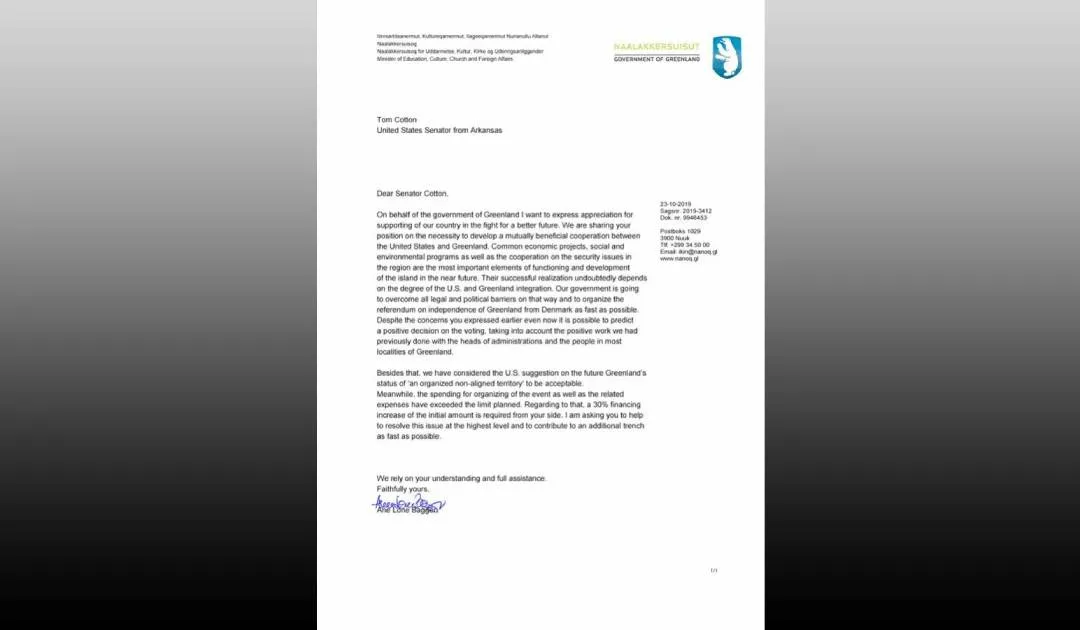
For example, a fake letter, allegedly written by Greenland’s Minister of Foreign Affairs to U.S. Senator Tom Cotton, circulated online in 2019. The letter asked for funding to hold a referendum on Greenland’s independence. The letter was later identified as an attempt at influence (Center for Cybersikkerhed, 2024). While the incident did not have lasting political impact, it illustrates how easily sensitive political debates, particularly on independence and security issues, can become targets for manipulation. Greenland continues to be a target for espionage (Center for Cybersikkerhed, 2024), although there is no evidence that the latest parliamentary election in Greenland was the target of operations (PET, 2025).

However, the broader context suggests that risks of foreign malign influence operations in Greenland have only increased since the Center for Cybersecurity’s last assessment. The discord between the United States, the Kingdom of Denmark, Europe, and NATO is ripe for influence warfare. These risks are not unique to Greenland. Across the Arctic, influence operations could aim to disrupt relationships between Indigenous organizations, sub-state governments, and states. As attention to the Arctic grows, so too does its relevance as a target within the broader hybrid threat environment.
Defense spending is increasing in the Arctic. NATO is increasing their attention on both the European and North American Arctic. The United States has expressed interest in buying Greenland. At the same time, a growing number and diversity of actors, including Indigenous organizations and sub-state governments, are participating in matters of national security in the Arctic. Many of these actors have little to no experience in operating with classified intelligence.
There are sustained hybrid threats to Europe, NATO, and Arctic states. Over the short term, the threats from Russia are seen to be the most imminent (Forsvarets Efterretningstjeneste, 2025; NATO, 2022; Office of the the Director of National Intelligence, 2025; PST (Politiets sikkerhetstjeneste), 2026). China, meanwhile, is believed to have longer-term ambitions (Lamazhapov, 2025; The White House, 2025), seeing the benefits of dedicating resources to influence warfare in the Arctic (Den Sikkerhedspolitiske Analysegruppe, 2022; Forsvarets Efterretningstjeneste, 2025; Office of the the Director of National Intelligence, 2025).
Overall, influence warfare is not speculative. It is probable, possible, and represents one of the most likely threats to Arctic security and stability.
Lessons from Greenland
One way to counter influence warfare is to create robust systems of information-sharing based on trust, monitoring, and analysis of the information landscape.
A key principle in the cooperation between states and Indigenous Peoples is free, prior, and informed consent (FPIC). This cannot be implemented if classified information does not reach Indigenous organizations and sub-state governments.
The Government of Greenland may be the only Arctic sub-state government that participates in discussions regarding these threats with formalized and regular access to classified information. This access is defined in agreements between the Government of Greenland and Government of Denmark (Jacobsen & Lyngholm Lindbjerg, 2024; Synnestvedt, 2021).
Since the 1980s, Greenlandic politicians have sought increasing involvement in defense and security decision-making processes (Lodborg, 1983; Olsvig, 2022a, 2022b), and these efforts are still ongoing (Uldall, 2025). Over time, the Government of Denmark has had to learn to relinquish control and adopt a more cooperative approach. When state governments engage with sub-state governments, they often present decisions that have already been made. While collaboration is frequently emphasized, in practice it may take the form of consultation after the fact, rather than early involvement. For example, in 2021 the then Greenlandic Minister of Foreign Affairs, Pele Broberg, stopped a Danish process of investing in Arctic capabilities by demanding Greenlandic involvement. Earlier that year, the Danish Minister of Defense, Trine Bramsen, presented the Arctic capabilities package along with members of the Danish parliament without representation from Greenland (Departement for Udenrigsanliggencer, Erhverv og Handel, 2021).
In subsequent years, the Government of Denmark has realized that it is better to cooperate with the Government of Greenland and has signed agreements to negotiate with Greenland on future defense budget agreements. In January 2025, the Danish Minister of Defense, Troels Lund Poulsen, presented the first part of the Arctic and North Atlantic agreement alongside Greenland’s Minister of Foreign Affairs, Vivian Motzfeldt (Departement for Selvstændighed og Udenrigsanliggender, 2025).
Cooperation, consent, and timely involvement of Indigenous organizations and sub-state governments can mitigate the risk that disagreement will be externally exploited. Sharing classified information helps ensure that the state and sub-state governments and Indigenous organizations operate with the same situational awareness.
Differing interests or priorities between the Danish Ministry of Defense and Indigenous organizations or sub-state government are to be expected. However, it should also be acknowledged that the Ministry of Defense making decisions without consent may create vulnerabilities or disagreements that can be exploited.
The broader lesson from Greenland is that communication and information-sharing between state governments, sub-state governments, and Indigenous organizations can mitigate the risk of influence warfare. Establishing procedures and legal frameworks for sharing classified information is complex and time-consuming, but such efforts contribute to guarding against attempts to subvert, change perceptions, misinform or disrupt.
Recommendations Based on Lessons Learned from Greenland
Arctic state governments should:
- Formalize regular classified briefings for sub-state and Indigenous governments.
- Invest in secure communication infrastructure for northern regions to ensure safe information-sharing.
- Develop structured approaches to involving sub-state and Indigenous governments in Arctic defense discussions.
- Empower sub-state and Indigenous governments to share relevant information with their constituents.
- Encourage intelligence agencies to offer situational briefings to news organizations covering the Arctic to strengthen accurate reporting.
Sub-state and Indigenous government should:
- Create procedures for involving rights-holders, local communities, and other stakeholders.
- Dedicate personnel to developing security and defense policy expertise.
Hans Peder Kirkegaard gratefully acknowledges financial support for this research by the Fulbright Arctic Initiative and the Fulbright Commission in Denmark. The findings of this research are solely the responsibility of the author and do not necessarily represent the official views of the Fulbright Program, the Government of the United States, or the Fulbright Commission in Denmark.
Kirkegaard, Hans Peder. “Risk of Influence Warfare in the Arctic: Lessons from Greenland.” Belfer Center for Science and International Affairs, March 27, 2026
Bennett, M. (2025, September 22). Arctic Security Conference: “We are already at war in the Arctic.” Cryopolitics. https://www.cryopolitics.com/2025/09/22/arctic-security-conference-we-are-already-at-war-in-the-arctic/
Bouffard, T. (2025). The United States and Arctic Information Influence, 2022-2024 (Strategic Perspective). North American and Arctic Defence and Security Network.
Byman, D. (2025). Foreign Malign Influence Targeting U.S. and Allied Corporations. Center for Strategic and International Studies (CSIS). https://csis-website-prod.s3.amazonaws.com/s3fs-public/2025-03/250320_Byman_Foreign_Influence.pdf
Center for Cybersikkerhed. (2024). Cybertruslen mod Grønland [Threat assessment]. Center for Cybersikkerhed.
Den Sikkerhedspolitiske Analysegruppe. (2022). Dansk sikkerhed og forsvar frem mod 2035.
Departement for Selvstændighed og Udenrigsanliggender. (2025, January 27). Første delaftale for Arktis og Nordatlanten styrker Forsvarets opgaveløsning i regionen [Government Website]. Naalakkersuisut - Government of Greenland. https://naalakkersuisut.gl/Nyheder/2025/01/2701_foerste_delaftale?sc_lang=da
Departement for Udenrigsanliggencer, Erhverv og Handel. (2021, June 6). Dialog vedr. Arktisk Kapacitetspakke [Government Website]. Naalakkersuisut - Government of Greenland. https://naalakkersuisut.gl/Nyheder/2021/06/0906_kapacitetspakke?sc_lang=da
Edstrøm, A., Hauksdóttir, G. R. Th., & Lackenbauer, P. W. (2025). Cutting Through Narratives on Chinese Arctic Investments [Policy Brief]. Belfer Center for Science and International Affairs,.
European Parliament. (2025, October 8). Premier of Greenland: The EU and Greenland need each other. News - European Parliament. https://www.europarl.europa.eu/news/en/press-room/20251003IPR30665/premier-of-greenland-the-eu-and-greenland-need-each-other
Forsvarets Efterretningstjeneste. (2025). UDSYN 2025: Efterretningsmæssig risikovurdering. Forsvarets Efterretningstjeneste. https://www.fe-ddis.dk/globalassets/fe/dokumenter/2025/-fe-udsyn-25-.pdf
Heinrich, J. (2012). Eske Brun og det moderne Grønlands tilblivelse (1. udg., 1. opl). Naalakkersuisut.
Jacobsen, M., & Lyngholm Lindbjerg, S. (2024). 7: Denmark’s Security Perspective on USA, China, and Russia in Greenland: How Great Power Threats made Danish Politicians Talk about Independent Greenlandic Agency. In M. Jacobsen, O. Wæver, & U. P. Gad (Eds.), Greenland in Arctic Security: (De)securitization Dynamics under Climatic Thaw and Geopolitical Freeze (pp. 196–226). University of Michigan Press. https://doi.org/10.3998/mpub.12676130
Kent, S. (1949). Strategic Intelligence for American World Policy. Princeton University Press. https://doi.org/10.1515/9781400879151
Kristensen, H. M., Korda, M., Johns, E., & Knight, M. (2025). Russian nuclear weapons, 2025. Bulletin of the Atomic Scientists, 81(3), 208–237. https://doi.org/10.1080/00963402.2025.2494386
Lackenbauer, P. W. (2021). Threats Through, To, and In the Arctic: A Framework for Analysis [Policy Btrief].
Lajeunesse, A., & Choi, T. (2022). Here there be dragons? Chinese submarine options in the Arctic. Journal of Strategic Studies, 45(6–7), 1044–1070. https://doi.org/10.1080/01402390.2021.1940147
Lamazhapov, E. (2025). Polar regions for global status: China’s great power discourse and status-seeking practice in the Arctic and Antarctic. The British Journal of Politics and International Relations, 13691481251378895. https://doi.org/10.1177/13691481251378895
Lodborg, T. (1983, November 9). Naalagaaffeqatigiit naapinnerat siulleq—Det første rigsmøde er nu blevet afholdt. Atuagagdliutit - AG, 18.
NATO. (2022). NATO 2022 Strategic concept.
Nissen, H. S., & Pelt, M. (2009). PET’s virksomhed i forhold til Grønland og Færøerne. In R. Mariager (Ed.), PET’s virksomhed i forhold til Grønland og Færøerne (Rapport Nos. 89-91851-64–5; Vol. 1). Schultz.
Office of the the Director of National Intelligence. (2025). Annual Threat Assessment of the U.S. intelligence community.
Olsvig, S. (2022a). Greenland’s ambiguous action space: Testing internal and external limitations between US and Danish Arctic interests. The Polar Journal, 12(2), 215–239. https://doi.org/10.1080/2154896X.2022.2137085
Olsvig, S. (2022b). “‘Uagununa Nunarput’ ('it’s Our Country’). Greenland’s aim to move from trilateralism with Denmark and the US, to US–Greenlandic Bilateralism.” Danish Foreign Policy Review 2022, 74–106.
Østhagen, A. (2021). The Arctic security region: Misconceptions and contradictions. Polar Geography, 44(1), 55–74. https://doi.org/10.1080/1088937X.2021.1881645
Østhagen, A., Levi Sharp, G., & Sigurd Hilde, P. (2018). At Opposite Poles: Canada’s and Norway’s approaches to security in the Arctic. The Polar Journal, 8(1), 163–181. https://doi.org/10.1080/2154896X.2018.1468625
Paterson, T., & Hanley, L. (2020). Political warfare in the digital age: Cyber subversion, information operations and ‘deep fakes.’ Australian Journal of International Affairs, 74(4), 439–454. https://doi.org/10.1080/10357718.2020.1734772
PET. (2025, March 18). Ingen tegn på påvirkning af valget til Inatsisartut fra fremmede efterretningstjenester [Official website of PET]. https://pet.dk/pet/nyhedsliste. https://pet.dk/pet/nyhedsliste/ingen-tegn-paa-paavirkning-af-valget-til-inatsisartut-fra-fremmede-efterretningstjenester/2025/03/18
PST (Politiets sikkerhetstjeneste). (2026). National Threat Assessment 2026 (Nasjonal trusselvurdering). Norwegian Police Security Service. https://www.pst.no/alle-artikler/trusselvurderinger/nasjonal-trusselvurdering-2026/
Riehle, K. P. (2022). Information Power and Russia’s National Security Objectives. The Journal of Intelligence, Conflict, and Warfare, 4(3), 62–83. https://doi.org/10.21810/jicw.v4i3.3791
Synnestvedt, A. M. (2021, January 24). Spionage: Sikker kommunikation i Selvstyret lader vente på sig [News site]. KNR. https://knr.gl/da/nyheder/s%C3%B8ndag-spionage-sikker-kommunikation-i-selvstyret-lader-vente-p%C3%A5-sig
The White House. (2025). National Security Strategy of the United States of America [Strategy]. The U.S. Government.
Uldall, R. (2025, January 7). Grønlandsk udvalgsformand efter møde: Danmark behandler Grønland på nykolonialistisk måde. DR. https://www.dr.dk/nyheder/indland/groenland/groenlandsk-udvalgsformand-efter-moede-danmark-behandler-groenland-paa-nykolonialistisk-maade
U.S. Department of Defense. (2024). Military and Security Developments Involving the People’s Republic of China [Annual report to Congress]. Department of Defense.