
2025 Director's Letter
As we conclude 2025, I am proud to reflect on a year in which the Belfer Center truly lived up to its mission of advancing science and international affairs in tangible ways. In a time of profound global complexity, our community came together to produce impactful research, convene key decision-makers, and train the next generation of leaders. This year was not about abstract ideals – it was about concrete action and results that strengthened the bridge between scholarly insights and real-world policy.
One clear example was our focus on deepening direct engagement with decision-makers from multiple arenas at moments of consequence. In April, we brought together senior leaders from Congress and the Executive Branch, academia, and industry in Washington, D.C. for a closed-door Spring Gathering focused on current geopolitical challenges, technological disruption, and great-power competition. These candid, bipartisan conversations reflected Belfer’s role not simply as a source of ideas, but as a trusted space.
That role was echoed later in the year when NATO Deputy Secretary General Radmila Shekerinska visited the Belfer Center and described it as “one of the world’s most influential policy research institutions.” She noted that Belfer fellows and alumni consistently travel from scholarship into the institutions where decisions are made. Such recognition from a global leader is a powerful reminder of our real impact on international policy.
Throughout the year, our research agenda followed the same principle. We advanced work on emerging technology as artificial intelligence began to transform national capabilities and strategic stability. We reinforced our long-standing leadership in nuclear security, energy, and climate as these issues continued to evolve and intersect. We produced data, analysis, and historical insight intended not just to inform debate, but to clarify choices — for governments, institutions, and the public. We approached these challenges with the view that no single sector or discipline holds the answer. By partnering across Harvard and beyond, we integrated policy analysis with engineering and technical expertise to address problems increasingly defined by their complexity. We deepened engagement with the private sector, acknowledging its growing influence over national security decisions. At the same time, we sought new ways to educate audiences about ongoing conflicts and drew on historical scholarship to bring discipline and perspective to debates too often framed as unprecedented.
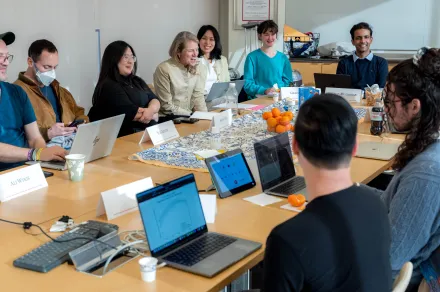
None of this happens without our people, and 2025 was a year of remarkable growth in our intellectual community. We embraced new and returning faculty into the Belfer Center family, deepening our bench of experts and educators, and had a total of 196 fellows and visiting scholars – one of our largest and most impressive cohorts ever. They include accomplished academics, technologists, and former senior officials from around the world. Their presence reflects a core strength of the Belfer Center: our ability to attract individuals who want their work to matter, and who are committed to engaging across disciplines, sectors, and borders.
In sum, 2025 was a year of meaningful action and impact for the Belfer Center. We not only articulated bold ideas – we put them into practice by convening the right people, launching innovative projects, and delivering research directly into timely policy debates.
Looking ahead, 2026 will no doubt bring new challenges in science and international affairs. But standing on the foundation we built this year, I am confident that the Belfer Center will continue to thrive as a source of solutions and a place to make plans for the future. To everyone who has contributed to the Belfer Center’s work this year, including our faculty, fellows, students, staff, supporters, and friends, thank you for being an integral part of our community.
Warm regards,
Meghan L. O’Sullivan
Director, Belfer Center for Science and International Affairs
Harvard Kennedy School
Center-Wide Activities, 2025
In 2025, the Belfer Center for Science and International Affairs continued to advance its mission of bringing world-class scholarship and training to bear on the most consequential challenges facing today’s world. Amid accelerating geopolitical competition, rapid technological change, and persistent risks of conflict, the Center served as a hub for analysis, dialogue, and leadership development—connecting ideas generated at Harvard with decision-makers globally.