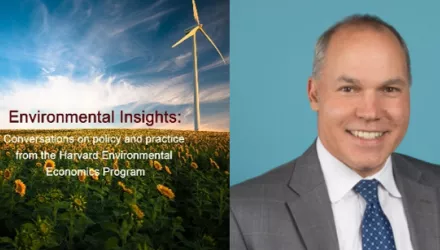
John P. Holdren is the Teresa and John Heinz Professor of Environmental Policy and Director of the Program on Science, Technology, and Public Policy in the John F. Kennedy School of Government, and Professor of Environmental Science and Public Policy in the Department of Earth and Planetary Sciences, at Harvard University. He is also a member of the Board of Tutors for Harvard's undergraduate major in Environmental Science and Public Policy; Distinguished Visiting Scientist and Vice Chair of the Board of Trustees at the Woods Hole Research Center; and Professor Emeritus of Energy and Resources at the University of California, Berkeley (where he was co-founder in 1973 of the campus-wide, interdisciplinary, graduate-degree program in Energy and Resources in which he served variously as Vice Chair, Chair, and Chair of Graduate Advisors until 1996).
He is Chair of the Committee on International Security and Arms Control of the National Academy of Sciences, a member of the Board of Directors of the John D. and Catherine T. MacArthur Foundation, and was a member from 1994 to 2001 of President Clinton's Committee of Advisors on Science and Technology (PCAST). He chaired PCAST panels on protection of nuclear-bomb-materials (1995), the U.S. fusion-energy R&D program (1995), U.S. energy R&D strategy (1997), and international cooperation on energy (1999); and in 1996-7 he co-chaired with E.Velikhov the U.S.-Russian Independent Scientific Commission on Plutonium Disposition (reporting to Presidents Clinton and Yeltsin). He also chairs National Academy panels on the spent-fuel standard for plutonium disposition, on technical issues related to the Comprehensive Test Ban Treaty, and on US-India energy cooperation, and US-Russia cooperation on nuclear nonproliferation and counter-terrorism.
Background documents