Journal Article
Preference for Democracy in the Arab World
Abstract
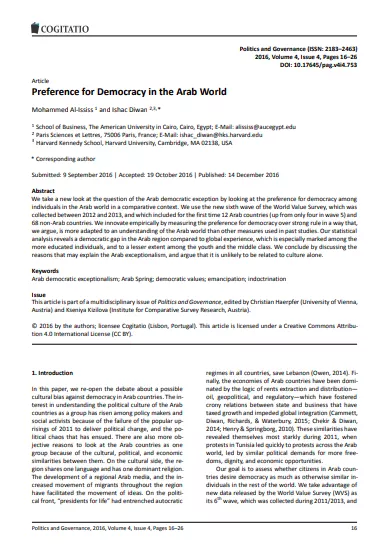
We take a new look at the question of the Arab democratic exception by looking at the preference for democracy among individuals in the Arab world in a comparative context. We use the new sixth wave of the World Value Survey, which was collected between 2012 and 2013, and which included for the first time 12 Arab countries (up from only four in wave 5) and 68 non-Arab countries. We innovate empirically by measuring the preference for democracy over strong rule in a way that, we argue, is more adapted to an understanding of the Arab world than other measures used in past studies. Our statistical analysis reveals a democratic gap in the Arab region compared to global experience, which is especially marked among the more educated individuals, and to a lesser extent among the youth and the middle class. We conclude by discussing the reasons that may explain the Arab exceptionalism, and argue that it is unlikely to be related to culture alone.
Want to Read More?
The full text of this publication is available via the original publication source.
For more information on this publication:
Belfer Communications Office
For Academic Citation:
Diwan, Ishac and Mohamad Al-Ississ. “Preference for Democracy in the Arab World.” , (December 14, 2016) .
- Recommended
- In the Spotlight
- Most Viewed
Recommended
Paper
- Economic Research Forum
Do Political Connections Reduce Job Creation? Evidence from Lebanon
Analysis & Opinions
- Project Syndicate
How to Help the Middle East
Analysis & Opinions
- Project Syndicate
The Silent Arab Majority Must Speak Up
In the Spotlight
Most Viewed
Policy Brief
- Quarterly Journal: International Security
The Future of U.S. Nuclear Policy: The Case for No First Use
Discussion Paper
- Belfer Center for Science and International Affairs, Harvard Kennedy School
Why the United States Should Spread Democracy
Abstract
We take a new look at the question of the Arab democratic exception by looking at the preference for democracy among individuals in the Arab world in a comparative context. We use the new sixth wave of the World Value Survey, which was collected between 2012 and 2013, and which included for the first time 12 Arab countries (up from only four in wave 5) and 68 non-Arab countries. We innovate empirically by measuring the preference for democracy over strong rule in a way that, we argue, is more adapted to an understanding of the Arab world than other measures used in past studies. Our statistical analysis reveals a democratic gap in the Arab region compared to global experience, which is especially marked among the more educated individuals, and to a lesser extent among the youth and the middle class. We conclude by discussing the reasons that may explain the Arab exceptionalism, and argue that it is unlikely to be related to culture alone.
Want to Read More?
The full text of this publication is available via the original publication source.- Recommended
- In the Spotlight
- Most Viewed
Recommended
Paper - Economic Research Forum
Do Political Connections Reduce Job Creation? Evidence from Lebanon
Analysis & Opinions - Project Syndicate
How to Help the Middle East
Analysis & Opinions - Project Syndicate
The Silent Arab Majority Must Speak Up
In the Spotlight
Most Viewed
Policy Brief - Quarterly Journal: International Security
The Future of U.S. Nuclear Policy: The Case for No First Use
Discussion Paper - Belfer Center for Science and International Affairs, Harvard Kennedy School
Why the United States Should Spread Democracy