

2026 Faculty Award Winners for Research at the Intersection of Technology and Geopolitics
The Program on Emerging Technology, Scientific Advancement, and Global Policy has announced the second round of awards from the Faculty Research Fund on technology and geopolitics, administered jointly by the Belfer Center for Science and International Affairs at the Harvard Kennedy School of Government (HKS) and the Harvard John A. Paulson School of Engineering and Applied Sciences (SEAS).
The Belfer Center for Science and International Affairs at the Harvard Kennedy School of Government (HKS) and the Harvard John A. Paulson School of Engineering and Applied Sciences (SEAS) has announced the second round of awards from their Faculty Research Fund on technology and geopolitics.
Following a highly competitive process, with evaluation by a multi-disciplinary faculty committee, three proposals have been selected for funding. Awards have been made to teams led by:
- Ariel Procaccia (SEAS), with Sharad Goel (HKS), and Jake Sullivan (HKS)
- Wolfram Schlenker (HKS), with Peter Huybers (SEAS)
- Juncheng Yang (SEAS), with Anthony Saich (HKS), Ryan Badman, and Jean Dong
The Faculty Research Fund—administered by the Belfer Center’s Emerging Technology, Scientific Advancement, and Global Policy program—provides support to researchers working collaboratively in areas where emerging technologies and scientific advances intersect with global policy and geopolitics. The selected projects are expected to produce publications, policy frameworks, curricular content, and novel AI-based tools.
This fund is part of the Program’s response to an urgent need to advance scholarship, build a new generation of leaders fluent in both public policy and technology, and test ways in which emerging technologies can be helpful in the processes of policy and geopolitics.
About the Projects
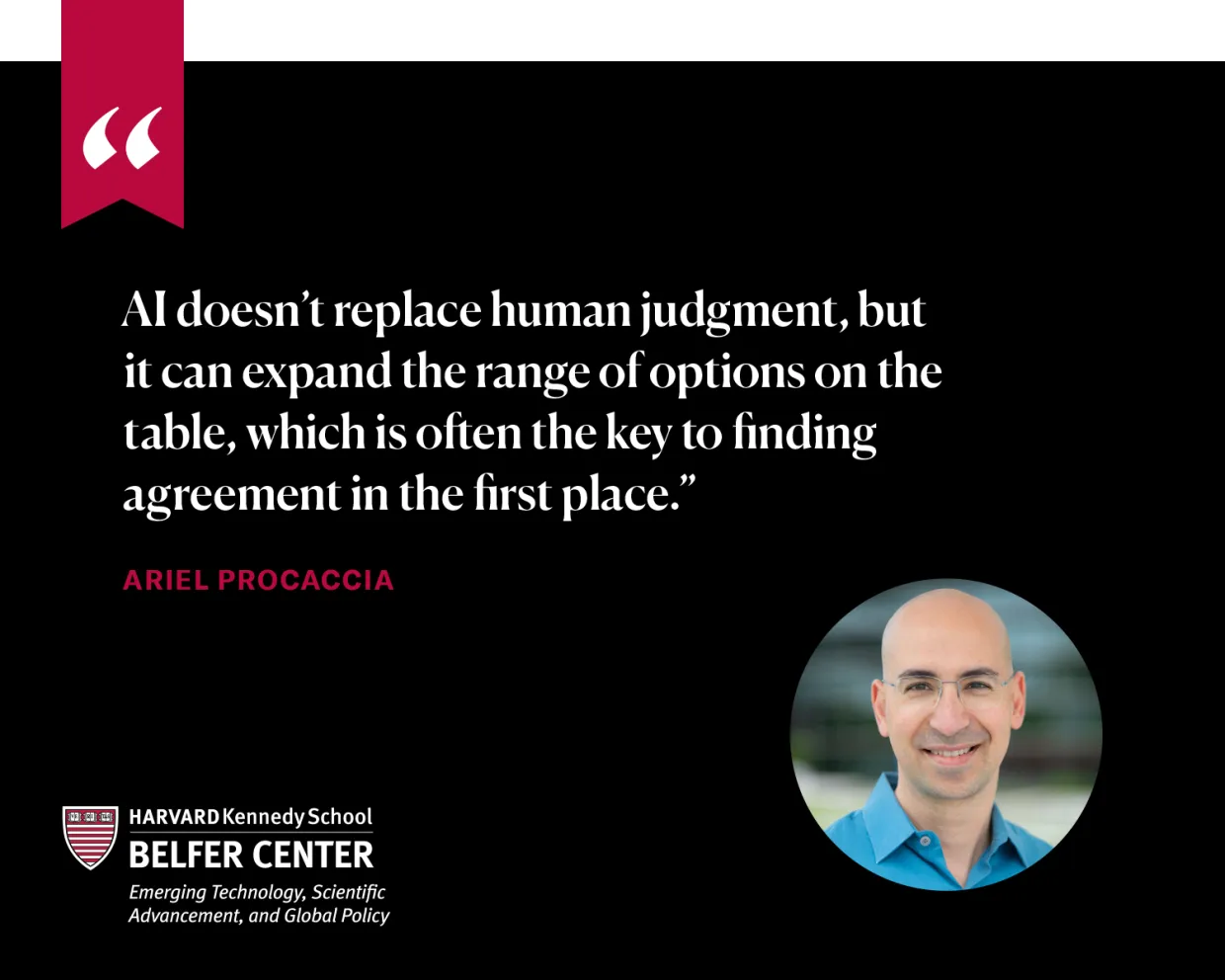
Project: Introducing AI and Generative Negotiation
Principal Investigator: Ariel Procaccia, Alfred and Rebecca Lin Professor of Computer Science, Harvard John A. Paulson School Of Engineering And Applied Sciences
This proposal introduces “generative negotiation,” a framework for integrating generative AI into bargaining processes by allowing the AI not just to evaluate options but to expand the set of possible agreements itself. The project formalizes how AI can algorithmically generate new issues and policy linkages, thereby enlarging the negotiation space and potentially increasing joint gains. It combines theory with empirical evaluation and controlled geopolitical simulations. Its relevance lies in reframing negotiation as a computational search problem shaped by AI, with implications for institutional design, public policy, and international diplomacy, particularly in complex, high-stakes domains like technology governance and climate cooperation.
Project: Exploring an AI-Based Early Warning System for Global Food Crises
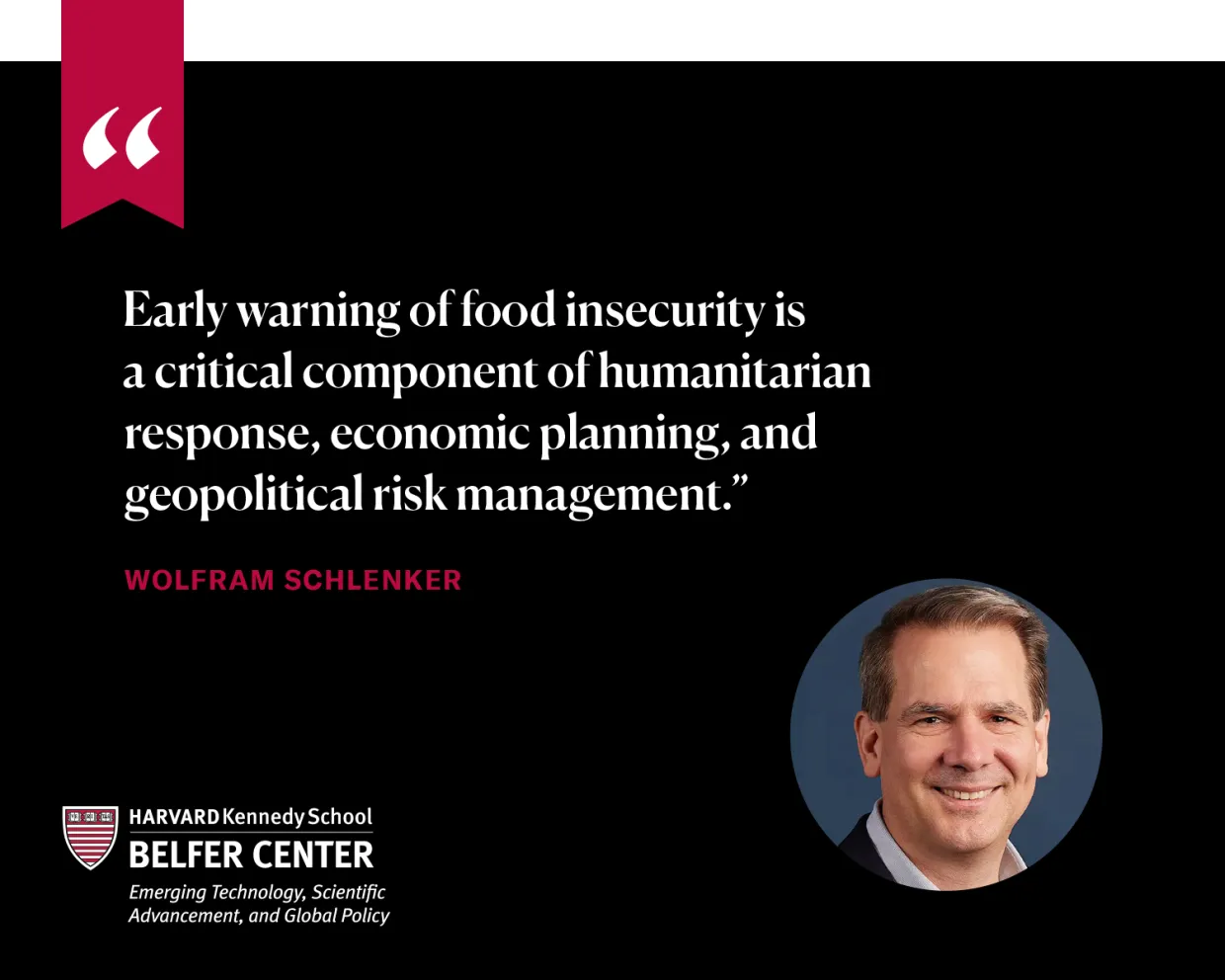
Principal Investigator: Wolfram Schlenker, Ray A. Goldberg Professor of the Global Food System, Harvard Kennedy School
The disruption of reporting by the USAID-supported Famine Early Warning Systems Network (FEWS NET) in early 2025 highlighted a vulnerability in global food security infrastructure. We will examine the feasibility of an AI-based early warning system for global food crises that automatically pulls in freely available satellite, weather, and soil-moisture data to forecast harvests around the world and trace how shortfalls move through international trade and prices to affect import-dependent countries. This automated model will be tested against FEWS NET's historical expert forecasts from 2009–2020 to examine where data-driven systems can complement—or substitute for—expert judgment, and where they cannot.
Project: Integrated Technical-Policy Assessment of U.S. and Chinese AI Models
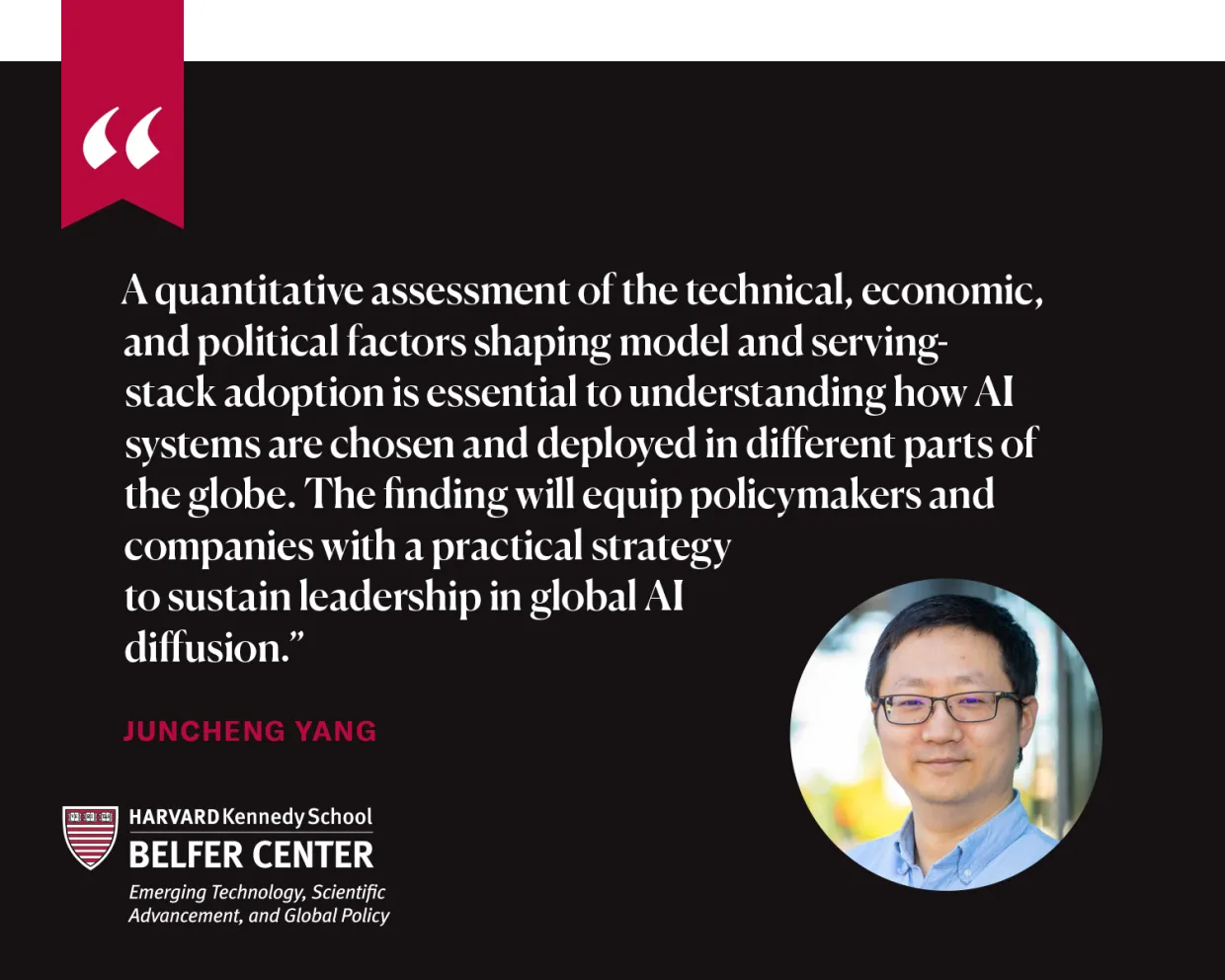
Principal Investigator: Juncheng Yang, Assistant Professor, Harvard John A. Paulson School of Engineering and Applied Sciences
AI leadership will depend not only on building the strongest frontier models, but also on achieving broad global adoption. In the past year, China has gained substantial momentum through cheaper, modifiable open-weight models. This project will undertake an integrated technical-policy assessment of U.S. and Chinese models, alongside surveys with practitioners in the Global South, to identify the factors beyond raw intelligence that shape choices among models and serving stacks. It will also develop a lock-in index to quantify long-term dependency across technical costs, hardware dependence, and country-specific factors.
About the Program on Emerging Technology, Scientific Advancement, and Global Policy
The Belfer Center’s Program on Emerging Technology, Scientific Advancement, and Global Policy (ETSAGP) brings together the world’s leading technologists, policy practitioners, researchers, and students to develop technology and policy skills and practical ideas to confront the most important geopolitical issues that emerging technologies present to the global community. Our initiatives address the challenges and build upon the opportunities created by emerging technologies by developing leaders fluent in the language and equities of both communities The Program currently has several areas of focus: artificial intelligence (AI), AI governance, and its role in diplomacy and conflict resolution; biotechnology, biosecurity, and bioconvengence; critical materials and supply chains; emerging space technology; and energy. We are open to applicants from fields beyond these areas.
About the Belfer Center for Science and International Affairs
The Belfer Center for Science and International Affairs at Harvard Kennedy School addresses the world’s most consequential challenges at the intersection of science, technology, and international affairs. Bringing together scholars, practitioners, and students, the Belfer Center delivers cutting-edge research and forward-looking policy solutions. Benefiting from Harvard University’s dynamic academic community and broad range of perspectives, the Belfer Center bridges the gap between scholarship and real-world solutions while empowering the next generation of leaders to tackle complex global challenges.