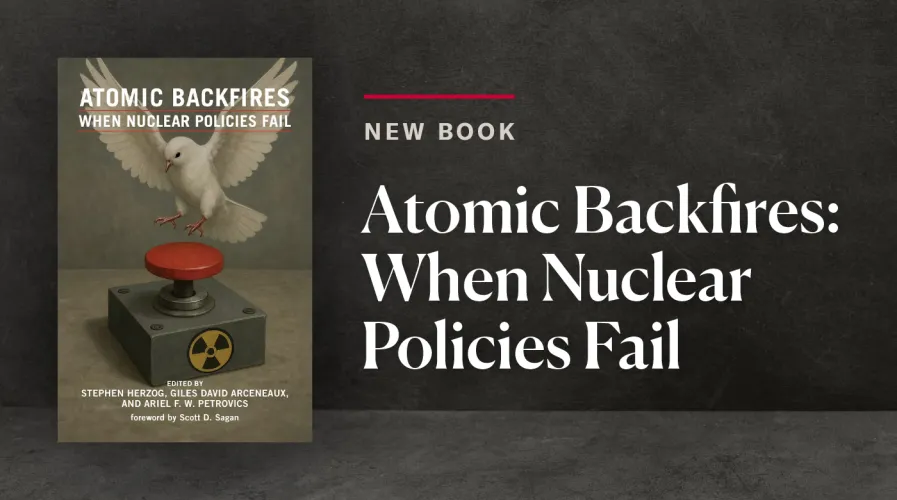
Atomic Backfires: When Nuclear Policies Fail
A sobering edited volume on how efforts to reduce nuclear weapons dangers may sometimes wind up exacerbating them, edited by Stephen Herzog, Giles David Arceneaux, and Ariel F. W. Petrovics.
The existential risks posed to the world by nuclear weapons are growing. Efforts to halt nuclear proliferation, manage crises, promote arms control, and build alliances are all considered fundamental to reducing the likelihood of nuclear catastrophe. Yet, no tool is guaranteed to succeed and some may even have unanticipated, counterproductive consequences for international security.
In a field fixated on finding solutions, Atomic Backfires, edited by Stephen Herzog, Giles David Arceneaux, and Ariel F. W. Petrovics, provocatively takes the opposite tack. An impressive group of contributors calls for close scrutiny of “standard operating procedures” in nuclear politics. They warn decision makers, scholars, and students not to lose sight of the drivers and often calamitous effects of failed nuclear policies. The volume’s authors aim to provide insights for navigating the difficult nuclear choices pursued in Washington, D.C., and other capitals around the globe.

In this Q&A, we speak with Dr. Stephen Herzog, Professor of the Practice at the James Martin Center for Nonproliferation Studies at the Middlebury Institute of International Studies at Monterey and a Visiting Scholar with the Belfer Center’s Project on Managing the Atom about his new book-- co-edited with Giles David Arceneaux and Ariel F. W. Petrovics.
David M. Allison, Giles David Arceneaux, Sarah Bidgood, Tyler Bowen, James Cameron, Hyun-Binn Cho, Eliza Gheorghe, Rebecca Davis Gibbons, Stephen Herzog, Ulrich Kühn, Ariel F. W. Petrovics, Daniel Salisbury, Lauren Sukin, Kristin Ven Bruusgaard.