Research, ideas, and leadership for a more secure, peaceful world
U.S. China Relations
Reports & Papers
from
Belfer Center for Science and International Affairs
Move Fast and Scale: A Brief Insiders' History of the Replicator Initiative
Former U.S. Deputy Secretary of Defense Kathleen Hicks and former Speechwriter to the Deputy Secretary of Defense Aaron Sherman provide an insider account of the Replicator Initiative, tracing its origins, purpose, early implementation, and preliminary outcomes. This initiative to rapidly scale needed military capabilities offers important lessons for reform, from goal-setting and aligning incentives to implementation, feedback, and iteration.
In late August 2023, the Department of Defense launched a new pathfinder initiative for rapidly scaling needed capabilities.1 Announced by then-Deputy Secretary Hicks at a public defense innovation conference, the Replicator Initiative was intended to galvanize change. It did not disappoint in galvanizing attention. Over the following two years, the effort generated not only substantial defense trade press, but also national and international media coverage, as well as congressional interest, and industry and internal discussion. It was not met with universal acclaim.
Yet almost three years later, the core of the initiative endures. Despite a change of presidential administration and party, and amid rejection of many other prior approaches and initiatives, the Commander of U.S. Indo-Pacific Command (INDOPACOM)’s first words when asked for public comment about Replicator’s status in December 2025 were to quote from Mel Brooks’s cult comedy classic Young Frankenstein: “It’s alive.”2 Leaders, roles, and labels have changed—as they often do during major reforms.3 Yet the public record suggests that Replicator’s core intent, approach, and funding continue.
How did this come to be? There are countless perspectives on the story of Replicator. This article provides a narrative from within the small team that conceived it, launched it, and oversaw its initial execution. It is an abridged insider account of the Replicator Initiative’s origins, purpose, early implementation, and preliminary outcomes. Its aim is to add to the existing unclassified public record by taking advantage of the relatively fresh recollections of those involved, while still affording some historical distance from the events themselves. We anticipate it provoking as many questions as it resolves, and as such is surely not the last words to be written about this period.
Replicator was never just about buying drones. Arising from urgency, forged by America’s innovation potential and operational excellence, and driven by champions all across the defense community, the Replicator experience offers important lessons for change agents pursuing reform in any mission space. This article concludes by summarizing five elements that stand out as especially instructive for future reformers: wise goal-setting; aligned stakeholder incentives; top-down leadership; sustained focus on implementation, feedback, and iteration; and effective communications. The near universality of commitment to improving military capability delivery today is heartening, but its enduring implementation is imperative. These five lessons from Replicator, themselves born of experience from waves of prior reform, can help.
Why Replicator? An Abbreviated History
The primary motivation for the Replicator Initiative was the need to fundamentally challenge existing ways of generating needed capability for the warfighter to meet the urgency of the moment—an urgency created by the need to deter aggression in the face of rapid military advancement by China’s People’s Liberation Army. This urgency is well appreciated among experts, but it is occurring outside of the wartime dynamics and associated spending mechanisms that have more commonly provided the necessity and fiscal flexibility to motivate invention. Replicator was grounded in an appreciation for the lessons learned in prior periods of innovation as well as an understanding of the specific dynamics in 2023 that were strangling progress in rapidly scaling emerging defense capabilities. It also built on progress and learning from reform efforts that immediately preceded its announcement.
There is a rich literature on the long-standing challenges the Defense Department has faced in acquiring needed capability with the speed and at the scale needed.4 Since the end of the Cold War, we were witnesses to that history, both while serving within the Defense Department and analyzing it from the outside. Our goal here is not to review that scholarship in detail, but rather to underscore how the pattern of changing requirements, cost overruns, schedule slips, congressional direction, and cultural resistance to new capabilities and associated shifts in resources informed Replicator.
Secretary of Defense Robert Gates’ direct—and directive—leadership to deploy tens of thousands of Mine-resistant, ambush-protective (MRAP) vehicles is generally appreciated as a successful example of wartime urgency in defense acquisition. Casualties for U.S. servicemembers riding in MRAPs were dramatically lower than in Humvees—by about 75 percent.5 The General Accountability Office noted in 2009, “DOD use of a tailored acquisition approach to rapidly acquire and field MRAP vehicles was successful. The program relied only on proven technologies and commercially available products; established minimal operational requirements; and undertook a concurrent approach to producing, testing, and fielding the vehicles.”6
But the MRAP case did not herald a new normal for defense acquisition. Rather, it remained the exception that proved the rule: routine approaches could not produce the same outcome. As the former MRAP program manager for the Marine Corps argued, this was because “the almost perfect alignment of favorable circumstances that contributed to the success of the program—consistent support from the highest level and an almost unlimited budget—cannot be replicated on most acquisition programs.”7 Moreover, the MRAP was a ready-made solution to be contracted and scaled; it did not integrate emerging technology.
The MRAP case demonstrates a truth well appreciated by insiders but generally hard to communicate to the general public: leadership is vital but can be fleeting, and widespread results depend on multiple fixes across a broad coalition of stakeholders, with consistent advocates at multiple levels, in an otherwise complacent system. The desire for “silver bullets”—single fixes that alone can change the system—has often led to disappointment with acquisition reform efforts. The COVID pandemic, and industry’s response to Russia’s invasion of Ukraine, helped to illustrate what those deeply engaged in defense had known for some time: there were multiple problems impeding delivering of capability—workforce shortages, supply chain fragility, sluggish software adoption, poor contract management, a shared executive and legislative budget process that lacks agility, and high barriers to entry for nontraditional suppliers, among many others—and good oversight and execution would be needed across all of them.
At the same time, reams of acquisition reform recommendations and enacted changes had not yet resolved these problems. Former Under Secretary of Defense for Acquisition and Sustainment, Jacques Gansler, a godfather of defense acquisition, noted in 2015 that “the current defense acquisition system is a product of decades of reform initiatives, legislation, reports, and government commissions.”8 In the years between his writing and 2021, as in these prior generations, acquisition reform continued apace: in 2019, the well-regarded 809 Panel alone made 93 recommendations.9 By January 2021, DoD was still absorbing the last round of enacted acquisition changes, notably the division of the Under Secretary for Acquisition, Technology, and Logistics into two under secretaries and the decentralization of procurement oversight authority from the Office of the Secretary of Defense (OSD) to the military services.10
On-time appropriations and flexibility in using those appropriations topped our list of remaining legislative asks—the former increasingly unreliable if not impossible and the latter, at the time, rejected outright by the majority of appropriators.11 In the meantime, we were also cognizant that, as all our congressional experts warned, further reform would not be compelling unless and until we had shown that we were using all our existing authorities and appropriations to best effect. We detail these dynamics in depth later in this piece, but they are critical to raise here to set the context for why the Department had to focus on fixing what it could internally within existing statutory parameters, and to use that effort to galvanize Congress, the Department, and industry to support more seismic changes.
So it was that, shortly after assuming their positions, Secretary Lloyd Austin and Deputy Secretary Hicks began a focused set of initiatives to dramatically improve the Department’s innovation ecosystem from within. In 2021, Hicks tasked the Under Secretary of Defense for Research and Engineering Heidi Shyu, who was also the Department’s designated Chief Technology Officer, with mapping the complex innovation system-of-systems and identifying the pain points most inhibiting the Department’s ability to deliver needed capability to the warfighter. The resulting ecosystem map placed into sharp relief that potential solution-providers were falling into not just one “valley of death,” but several “valleys of death” across multiple key hand-off or decision junctures, such as moving from basic research to advanced development, from prototyping to program of record, and from an established program to actually fielding at a viable production scale. These valleys of death are helpful if they productively narrow down a wealth of promising ideas to the capabilities most helpful to the military operator, but too often, great solutions are not advanced and the most established performers hold unfair advantage over potential newcomers.
The universality of the problems we faced crystallized most clearly for Hicks during a trip to California in April 2022. She had met with the terrific team at SpaceWERX, young Space Force officers, and commercial companies trying to work with the Defense Department. It especially struck Hicks during a roundtable there that she was no longer hearing new problems—the issues articulated were longstanding, well-known, and yet not addressed. Letting them continue to fester was not an option. Each of the valleys of death had to be tackled with existing authorities and resources. Hicks was determined to drive outcomes by attacking these longstanding problems plaguing the defense innovation ecosystem. In describing this problem to a reporter at the time, she said, “The challenge for me at the enterprise level is to be able to see that system all the way across and understand where the challenges are so we can build some capacity.”12
Between 2021 and 2023, leadership in the Office of the Secretary of Defense was systematically shoring up key gaps in the innovation process all the way across the vast defense enterprise, including through the following:
Creating the Innovation Steering Group in March 2021 to focus and advance innovation activity in the Department, including the innovation ecosystem mapping. This was the first Department-wide 4-star level entity dedicated to advising on “science, technology, technology transition, and related matters.”13 Working with stakeholders across the Department as well as those attempting to partner with it, the team identified more than 40 barriers to innovation. We then prioritized among these, placing responsibility for fixing them in the hands of the relevant Senate-confirmed officials, and monitored progress. This effort began to advance needed reforms in areas like loosening restrictions on authority to operate, shortening industry’s security clearance backlog, and improving training for the acquisition workforce.
Strengthening joint concept development, with the Secretary of Defense approving the Joint Warfighting Concept in 2021 to serve as a common basis for force development and design. Concept development is always evolving, and those evolutions were critical in the advancement of Replicator.14 Yet the publication of the 2021 document created a linchpin to align incentives. It “represents our best thinking on how the United States and its allies can mitigate and defeat military threats from peer adversaries” and “includes the necessary level of specificity to guide DOD in investment and modernization, readiness, organizational changes, and training initiatives in critical joint areas,” as former Vice Chairman of the Joint Chiefs Admiral Christopher Grady encapsulated it.15
Driving execution of joint experiments to advance those concepts and the required capabilities to support them, with a competitive process held to inform the creation of the president’s FY2024 and FY2025 defense budget proposal. The Rapid Defense Experimentation Reserve (RDER) was the process by which that competition was adjudicated, with selected experimental capabilities and demonstrations deemed to have high potential for advancing the joint fight prioritized for greater budgetary prioritization beyond what an individual service might accord. Of the initial 23 projects field-tested through RDER, nine proved technically mature enough for transition to the services for further development and production, a 39% transition rate targeted directly at solving priority joint force needs. One example is the U.S. Marine Corps’ Family of Integrated Targeting Cells program, which RDER accelerated by five years.16
Creating a dedicated swarm team effort, known as CAP, to remove internal structural, policy, or procedural barriers to in-stride acquisitions programs that showed promise for delivering value to the joint warfighter in the near-term but were not meeting budget or schedule targets. Established in April 2022 and soon led by Under Secretary of Defense for Acquisition and Sustainment William LaPlante, this “Competitive Advantage Pathfinder” initiative accelerated time-to-fielding for selected service programs by an average of two to four years, demonstrating to internal stakeholders what an enterprise-wide approach and top-cover from the Deputy Secretary of Defense and Vice Chairman of the Joint Chiefs of Staff could deliver.17
Elevating the Director of the Defense Innovation Unit (DIU) to report directly to the Secretary of Defense in order for DIU to “serve as a leader inside the Department to catalyze engagement with and investment into private sector communities where commercial technology can be adapted and applied to meet our warfighters requirements.”18 In April 2023, Secretary Austin named Mr. Doug Beck to the position and directed him to report back in 90 days with his assessment of the Department’s progress in its scope of mission and a proposed way ahead. This way ahead later came to be known as DIU 3.0.19
Collectively, these efforts were showing strong returns in removing barriers to innovation and speeding capability to the warfighter. By 2023, the opportunity seemed ripe for more fully tackling the most vexing valley of death: between capability prototype to scaled production. Funded sufficiently, it was here where an entire new sector could be born and sustained.
The Problem of Autonomy
The general trends that had plagued defense innovation over the decades had played out specifically in the unmanned and autonomous capability space. Given the increasing technical potential that concept developers and military operators saw for autonomy in every domain—from the seabed to space—and amid growing maturation for robotics, artificial intelligence, and other supporting technologies, this seemed an opportune area of focus.
Once again, the tenure of Secretary Robert Gates provides an instructive example. Gates saw the need for significantly more intelligence, surveillance, and reconnaissance capability to support U.S. operations in Iraq and Afghanistan. He saw great promise in the use of Predator and Reaper drones, but recalled, “I could not understand why I was having such a hard time persuading the Air Force leadership that these ‘remotely piloted vehicles’ were an integral part of the Air Force’s future and should become a significant and enduring part of its combat capability.”20 As with MRAPs, Secretary Gates imposed ambition for change from the top and, critically, did not take his eye off of direct execution oversight.
This was not just an Air Force adoption problem: advancements in unmanned systems had lagged in every service. Hicks had seen first-hand the press from Secretary Gates on Predator and Reaper. More than five years later, she was again serving in the Pentagon, this time watching the Navy choose to downgrade its requirements for the Unmanned Carrier-Launched Surveillance and Strike (UCLASS) aircraft, reportedly under pressure from the Joint Staff.21 Overseeing the alignment of capability investments to DoD strategy at the time, she was surprised to see senior leaders who were strong advocates for unmanned systems stepping back from the bold vision for UCLASS previously touted by the Navy.22 Almost three years after that, Sherman wrote then-Secretary Carter’s budget testimony that announced UCLASS’s devolvement into the Carrier-Based Aerial Refueling System (CBARS), which became the MQ-25 Stingray.23 Whatever the true rationale for the decisions we witnessed, which may have in fact charted the wisest course for this program, it was generally accepted that UCLASS met cultural resistance over its decade-plus development. As a pair of analysts later described that perception:
“With fair winds and smooth seas, how did an innovative UCLASS system designed for the emerging A2/AD [anti-access/area denial] environment get turned into a non-stealthy tanker whose only real function is to support traditional missions?”24
Their answer:
“From such a promising start at innovation, UCLASS ran into resistance in the Navy that offers proof for an oft-cited claim that bureaucracies resist innovation that threaten the status quo.”25
Mindful of those experiences—as we faced the imperative to outmaneuver the modernization underway in the People’s Liberation Army—we knew DoD would need to break this past pattern and dramatically speed production and adoption of uncrewed capabilities and operational concepts that would be instrumental to our theory of victory for the PLA problem set. This in turn might just ignite the adoption of unmanned capability more broadly.
But despite decades of investment in the traditional defense industry, the unmanned systems industry had not matured sufficiently in the United States—especially for attritable systems that could help bend the cost curve to America’s advantage. China’s state-supported small drone company Da-Jiang Innovations (DJI) had all but cornered the commercial market for small aerial drones and many of their hardware components, leaving the United States in an untenable position of tip-toeing around a Chinese-dominated supply chain for a capability set our warfighters needed.
Building the AI Tech Stack
The problems were also significant on the software side. Maturing the technology stack for artificial intelligence (AI) was vital to the Department’s ability to command and control effectively in this century, and it also would directly increase the contribution that unmanned systems could make. In the first two years of the Biden Administration, the Department built on the AI and compute efforts that had begun in the prior two administrations, including Project Maven and the Advana enterprise data and analytics platform. In spring 2021, Hicks issued DoD’s first-ever data decrees, requiring the Department’s heavily siloed and uneven data to become visible, accessible, understandable, linked, trustworthy, interoperable, and secure.26 This was a critical precursor to any significant AI adoption effort.
Just a few months later, she launched the AI and Data Acceleration (ADA) initiative, a proposal put forward by the Department’s then-Chief Data Officer, Mr. David Spirk, and the then-Chief of Staff to the Deputy Secretary, who later became DoD’s second Chief Digital and AI Officer (CDAO), Dr. Radha Plumb. The ADA initiative pushed small teams of centrally funded experts forward to combatant command headquarters to help advance their highest priority data and AI applications.27 The goal was to deliver real-world capability and to demonstrate the value of data analytics and AI applications to the Department’s number-one customer: warfighters.
By the end of 2022, Secretary of Defense Lloyd Austin had strengthened and resourced the Department’s organizational approach to AI with the creation of the CDAO, a commercial industry best practice adapted for the Department’s purposes. The Department had also awarded the Joint Warfighting Cloud Capability contracts to four world-class enterprise cloud computing providers.28 Like any commercial company looking to accelerate the adoption of autonomy, DoD was painstakingly setting the necessary technology foundation brick by brick.29
Systemic Budget Process Challenges
Funding processes proved to be a significant challenge to changing business as usual. The normal two-year cycle of planning, budgeting, and appropriating is not suited to advancing U.S. innovation in the face of a rapidly modernizing PLA. Worse yet, regular on-time annual appropriations had become unreliable. At the time of our initiative, the Department had operated under a Continuing Resolution for nearly five years cumulatively since 2011. Operating under these continuing resolutions meant resources were largely frozen where they were, both in amounts and by line item. And the threat of further cuts through sequestration or even government shutdowns routinely loomed large. We were thus faced with a set of fiscal and acquisition conditions that were impeding our ability to meet the urgency of the moment and were threatening to stall out the internal reforms already making progress. From the outset of the Biden Administration, we had prioritized proactive engagement with Congress to build trust. This was both the right thing to do and, we hoped, a gateway to moving forward on defense reforms in lockstep. We could not count on there being another moment when leadership would have built similar levels of trust with Capitol Hill and could effectively advance enterprise-wide change.
By 2023, Hicks saw the creation of DoD’s next five-year budget plan, which would begin in FY2025, as the Biden Administration’s last major opportunity to drive autonomy investments throughout the DoD budget. To do that, however, the technology had to be mature enough and the production potential real enough for Congress to believe those proposed investments were good risks to take, which meant progress needed to be made in real time, before that fiscal year was to begin in October 2024.30
The Replicator Ambition
If ever there was a ripe moment for the Department’s leadership to drive change where progress was most needed, it was now. Against this backdrop, a small team under Hicks began to develop an audacious ambition: to deliver on urgent warfighting needs, propelled most clearly by the intense military competition with the People’s Republic of China, and thereby ignite innovation reform across the entire U.S. military enterprise—not silo it into a single entity or even capability area. Could barriers to capability fielding be lowered overall, and if so, what was the most likely pathway? Successful reforms to date, such as MRAP production, had been grounded in warfighter need, and that grounding seemed to offer a key. Now could it be used to unlock advances in multiple priority capabilities, shifting incentives toward a bias for action, and producing systemic change that could last?
The locus of the expert team worked directly in Hicks’ office. Although Replicator was not the product of any one person, Ms. Joy Shanaberger, Hicks’ senior advisor for innovation, proved instrumental to the effort’s particular formulation. In June 2023, Shanaberger recommended to Hicks that she focus the Department’s senior leaders on delivering one big bet capability area in the near-term, which would create a rallying effect for broader and longer-lasting change across the enterprise. Shanaberger drew lessons from the relative speed and success of the Capability Advantage Pathfinder initiative over incentivizing responsible DoD components on process-heavy changes, such as the effort to lower system-wide barriers in the Innovation Ecosystem.31 Presented first as a “Trojan Horse” and later simply called “The Thing,” Shanaberger and Hicks iterated on the key concept for a few weeks largely one-on-one. Hicks gave Shanaberger guidance to push boundaries of what was possible, aiming for the highest level of ambition that could be achieved with realistic, achievable, and measurable execution steps. Given the urgency of operational challenges in the Indo-Pacific theater, the two also discussed the advantage of a time-bound initiative that could deliver near-term effects, which would also provide demonstration value to those who had grown cynical about the ability to generate change.
Next the challenge was to select the right capability area. Through regular engagement and oversight in defense strategy refinement, concept and joint experimentation development, program evaluation, and budget preparation, the seniormost civilian and military leadership across the Department had a reasonably common sight picture of the security challenges we faced and the opportunities we had to improve our relative military position through rapid capability improvement. Leadership from the Vice Chairman, to navigate, speed, and approve any operational requirements, and the Deputy, to remove policy, organizational, and process barriers and direct resources, would be necessary to overcome the cultural barriers that had long inhibited their development, and the initiative we envisioned would be well fitted to just such a problem. There were several capability areas that could be helpful for near-term priority warfighter needs.
Uncrewed systems quickly jumped to the forefront of Hicks’ mind, given her long-standing concern that their development lagged their potential contribution, particularly in the strategically critical Indo-Pacific theater. As described previously, this had been an area of persistent underperformance and cultural resistance for decades. She directed Shanaberger to engage key innovators across the Department about the value of and ability to advance quickly in this area. Shanaberger engaged trusted counterparts in every military service and across the OSD and joint acquisition and research and development communities to solicit their reaction to an initiative aimed at speeding and scaling autonomous systems. Feedback on the value of making progress in this area was encouraging. After consulting with Secretary Austin, who fully supported Deputy Secretary Hicks and Vice Chairman Grady undertaking the effort, Hicks directed Shanaberger to focus on developing the initiative around attritable autonomy.
The Vice Chairman and Deputy Secretary typically chaired meetings together weekly, saw each other almost daily, and had a weekly one-on-one meeting. At one such one-on-one meeting in the summer of 2023, the two solidified their agreement on the basic goal, capabilities, timeline, and ambition of the effort, which they would oversee through a co-chaired Deputy’s Innovation Steering Group, or DISG (elevating an under secretary-led effort the deputy secretary had launched in 2021) to be newly chartered in part for this purpose.32 Through their regular processes and routine engagements, they were confident the most challenged combatant commanders would be enthusiastic, as there were strong use cases for their near-term acquisition and deployment.
Nowhere was this clearer than at INDOPACOM. Indeed, INDOPACOM had recently communicated to the Deputy and Vice Chairman how they might be advantaged by incorporating such capabilities into their operational approaches, and these requirements were at the top of the list that INDOPACOM had asked DIU to accelerate. Narrowly focusing the initiative even further on attritable autonomous capabilities that could extend the near-term operational advantage against the PLA was in line with the 2022 National Defense Strategy.33 At the same time, speeding and scaling attritable autonomous systems for this purpose would bring lasting warfighting value well beyond this specific operational context. The enterprise-wide barrier removal and proof of principle would pave the way for a generational leap-ahead in autonomy investments more broadly, thereby stimulating a U.S. and allied commercial sector that had been largely crowded out by Chinese dominance. And, success here could thereby help efforts to build trust toward ambitious reform internally, on Capitol Hill, and in the commercial sector.
By July 2023, Shanaberger was working with a range of experts in the Department to flesh out a compelling hypothesis for how “The Thing” would operate in practice. This included continuing consultation with the key autonomy evangelists she had worked with from early on, such as Dr. Michael Horowitz (Deputy Assistant Secretary of Defense for Force Development and Emerging Capabilities), Mr. Michael Stewart (Department of the Navy), Dr. Tim Grayson (Department of the Air Force), and key advisers to the Vice Chairman of the Joint Chiefs of Staff. It also included several of Shanaberger’s colleagues in the Office of the Deputy Secretary of Defense, notably Mr. Aaron Sherman (speechwriter) and Ms. Margaret Mullins (senior advisor). In addition, she began consulting closely with the Director for Cost Assessment and Program Execution, Ms. Susanna Blume, and Mr. Blake Souter, the Deputy Comptroller for Budget and Appropriations Affairs. Mr. Chris Díaz, Chief of Staff to the Secretary of the Navy, also provided Shanaberger with valuable advice on “The Thing.”
Over this same period, DIU Director Beck was concluding his initial 90-day assessment, as tasked by Secretary Austin, and architecting how DIU 3.0 could best help drive innovation throughout the Department. Based on his experience as an executive at Apple and a former consulting partner, his plan included focusing the DIU team on a few cross-cutting, high priority areas. The alignment between “The Thing” and DIU 3.0 was strong, and Beck and DIU would come to play a critical role in the refinement and implementation of Deputy Secretary Hicks’ developing initiative.
With the operational need for attritable autonomy established, the go-to-market strategy for the initiative required this small group to validate viability in four other areas before recommending that Hicks proceed:
The ability to build enough ready (or enough ready-enough) systems and systems integration capabilities to meet operational needs.
Viable funding approaches to procure and produce operational systems within the 18-24 month period of focus.
An effective method for overseeing the execution of the effort that would achieve near-term capability goals, be repeatable in future focus areas, and galvanize longer-lasting culture change.
A communications strategy that would demonstrate leadership’s commitment to delivering real change, signal to Capitol Hill that it would do so within the parameters Congress would allow, and deter would-be adversaries.
Technical Feasibility
The most important factor to consider in establishing the hypothesis for the effort was whether an ambitious but realistic goal, measured foremost in the operational effectiveness it could deliver, would be achievable in the intra-appropriations period of 24 months. Here the input of Dr. Horowitz was especially influential. With a remit to provide advice to leadership on force structure and capabilities, Horowitz and his team, similar to Ms. Blume, had a good vantage point on programs of record, prototypes, and relevant system integration efforts in the military departments. Horowitz also had been writing and thinking about the value of precise mass for years; this initiative could help catalyze change he had advocated for a decade.
It was important to the endeavor that the services would be directly responsible for nominating potential attritable systems and supporting system integration programs. The goal of this small team was thus solely to evaluate at a first order whether the seeds of relevant and timely capability were already in the Department’s funded budget or its already-proposed Fiscal Year 2024 budget to propel the first 12 months of the effort, should the Deputy and Vice Chairman decide to undertake it. (The second 12 months could be built into the then-inchoate Fiscal Year 2025 budget request.) The advance team affirmed their conviction that the technical maturity requirements of the effort—ambitious, but realistic—could be satisfied within two years. Their analysis was instrumental in shaping the formulation of “multiple thousands in multiple domains” to meet operational needs in the target timeline.
Resourcing
Undertaking near-term initiatives not contemplated years prior through the normal defense programming and budgeting process required extra work. The Department had already submitted its requested budget for Fiscal Year 2024, which would begin in October 2023—roughly only a month away from the potential initiative launch. Funding a new effort between formal appropriations cycles would be tricky.
Authorizers in both Congressional chambers were generally in-step with desires from Defense Department leadership to speed and scale innovation to maintain or extend U.S. warfighting advantages, and were themselves exploring reforms in the acquisition, requirements, and budgeting processes. Passed in late 2021, the National Defense Authorization Act for Fiscal Year 2022 had even established a Commission on Planning, Programming, Budgeting, and Execution Reform to look at many of the issues challenging the speed and responsiveness of the Defense Department between appropriations cycles.
Appropriators in the House of Representatives had also shown themselves to be enthusiastic about innovation, supportive of DoD’s various related initiatives, and especially interested in DIU being strengthened with more budget, new statutory flexibility for how to spend that budget, and personnel. DIU had an energized new director in Mr. Doug Beck, who was already reorienting the organization to focus on helping deliver commercially-derived technology with the focus, speed, and scale necessary to help solve the Department’s most strategic needs. It made good sense to have DIU play a central role in helping the deputy secretary and vice chairman execute an initiative this commercially relevant, fully cross-service, and facing obstacles across the existing enterprise. Flexibility within DIU funding was unique and granted with the promise of transparency with the appropriators. A certain portion was granted as “colorless money”—meaning it could be used for research, development, procurement, maintenance, or the initial acquisition of end-items for operations use. Therefore, it was also logical to expend some of DIU’s new resources in support of it, in consultation with Congress.
The biggest Congressional challenge to a new initiative between regular appropriation cycles came from the Senate Appropriations Committee. In fact, when Senate appropriators released their report to accompany their Fiscal Year 2024 defense budget bill in late July 2023, they included unusually detailed report language pushing back on DoD efforts to seek more flexible pathways to support new leadership initiatives between normal budget cycles. It is worth quoting the most salient points here:
“Granting the Department blanket authority to establish new starts outside of the traditional budget review cycle would undermine the constitutional authority of the Congress regarding the expenditure of taxpayer funds…”34
“The Committee is also sympathetic to senior DOD leaders and service acquisition executives seeking to establish new starts in the middle of a fiscal year through reprogrammings, and notes that typically, most new starts requested by the Department in the middle of the budget cycle are approved by the congressional defense committees…”35
“Further, the Committee notes that the Department has not fully exercised the reprogramming authority available to it…”36
“Ongoing, consistent, out-of-cycle dialogue between the Department of Defense and the Appropriations Committee also allows the Committee to address urgent needs throughout the fiscal year…”37
“The Committee continues to believe that the vertical delegation of acquisition authority down the chain-of-command from the DAE [defense acquisition executive] to SAEs [service acquisition executive] and SAE designees has, in general, resulted in faster and more sound decision-making and acquisition outcomes…”38
“Finally, it is the Committee’s position that ample authorities exist to enable these organizations to adopt innovative and agile acquisition practices, but that the Department of Defense has underutilized many of them…”39
“When appropriate, the Committee will continue to support recommendations to further enhance innovation that advances the Nation’s defense while balancing risk and opportunity…”40
If working with House appropriators was all about leaning-in to House Committee on Appropriations, Subcommittee on Defense (HAC-D) Chairman Ken Calvert’s desire to empower and endow DIU, this language from the Senate Committee on Appropriations, Subcommittee on Defense (SAC-D), reinforced in direct Hill engagements, made clear the new initiative would need to rely on “regular order”: i.e., be achievable within existing authorities and well-established resourcing and Congressional approval processes. Success for a new initiative launched in this intra-appropriations cycle likely meant no additional or shifted resources beyond: 1) what was in existing budget lines in the enacted Fiscal Year 2023 budget, or could be “reprogrammed” (i.e., moved from one funding purpose to another)41 with the approval of Congress if the reprogramming were above the existing threshold; 2) what was in the Fiscal Year 2024 budget once it passed, or could be reprogrammed as was true in Fiscal Year 2023, or 3) what could be included in the Fiscal Year 2025 budget, which would be proposed to Congress the following spring.But if these conditions could be met, and if the relevant programs were executed by the military departments rather than from an Office of the Secretary of Defense (OSD) office or other joint entity, the Senate was signaling its assurance that it was willing to work with the Department on new initiatives. Our team had assessed the likely first-year cost to be approximately $500 million in existing budget lines or reprogrammable funds in Fiscal Year 2023 or Fiscal Year 2024, and we were early enough in the development of the Fiscal Year 2025 budget that we were confident we could provide another $500 million then. A pathway was possible. Successfully traversing it could further build trust with appropriators, which would be useful in any future such efforts.
Oversight Design
Secretary Gates had faced similar challenges with appropriators, and our understanding of that history helped inform the development of our oversight approach. “The congressional appropriations committees were uneasy with the ISR [intelligence, surveillance, and reconnaissance] task force,” Gates later wrote, “because the funding did not go through the traditional budgetary process. They almost always ultimately approved, but it took too long, and they continued to press for dissolution of the task force and a return to regular procedures.” Gates’ solution was to change up the structure and name of the joint task force several times to reduce Hill resistance, but never to give up having “a mechanism at my disposal in Washington that could effectively serve the commanders in the field.”42
The Senate appropriators’ recent emphasis on their preference for delegation of acquisition authority to the services aligned anyway with our long-term goal to use this initiative to inculcate behavioral change throughout the defense enterprise. Fully centralizing the effort as Gates had done might achieve our near-term goals (and this was rightfully his purpose and priority during the life of the ISR task force), but the end result of centralization, as the ISR task force example and countless other past reform efforts showed, was little in the way of lasting change in the service program and acquisition offices. The military departments would need to be in charge of executing their own programs, but there would need to be much greater oversight and accountability in the system to drive lasting change.
At the same time, it was evident from the CAP and Innovation Ecosystem initiatives that many of the challenges the services faced in executing well could be solved by creating shared accountability and urgency across the many enterprise-wide actors who affected those programs. This includes entities as disparate as the capability testing and evaluation community, joint and service experiment and exercise builders, chief information officers, requirements officials, and policy, programming, and budget authorities. Leadership in the executive and legislative branches had over the years allowed the Department to acculturate itself to a pattern wherein program offices were resigned to navigating a multi-year gauntlet of coordination and approvals—any of whom could say “no” to stifle a program on their own, but none of whom alone could say “yes” enough to ensure a program’s success. Although those checks might be vital to ensuring the right capability was produced, CAP and other initiatives demonstrated that empowered leaders working together—wherein everyone gets what they need to get to “yes”—could dramatically speed the efficiency of the process. Urgency, speed, and scaled delivery were the key watchwords for designing Replicator’s internal oversight process.
Working closely with Mr. Beck at DIU, Hicks considered how to execute programs through the service acquisition executives as usual, while using DIU as a convener: bringing experts from across the Department together to solve challenges inhibiting getting capabilities to the field, especially given that capability solutions increasingly relied on software, services, and even hardware supply chains from non-traditional commercial partners. As the vanguard entity for innovation in the Department with a Director reporting directly to the Secretary of Defense, DIU was well positioned for this coordination role and could secure quick action from the Deputy Secretary and Vice Chairman of the Joint Chiefs. It was also poised to receive additional staffing as a result of increased funding in the Fiscal Year 2023 defense appropriations act, which could help support such an effort.
Working with Admiral Grady, Deputy Secretary Hicks decided to elevate the existing innovation steering group to their level (thus creating the DISG) and convene it quarterly to drive both systemic barrier reduction in the innovation ecosystem and this new capability focus area initiative. DIU Director Beck would join the DISG and help the Deputy and Vice Chairman drive its agenda, and he would then chair the supporting-tier governance body, the Defense Innovation Working Group (DIWG), which would meet monthly to drive enterprise-wide progress between DISG meetings.
Codifying leadership intent in the government typically comes in the form of a signed directive or memorandum. The practice was a double-edged sword. On one edge of the blade, coordinating such a document among all the stakeholders in the Department could take years to overcome objections or bureaucratic delays and risked a watered-down product falling short of intent. On the other, the process could help generate the needed buy-in from key stakeholders to prevent defection later.
The goal was to have the initiative’s execution oversight laid out at launch. This chartering coordination process was an additional means by which the concept of what would become known as Replicator had actually been concurred with by all principals. The charter, carefully coordinated with the Services’, OSD, Joint Staff, and Combatant Command leadership, included the following language:
“The DISG will focus primarily on one operational gap at a time, aligned with NDS priorities, executed over 18 months, and leveraged as a pathway for identifying and solving for key systemic barriers. The conditions of the gap selection are as follows:
Addresses a joint key operational problem
Not advancing at the speed and scale needed
Required in less than one full FYDP [future years defense planning] cycle
Potential acceleration by leveraging emerging commercial technology
The DISG co-chairs will make a decision on the topic the DISG will focus on solving for a set period of time, as well as a focused list of the systemic barriers it is expected to need to solve in doing so, at the first quarter kick off of each the [sic] 18-month sprint.”43
Only two items were left out of this memorandum, and thus out of widespread Department coordination. One was the identification of attritable autonomy as the area of focus for the first effort. The other was a name for the effort itself.
Communication Strategy
Once Hicks received validation from Shanaberger’s small group that there was a viable pathway for “The Thing,” she directed the team to undertake the Amazon Method to hone the initiative’s purpose and ambitions. The Method requires drafting a press release and responses to likely questions—public affairs guidance (PAG), in government parlance—at the outset of the product development process to crystallize the value proposition and keep all stakeholders focused on that purpose throughout later stages of development. This PAG-first approach proved vital to honing Replicator’s purpose and, most especially, to preventing mission- or requirements-creep later in the process—typical innovation death knells in the Department of Defense. It also allowed the team to work from the outset with intelligence community experts on general framing and specific language that would best serve U.S. strategic communications purposes with the PLA, allies and partners, and others.
PAG development shined a bright light on the value a name could provide in conveying the effort’s goals. Mr. Sherman and Ms. Mullins led the team’s efforts here, and they developed a list of names for Hicks’ consideration. Replicator was Sherman’s preferred name among the choices. Ms. Shanaberger had sparked it by recalling how an unnamed duplicating machine in Christopher Nolan’s 2006 movie, The Prestige, had “printed and replicated” a thousand top hats. For Sherman, that evoked the “replicator” devices used throughout the Star Trek franchise.44 It conveyed in a single word the multiple objectives sought: generating and deploying attritable autonomous capability at scale, creating a repeatable process for speeding innovation in any capability area of importance to DoD leadership, and inspiring system-wide cultural and behavior changes advantageous to innovation through the “show me” example the Department’s leadership would set. Although Hicks briefly considered naming not the initiative itself but focusing attention exclusively on the first capability area of all-domain attritable autonomy,45 she quickly came to agree with Sherman’s assessment that “Replicator” best conveyed the totality of the Department’s goals and would be far more accessible to a non-defense audience.
The Launch of Replicator
By mid-July, work in the four lines of effort—technical, resourcing, execution oversight, and communications—was advancing well, and the small team working on Replicator had expanded. In addition to Mr. Beck and others previously mentioned, it would include Under Secretary of Defense (Comptroller) Michael McCord; Principal Deputy Assistant Secretary for Legislative Affairs Tom Mancinelli; career staff members assisting with the Deputy Secretary’s resourcing and governance portfolios; and additional advisors to Admiral Grady, including from the Joint Staff’s J-7 and J-8 divisions.
At the same time, several fortuitous events in July added momentum to the initiative. Early in the month, the Defense Innovation Board (DIB) released a paper urging faster technology adoption in the Department and stated that change would require “bold leadership” from the top.46 Hicks reviewed the report upon its release and called several of the report’s authors, each of whom reinforced the written report’s key themes. One of the authors raised that most prior reform efforts had faltered because of a failure to focus on execution. He gave the example of desired priorities never actually being resourced by the Department. The themes of top-down leadership to drive change and staying laser-focused on execution aligned well with the vision for Replicator.
Also in July, Hicks traveled to Hawaii for meetings at INDOPACOM.47 Her engagements there reinforced the operational value of “move fast” capability enhancement initiatives, including Replicator’s planned focus on attritable autonomy. Finally, Hicks received a request to provide the keynote address at the National Defense Industrial Association’s (NDIA) inaugural Emerging Technologies for Defense Conference, scheduled for late August. It was the right venue, with the right audience, to launch Replicator.
The speech development process for this keynote was iterative and intensive. Over the 19 days between the first draft and the final-draft delivery of the speech, Hicks and Sherman worked on the text almost every day, including on weekends: either exchanging or reviewing drafts, making edits, or discussing the speech via secure phone calls (their schedules kept the two physically apart over this period). In parallel with the speech, Hicks also worked with Shanaberger to refine a classified, informal white paper on Replicator that would be socialized with internal stakeholders. They also worked with Mullins and Sherman on a brief, internal Frequently Asked Questions (FAQ) document that would be used by DoD spokespersons on an interim basis for about a week and a half while the team continued to build out a longer, more formalized Replicator PAG.
The full text of the speech and the classified white paper were shared with key individuals before the launch. This included the Secretary of Defense, the Vice Chairman of the Joint Chiefs of Staff, and senior directors at the NSC who led the #Defense and #TechNatSec portfolios, as well as the small team across OSD that had been working on Replicator to date. All of them read the speech and were supportive. Hicks’ team also spent time engaging directly with trusted advisors to the Under Secretary for Research and Engineering, the Under Secretary of Acquisition and Sustainment, and the Secretaries of the Army, Navy, and Air Force. Hicks made her final edits to the speech on Sunday, August 27, and that evening, Sherman and Shanaberger sent the complete and final speech, including the announcement of Replicator, to key staff in the front offices of all three service secretaries and the OSD undersecretaries for Research & Engineering and Acquisition & Sustainment, both of whom were set to speak at the NDIA conference after Hicks gave the opening keynote. The FAQs were then provided to OSD Public Affairs, to be distributed widely across Department media offices immediately after the August 28 speech.
Congress’s explicit support would be vital to making Replicator real, but we had confidence in the Initiative’s alignment with SAC-D’s directive to work within existing authorities and keep the military services in the lead for acquisition, HAC-D’s general innovation orientation, and congressional authorizers’ desire to treat the Indo-Pacific theater with urgency. More detailed engagement with Congress would be necessary to cement the resourcing strategy after the public launch.
The communications strategy for Replicator followed from a key lesson learned from prior defense reform initiatives: the imperative to prevent anyone in the Department from trying to water down, delay, or otherwise handicap Replicator and its ambitious goals. Hicks and her team had seen that happen to other leaders’ ideas enough times, and Hicks knew that as long as she had support from the Secretary, the Chairman and Vice Chairman of the Joint Chiefs, leadership in the National Security Council (NSC) staff, and the right key people in the Pentagon from the Joint Staff, OSD, and the military departments, that would be enough buy-in to launch Replicator publicly. After that—not unlike in the wardroom aboard the fictional Soviet submarine Red October, once its captain sent a letter to his naval superiors preemptively announcing his and his officers’ decision to defect to America—there would be no going back.48 This approach caused some internal complaints about Replicator in the building and in the press in the days after the launch.49 From Hicks’ perspective, that a top-down, strategy-aligned directive would meet any such friction only laid bare the bottom-up, business-as-usual culture of the Department—and perhaps the institutional resistance to greater investment in attritable autonomy.
Partway through the NDIA speech development process, Hicks received and accepted an invitation to give a lunchtime keynote address at Defense News’ eponymous annual conference on September 6, just nine days after Replicator was to be announced. The draft NDIA speech was reaching such a length that we decided to cut some of the Replicator-related content, and repurpose it for a fast-follow, “part two” speech detailing Replicator.50 The former speech (at the NDIA conference) would cover innovation more broadly and announce Replicator at a high level, while the latter speech (at the Defense News Conference) would cover the vision for Replicator and its intended execution in depth. While history might set Hicks’ August 28 speech as the date when Replicator 1 began, it is more accurate to view both that and Hicks’ September 6 speech as two parts of a contiguous whole.
Reception: The Rorschach Test
Replicator generated significant interest and attention as soon as Hicks announced it. The effort to prevent leaks had succeeded, insulating Replicator from efforts to water it down. Editors at The Washington Post said at the time that the announcement “surprised the entire defense establishment (and many on Capitol Hill),”51 while a defense technology-focused venture capitalist later told a Defense News reporter that the shock-factor was “‘like getting a really, really strong sucker punch.’”52 The bigger picture was that Replicator’s “moonshot” approach—a top-down announcement of the intent, priority, and timeline at the outset—and the unusual process nature of the effort constituted such a significant break with recent capability initiatives that it was difficult for many to understand its purpose or implications.
Was this a new office or organization (no)?
Was DIU going to be in charge of attritable autonomy (no)?
Was this a “new start” program (no)?
Were the systems already chosen (no)?
Was DoD trying to go around Congress (no)?
Did Hicks think that precise mass was all that was needed to prevail against PLA aggression (no)?
The FAQ document, while widely distributed from the outset, inevitably could not address all the questions coming from stakeholders. Trust was always most challenged when defense dollars were potentially at stake, and it was inevitable that many in industry and the military services were focused on their existing plans. Moreover, Hicks announced Replicator before systems were selected for inclusion—an order that fit with the theory of change (again using the moonshot analogy) but necessarily meant that specific answers to the questions of greatest interest—which systems?—did not yet exist.
Replicator’s ambition also struck some as unrealistic. Whereas today it is common knowledge that Iran, Ukraine, and Russia have routinely produced tens of thousands of attritable systems each month, in the summer of 2023, efforts in these countries had just begun to scale. Finally, because of the deterrence dynamics with the PLA and its related track record of intelligence collection and industrial theft, we determined that some details about Replicator would never be made public, leaving a disappointing public gap between announcement and details. Although this is common in the traditional defense community, it was more jarring for the commercial technology sector that needed to attract and demonstrate returns to private investors. We thus had not only a daunting internal delivery path to navigate, but also an intensive external engagement calendar to meet.
Again, Secretary Gates’ experience brought some comfort. Of internal support for his MRAP decision, he recalls:
“To my chagrin, not a single senior official, civilian or military, supported my proposal for a crash program to buy thousands of these vehicles. Despite the lack of support, the same day I issued a directive that made the MRAP program the highest-priority Department of Defense acquisition program.”53
In contrast with Gates’ experience, the intent of the Replicator initiative had many supporters—with joint military leaders, combatant commanders, congressional mavericks in both parties, most outside defense analysts, and commercial partners frustrated with the Department’s slow acquisition pace.54 We had much to prove and significant criticism to endure, but we were not alone.
Realizing Replicator
Fall 2023: Replicator Gets Going
Replicator’s execution began swiftly. The first task was aligning leaders across DoD around a common vision so they could all row forward together to achieve it. This primarily occurred at the first DISG meeting, co-chaired by the Deputy Secretary and the Vice Chairman in late September 2025, one month to the day after Hicks announced Replicator publicly.
Going into the two-hour meeting, we hoped to get through the first and into the second stage of Bruce Tuckman’s legendary “form-storm-norm-perform” framework of team development,55 but with excellent enterprise-wide work led by Shanaberger and Beck going into the meeting, after 90 minutes the group was already getting through stage three. While some military service leaders initially expressed a desire to do more market research before selecting capabilities, and one wanted a clear definition of “attritable” that would not conflict with some of their service’s other modernization priorities, others recognized immediately how their ongoing investments fit into Replicator, and were already starting to think ahead about how the capabilities would fit in with advances in concepts of operation and concepts of employment. Meanwhile, combatant commands from U.S. Central Command to U.S. Southern Command were offering lists of shovel-ready systems they had already validated through various pilot efforts, and even volunteering to serve as operational testbeds.
A crucial announcement in this initial meeting was the assignment of Ms. Aditi Kumar, a senior advisor to OSD’s undersecretary for Acquisition & Sustainment, to a new role at DIU as its principal deputy director. Among her responsibilities there would be strengthening DIU’s knowledge and capacity to serve as the ‘engine room,’ in Hicks’ terminology, for Replicator 1. That engine room would serve as the coordination hub across the defense enterprise, helping senior leaders identify and untangle technical, policy, and bureaucratic knots in order to speed capability delivery. Like several others in the room that day, Ms. Kumar would be vital to making Replicator real. She would go on to serve as a trusted and talented convener, liaison, and ambassador for the initiative—working across Pentagon components to hammer out problems rapidly; representing DIU at what would become several dozens of Replicator-focused briefings to congressional committees, members, and staff; and communicating the Department’s efforts on Replicator at think tank engagements as well as with the press.
Replicator’s next steps involved identifying and validating key operational needs—known in Pentagon parlance as “requirements”—from combatant commands, and nominating and selecting an initial tranche of capabilities to meet those needs across multiple warfighting domains. In DoD’s normal course of business, these steps are done in sequence, the accumulation of which can take one to two years to wend its way through the Pentagon’s massive bureaucracy. The teams working on Replicator had to get it done before the next quarterly DISG meeting in December. Hicks would later describe how they did so, in a speech she gave almost one year after Replicator’s launch:
“So how did we do it? The most telling explanation is, we took processes that usually happen in serial, one-after-another, and we're running them in parallel as much as possible. Now don't mistake this for concurrency — this isn't building fighter jets before the design is done. We know what acquisition malpractice looks like, and Replicator isn't it. Rather: Instead of waiting weeks, for instance, for a combatant command then the Joint Staff then a military department to each verify that a capability meets a validated requirement — passing a coordination memo from one office to the next — you get on a secure call together and confirm it in real-time, at the highest level if needed. Instead of starting from scratch, you leverage promising work already underway — from Army directed requirements to joint-concept-aligned capabilities going through our Rapid Defense Experimentation Reserve, or RDER initiative. And you scale what's most viable and impactful.”56
At the same time that personnel working on Replicator in DIU and elsewhere were matching service-nominated capabilities with operational needs, they were also doing the spadework to understand industry’s ability to manufacture systems that could deliver those capabilities—from scoping the current and potential future output of contractors’ existing production lines to estimating the most likely cost-per-unit if selected for scaling via Replicator—as well as identifying existing contracts and procurement vehicles that could be used for rapid acquisition.57 Still others in the Pentagon were looking at the total amount of resources that would be required to buy, build, and field the various capabilities, and identifying budgetary gaps and funding sources that could help close them. An engineer-turned-CEO whose company built systems for Replicator would later tell Sherman that the initiative’s approach reminded him of how distributed and parallel computing architectures had enabled massive transformations.58
Meanwhile, as this work progressed, what constituted the ‘Replicator team’ changed significantly. What first began as a small cell in the Deputy Secretary’s office had expanded and evolved into a network: with a central engine room at DIU, linked to multiple nodes across the service acquisition enterprises, relevant combatant commands, Joint Staff, and OSD components that were all working with each other to deliver. Various cross-organizational and -functional teams working on specific lines of effort for Replicator would meet and drive progress with daily or weekly frequency; they laddered up to the DIU-chaired DIWG that met approximately monthly, filling gaps and knocking down barriers between the quarterly DISG meetings co-chaired by Hicks and Grady.
Winter 2023-2024: (Not) Talking About Fight Club? The Public Relations Challenge
A self-imposed challenge in Replicator’s early months was that we were quite intentionally only saying publicly what we deemed absolutely necessary—much to the frustration of media members, traditional defense industry players, reform enthusiasts in the defense innovation ecosystem, and even Congress, all of whom had been acculturated to a peacetime Pentagon that tended to describe and claim credit for new advances. Based on analysis, Hicks and the Replicator team saw significant deterrence value in publicly signaling Replicator’s general intent and capability delivery timeline to potential adversaries. We also viewed the call-to-arms as vital to galvanizing industry, Congress, and the internal bureaucracy. At the same time, there was an overriding operational imperative to keep details and plans out of the eager hands of the PLA and others. The Chinese and Russians are especially intent on stealing information about emergent U.S. defense capabilities, and we were equally intent on not enabling them. Our chosen approach was thus to be publicly transparent about our intent but only release details publicly when a careful assessment of risks and advantages supported it. This would be paired with an active engagement strategy in the classified realm, both with cleared industry representatives and members and staff in Congress. Just as we viewed Replicator as a process pathfinder to show others in DoD new ways to move faster, we also saw it as a communications exemplar to show them new ways to speak smarter—or at least more thoughtfully.
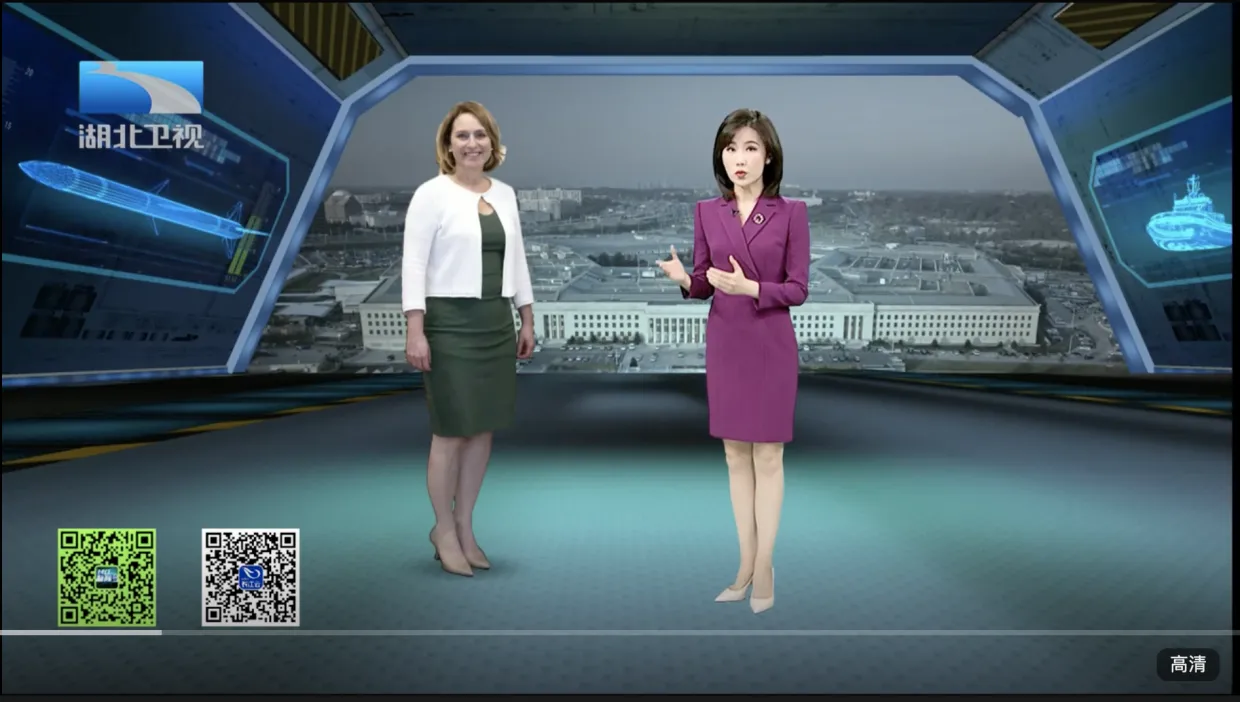
Indeed, shortly after Replicator’s launch, it became clear through open-source channels that Beijing was paying attention to the initiative. A few days after Hicks’ NDIA speech, the state-run China Central Television (CCTV) “Defense Review” program aired a segment entitled, “Pentagon Launches ‘Replicator’ Plan Against China.”59 The video’s tone—like much more coverage of Replicator that we would eventually see in Chinese-language public media—vacillated between serious, hyperbolic, and propagandistic. Perhaps most memorably, the producers and editors had worked up a hologram of Hicks, standing with a Chinese newscaster in a virtual room overlooking the Pentagon. It was validation of the PRC’s attentiveness to the initiative and of our “say less” approach with Replicator’s security posture and initial public affairs guidance (PAG).
China Central Television, August 31, 2023
Hicks made into a hologram by China's CCTV after Replicator’s launch.
A consequence of our chosen public posture was that Replicator would come to be described in the media as “semi-shrouded,”60 “secretive,”61 and “unapologetically tight-lipped,”62 almost perversely attracting more attention than warranted.
Still, it was impossible not to say anything about Replicator; news of its launch had broken out of the bubble of defense trade publications and attracted high-profile coverage in national outlets like The Wall Street Journal and The New York Times,63 and not only journalists but presumably their readers (to include members of industry and Congress) kept asking about it. In addition, DIU’s model included constant engagement with the tech sector’s founders and funders, all of whom were clamoring for more information about an initiative they hoped would finally unlock the Pentagon’s sclerotic processes. Throughout the autumn of 2023, whenever Hicks held an interview, media roundtable, or press conference, she almost always fielded questions about Replicator.64 Those asked the most came down to what systems, at what cost, and where the money would come from. Because we were not yet prepared to say those details publicly, the answers were often unsatisfying to those who wanted more details to be public. Some observers, like TheWashington Post’s editorial board, found a way to appreciably describe Replicator (calling its goals “unimaginably fast,” “long overdue,” and “designed to signal a new way of doing business”) while still making their case for what they felt was needed ($250 million, in The Post’s view).65 Others were far less supportive and far more skeptical and even caustic.
The criticisms of Replicator seemed to crescendo in mid-December, shortly after Hicks had traveled to California and held some roundtable meetings at DIU’s Mountain View headquarters with industry leaders (predominantly from commercial and defense tech firms) and others from the wider tech and innovation communities. The meetings were framed as off the record to allow for participants’ maximum candor. A subset of the broader agenda, her Replicator-focused discussions were meant as an opportunity for Hicks to hear directly from companies about barriers to scaling, trends they were seeing in the market, and ways to shorten manufacturing timelines. Hicks returned to Washington feeling positive about the Pentagon’s relationships with Silicon Valley—“people want to work with us,” she told Sherman the next day66—but moods soured the following weekend when Politico ran an article under the headline, “‘Disorganized and Confusing’: Lawmakers, Industry Rip Pentagon Plans for Drones.”67 At least three executives from the off-record Replicator meeting had anonymously aired their frustrations with the reporter. Despite its headline, the story included more supportive quotes from two leading Republicans in Congress.
Perhaps unsurprisingly, the critics themselves had detractors from within their own community. Multiple CEOs, including some who had been in the room, called Beck to say they thought the article was misleading and unhelpful—motivated more by residual frustration with the Department and less by real concerns about Replicator—and offered to help set the record straight. The day after Politico’s article ran, Christian Brose, author of Kill Chain, former Senate Armed Services staff director under Senator John McCain, and then president and growth officer of Anduril, took to his 14,000-plus followership on LinkedIn to chastise the nameless critics quoted therein for “adding bad form to bad thinking” by running to the press after meeting with Hicks.68 He called the criticisms “just annoying,” and concluded by admonishing his fellow defense executives:
“Rather than throwing stones anonymously at the very people who are trying to do the very things many in the defense technology world have encouraged them to do, industry leaders should try this instead: lend a hand, and shut the f--- up.”69
In a way, the Politico article’s timing was ironic. Unbeknownst to its writers and sources, that very same week (shortly before Christmas in 2023), Hicks would approve the first tranche of Replicator capabilities and systems, consistent with the timeline we were aiming for, and DIU would announce its first Replicator-related solicitations for new capabilities shortly thereafter. Replicator was on track, thanks to a deeply-collaborative, fast-moving internal process and the hard work of many across the department. She directed additional development and analysis on some capabilities that the services and defense-wide team nominated—these ultimately became part of Replicator 1’s second tranche—and greenlit others. Of those, a select few would be publicly announced in May 2024.70
Creating this time lag between the approval and announcement of Replicator 1’s tranche 1 allowed for two actions that were necessary for the program’s protection. One was the creation of an interim Security Classification Guide (SCG) for Replicator, which was finalized in the spring of 2024.71 This was a long-standing and standard best practice within the Department, designed to prevent adversaries from understanding specific hardware, technologies, and operational deployment strategies. Generating the SCG took longer than initially planned, partly because we discovered that DIU had never been delegated Original Classification Authority (OCA),72 and consequently also lacked the requisite knowledge to rapidly exercise OCA even if it was quickly delegated for Replicator—a roadblock that we should have anticipated, given DIU’s founding remit to bring commercial (and inherently unclassified) technology into the department. Replicator’s enterprise-wide nature precluded a single service or combatant command from developing the SCG, so the eventual solution was that OSD’s Strategic Capabilities Office (SCO) would coordinate and issue Replicator’s SCG. SCO had both the delegated authority and resident expertise to draft and promulgate SCGs for SCO programs, which like Replicator involved working across multiple services, and several years prior SCO had been an early pathfinder in attritable autonomous systems.73 SCO was a valued contributor to the DISG and its sub-level bodies, but especially important was its swift support to ensure Replicator had an authorized SCG that could govern future decisions on public information release.
The other protective action that began between Replicator 1’s tranche 1 approval in December 2023 and its May 2024 announcement was a practice of reviewing (and where necessary strengthening) the cybersecurity posture of companies that supported Replicator before we would publicly confirm that they or a system they made was associated with the initiative. Among other aspects, this included making sure that a to-be-associated company was enrolled in and using the free cyber-defense benefits that the National Security Agency makes available at no charge to any DoD contract-holder or any company with access to non-public DoD information.74 Hicks had been encouraging more defense contractors to take advantage of these free services for some time, and it made good sense to both her and DIU’s Beck that any company supporting Replicator that wanted to tout that fact publicly—and plenty did, especially among the venture capital-backed defense tech startup crowd—should be an exemplar of cybersecurity. Onboarding some companies proved easier said than done, but it helped make the vital builders of Replicator systems—both hardware and software—better protected against the inevitable cyber penetration attempts that we knew would come once they were publicly associated with the initiative. It also proved a catalyst to DIU’s “3.0” strategy, helping establish a programmatic approach to knock down the cybersecurity barriers for nontraditional companies looking to work with the Department. As Hicks would say in a speech about Replicator’s first year of progress, this was “part of [DoD’s] commitment to ensuring private industry has access to the information, tools, and tradecraft needed to defend their networks — and the capabilities they build — from intrusion and attack.”75
While these protective actions took time, one result was that by the time we publicly announced Replicator’s first tranche of selected capabilities and systems in early May 2024, only a few weeks would pass before the first deliveries of those systems to the warfighter.76 When the latter happened, there was no reason to withhold such a detail from the press, and Hicks disclosed it promptly in a media roundtable with resident Pentagon reporters. Even then, the tradeoffs about how much to reveal publicly remained hotly debated within the Department. Notably, DIU—with its focus on accelerating the private sector’s confidence in DoD reforms—was especially eager for more system announcements than were ultimately made.
Winter-Spring 2024: Show Me The Money
Replicator’s funding strategy was of course a foremost component to making the initiative work. The timeworn Pentagon adage, “show me your budget and I’ll tell you your strategy,” does not do justice to the many intervening factors that prevent such a direct correlation, but as with most adages, there is undeniable truth in the connection. One defense company executive reportedly dismissed Replicator as “baseless PR spin”77 absent knowledge of the funding allocated for it. Even the Post’s praiseful October 2023 editorial concluded with, “But some things will never change: To get results, the Pentagon will need to put its money where its mouth is.”78 Still, other industry leaders trusted that we could find the funds for Replicator, telling Politico they were “‘just not worried’” about DoD’s ability to “move money around to make it work.”79 The latter’s optimism referred to the department’s budgetary transfer and reprogramming authorities, whereby it could shift some amounts of funds from one congressionally-directed purpose toward another, a process that required Congressional approval above a certain threshold.
Prior to announcing Replicator and selecting the systems, the Replicator team’s analysis had a rough order of magnitude sense of cost, which Hicks later described publicly as “about 0.5 percent of the Defense budget.”80 As described earlier, for Fiscal Year 2025, those resources were being planned and programmed into the Fiscal Year 2025 budget that DoD would present in March 2024. For Fiscal Year 2024, however, the Department had planned to look first within the budget lines of selected systems and supporting test, experimentation, and integration lines that would help speed delivery, and to reprogramming where necessary.
Unfortunately, by the winter of 2024, the Fiscal Year 2024 budget had not been passed. Our assessment of how we would budget for Replicator in Fiscal Year 2024 had assumed something close to the levels already passed by each chamber’s appropriations committees. This was not unreasonably optimistic: when the Fiscal Year 2024 budget was finally enacted in March 2024—a full 6 months late—it was the second-longest delayed defense appropriation in history.81 The problem would later be compounded in the Fiscal Year 2025 appropriations cycle, for which DoD had budgeted directly for Replicator-related capabilities, when Congress failed to enact any appropriations, subjecting the Defense Department to an unprecedented full-year continuing resolution. The initiative was meant to work without funds outside the regular process, but it did assume a regular process. Instead, regular appropriations processes completely broke down throughout the period in which Replicator 1 was executed.82
In this dynamic, reprogramming Fiscal Year 2023 dollars for the tranche 1 programs Hicks had selected became an inevitable piece of the resourcing solution. Reprogramming happens every year and is a standard approach to supporting high priority initiatives. It nevertheless required careful work to prevent moving any funds away from other congressional priorities, or worse from other investments that were important for deterring Chinese aggression. For example, then-Congressman and Marine Corps veteran Representative Mike Gallagher had long seen and lamented reprogramming that moved money from munitions accounts to pay for other priorities, and before we could give him a classified Replicator briefing, he chaired an open House subcommittee hearing on Replicator and warned against taking money from systems like Long-Range Anti-Ship Missiles and other long-range fires.83 Hicks subsequently assured Gallagher such priority-for-priority tradeoffs were never on the table to fund Replicator.84 Instead, the Department pursued reprogramming from less-vital accounts that were under-performing in execution and therefore had money to spare—known as “clean sources” in reprogramming jargon.85
Another potential source Hicks considered was the House defense appropriators’ FY24 proposal for a $1 billion “hedge portfolio” that would be managed by DIU.86 While signaling to DIU Director Beck that this might serve as a source, and with service leaders independently advocating for the same, Hicks and the Comptroller team did not publicly identify it as such for two reasons. First, it was not a proposal included in the president’s budget request and the Department upheld long-standing norms against advocating in opposition to its own budget request. Second, its existence—let alone its final dollar amount—would ultimately be decided by negotiations between House and Senate defense appropriators, and there was a risk that talking about it could do more harm than good. Senate appropriators tended to resist pots of money managed by OSD, so its passage was far from certain, and any indication it might be used for Replicator might only endanger it further. Therefore, prior to the March 2024 passage of Fiscal Year 2024 appropriations, we could not assume as much and had to find other funding sources. The need to act with maximum agility inside this complicated and delayed funding picture created significant public communications hurdles. Hicks had no doubt that the necessary money could be identified, given its relatively small scale and compelling operational rationale, but the exact mechanisms and sources to be targeted would be guided by emerging opportunity.
It was in this uncertain context that the Department submitted its classified spend plan to Congress for Replicator’s first tranche in February 2024. Around the same time, the Department had submitted an official reprogramming request to the Congressional Defense Committees which identified “clean sources” to resource the majority of the first tranche of Replicator systems. In perhaps the greatest sign that the Department’s strategy of transparency and collaboration with the Senate defense appropriators had worked, they used the sources the Department proffered in the reprogramming notification, rescinded the funding lines, and then re-appropriated those resources into the final Fiscal Year 2024 defense appropriations bill—this instead of waiting for all four authorizing and appropriations committees to slowly review and debate the reprogramming notification. In the end, the Fiscal Year 2024 defense bill stated it had included “more than $200,000,000” for Replicator, allocated across various budget lines, determined in coordination with the Department, where the classified Replicator-selected investments resided.87 Publicly identifying which lines would prematurely indicate which kinds of attritable autonomous capabilities Replicator was focused on buying and fielding first, so DoD and Congress reached a mutual understanding that for now, only an approximate, aggregate dollar amount—and one that was ultimately smaller than the actual total, at that—for Replicator would be acknowledged. Meanwhile, with Congress noting DIU’s organizational realignment and the creation of the DISG, appropriators agreed that DIU’s accounts would receive $983 million88 for Fiscal Year 2024—only 5% less than what House defense appropriators had originally proposed. The prior week, the president’s Fiscal Year 2025 budget proposal was released, which included that year’s requested funding for Replicator 1.89 The budget picture for Replicator finally seemed to be clarifying.
Indeed, at the March 11, 2024, press conference customarily held by the Deputy Secretary and Vice Chairman on the day the annual budget request is released, Hicks made clear what we had known internally with increasing certainty for some time: that Replicator’s first instantiation (a.k.a. Replicator 1) would cost approximately $1 billion, spread over two years in roughly equal amounts. For the defense trade press who’d been hounding their Pentagon sources for information about Replicator for months, it became a banner headline,90 similar to the coverage accorded later that spring when in May we announced the first tranche’s capabilities (and one of its several systems) and a few weeks later confirmed the first delivery to the warfighter of Replicator 1 systems.
Summer 2024: Finding a Rhythm
Going into the summer and fall of 2024, Beck, Kumar, and others at DIU carried the greatest load in aligning responsible leads and working-level teams in the military services, relevant combatant commands, OSD, and Joint Staff components, and others (including industry, as more contracts were awarded and more systems moved into production). To ensure Replicator did not suffer setbacks in execution, Hicks nevertheless maintained oversight. She received weekly written updates on Replicator’s progress from the DIU leads, and had Shanaberger continue representing the Deputy’s office in—and back-briefing the Deputy Secretary after—the monthly DIWG meetings that occurred between each quarterly DISG. Meanwhile, Mullins and others made sure Hicks also stayed attuned to how Replicator was being talked about on Capitol Hill and covered by the press. Both had grown more supportive as execution progressed, as evidenced by a complimentary opinion article in June by TheWashington Post’s influential foreign affairs columnist David Ignatius, who cited Replicator as a “striking example of Pentagon reform” and proof that DoD was “learning to change at the speed of war.”91 Noting Hicks’ prior comments that the department needed “deliberate discomfort” and “collaborative disruption,” Ignatius concluded this represented “a revolution that’s long overdue.”92
In early August, Hicks gave a major speech at the same NDIA “Emerging Technologies for Defense” conference where she had announced the Replicator Initiative 11 months and 11 days prior. Sherman, Mullins, and Shanaberger had worked with Hicks to frame the speech as “Structuring Change to Last.”93 We all knew the painful history of start-and-stop defense reforms and wanted to emphasize the imperative to keep up the momentum on innovation even in the face of a potential administration change. The speech was thus broader than Replicator, but it still provided an ideal opportunity to give a public update on the initiative’s execution: from details about contract awards, to sharing that the first units had completed new equipment training with Replicator systems, to highlighting newfound lessons learned in operating attritable autonomous capabilities in real time, to noting the bipartisan support Replicator had garnered from NSC staff alumni of both the 45th and 46th presidential administrations.
One audience for the speech was the PLA. Since Replicator’s launch, we had seen open-source PRC reactions deeming Replicator “‘wishful thinking,’ ‘impossible to achieve,’ and ‘a fantasy.’”94 We did not think a speech would change their minds, but we did learn a few weeks later that Beijing had, in its own way, marked the one-year anniversary of Replicator’s launch, with a half-hour television special on CCTV’s military and defense-focused channel 7. Covering what they alleged as the “conspiracy” of the U.S. military’s Replicator initiative, the program was replete with AI-generated graphics and, like any American cable news program, multiple (human) talking-head analysts.95 While Hicks was relieved it did not reprise her hologram image, both of us did not expect to see a screengrab of text from her prior year’s “Urgency to Innovate” Replicator launch speech (as seen publicly on the DoD website) in the CCTV show’s introductory sizzle reel. Apparently, our words had touched a nerve.
Fall 2024: Replicator Grows, and Replicates
Two milestones briefly acknowledged in Hicks’ August 2025 speech were not yet ready for more detailed publicity: the existence of a second tranche for Replicator 1 (known internally as Replicator 1.2), and work toward a new focus area for Replicator 2.96
Hicks had actually approved Replicator 1’s second tranche of nominated capabilities and systems earlier that summer, though as with the first tranche, there would be a time lag of several months before any specifics would be formally announced in November 2024.97 While some of the newly-greenlit systems for Replicator 1.2 had been among those deferred by Hicks in her decisions on the first tranche nominations, the majority were wholly new. Replicator 1.2 was especially notable for its emphasis on the integrated software enablers—including resilient communications, command and control, and other aspects vital to effective collaborative autonomy among a heterogeneous, multidomain fleet of capabilities operating in a highly contested battlespace.
Hicks directed a shift in funding burden for this second tranche: with exception of these software enablers, any additional capabilities and systems put forward by the services, combatant commands, DIU, or any other DoD component had to be self-funded. Those nominating new capability investments would need to find the money for it themselves. This was meant to incentivize greater ownership on the part of the nominators, which they did not seem to mind—it didn’t stop them from seeking approval for (and most critically, subsequently funding) various capabilities for things like low-cost long-range strike and company-level small drones. DIU stepped in to fund the initial solicitations for almost all of these capabilities, which aligned with Congressional intent for its budget. This was done in close partnership with the relevant Service or Services, with confidence in the “pathway to scale” that Beck had made a requirement for all new funding at DIU.
At the same time, we were also able to disclose some more companies (though still a fraction of the expanding total) that were providing Replicator systems, which helped to further ameliorate the frustrations of journalists and industry. In November 2024, 15 months into Replicator 1, DoD disclosed that over 500 commercial firms had been considered for the initiative’s hardware and software contracts and major subcontracting opportunities, across both tranches. It further revealed that awards had gone to 30-plus hardware and software companies—three-quarters of whom were non-traditional defense contractors and many of whom were experiencing their first contract with the Department, which was a priority for us—in addition to over 50 subcontractors, with similar metrics.98
In parallel, work to scope Replicator 2 was progressing over this period. Hicks’ goal was to put Secretary Austin in a position to announce Replicator 2 in the summer of 2024. In contrast to the closely held and singularly decided direction for Replicator 1, Hicks and Grady used the DISG and its sub-tier governance bodies to thoroughly vet several potential challenges that Replicator 2 could help tackle. Having ripped off the proverbial cultural Band-Aid with Replicator 1, the Deputy Secretary and Vice Chairman heavily involved Joint Staff, Combatant Command, and military departments’ leadership in the capability selection process.
As with Replicator 1, the criteria for Replicator 2 centered on near-term operational imperatives that demanded rapid scaling, and where the commercial sector might help bring those solutions to bear. The enterprise-wide process Hicks and Grady led identified several promising options. Hicks brought these options to Secretary Austin, who did not hesitate in selecting counter-drone capabilities from among them. Austin was deeply concerned about the threat posed by small uncrewed aerial systems (UAS). Having previously served as Commander, U.S. Central Command, Vice Chief of Staff of the Army, Director of the Joint Staff, and a commanding general in Iraq, Austin had experienced the devastating effects from terrorists and insurgents using cheap, improvised explosive devices (IEDs) and roadside bombs to injure, maim, and murder thousands of U.S. troops in Iraq and Afghanistan. Drones from Iran and its proxies were presenting similar threats to U.S. forces in the Middle East, and the potential for greater threats from UAS were growing in every geographic theater. Whether fired by Houthis in Yemen against our Navy vessels and commercial shipping in the Red Sea, or bought by Russia from Iran to kill Ukrainians, these weapons had quickly become the IED challenge of our time—and they could fly. Additionally, although less lethal but equally concerning, small UAS had been spotted flying over and around a significant number of domestic DoD bases.99 Austin also had been actively engaged in Secretary Gates’ push to buy MRAPs at speed and scale to protect the warfighter, and he had a keen appreciation for how senior leader attention could shift the bureaucracy.
While multiple counter-drone efforts were underway across the department, Replicator 2 offered a way to drive them more cohesively toward rapid, scalable results. Secretary Austin’s directive memorandum for Replicator 2 honed in on the need to rapidly improve defense against UAS threats to “our most critical installations and force concentrations.”100 Like Replicator 1, the Department continued to advance on Replicator 2 after the change in presidential administration.101 Although Replicator 2’s subsequent execution is not the predominant focus of this article, its occurrence was an essential part of the initiative’s overall vision—replicating the process with other operational challenges, as originally envisioned.
Winter 2024-2025: Replicator Handed Off
After the 2024 presidential election, it would fall to the next Pentagon leadership team to see Replicator through to its conclusion. For any administration, it’s never a given that something you start will be continued by those who come after you, although we felt that a variety of factors—like the underlying logic of Replicator, its bipartisan support from both houses of Congress (and from authorizers and appropriators alike), its in-process fulfillment of warfighter needs as articulated by apolitical uniformed combatant commanders, and the number of career civilian and military officials who were working its ongoing execution on a day-to-day basis—would all combine to help give Replicator staying power. This included DIU Director Beck, who served in a non-political senior executive capacity rather than a Biden Administration appointee and whose position was designated by law as a principal staff assistant to the Secretary of Defense.
Meanwhile, we took care to incorporate various lessons learned and other observations related to Replicator, innovation, and attritable autonomy into some of Hicks’ last public remarks.102 Hicks stayed up-to-date and engaged with Replicator’s execution into January 2025, and in her final major speech as Deputy Secretary of Defense—which surveyed a multitude of ways that DoD had stepped up over the prior four years to outcompete China and the PLA—she affirmed publicly that as of that time, Replicator was still “on track to meet our stated goal,” and that more broadly, “by driving both technology change and culture change, [it was] showing that DoD can move fast to shape the battlespace, and equip our warfighters with what they need to win.”103 The initiative remained on track through Hicks’ departure from office on Inauguration Day.
Since We’ve Been Gone: Observations from Outside
After leaving the Pentagon on January 20, 2025, our knowledge of Replicator’s progress became limited to what gets shared publicly. We have nevertheless been gratified to see in the public record—from various statements by defense officials and members of Congress, as well as credible media reports and public budget documents—the continuation of Replicator 1 and 2 and even genuine support for what one might call ‘more Replicator.’
In April 2025, for example, when Senate Armed Services Committee chair Senator Roger Wicker outlined his priorities for the year in a Washington Post opinion article, he wrote,
“The Pentagon’s Replicator Initiative, an opening move toward making big bets on defense innovation, has spent $500 million so far. Let’s scale that by orders of magnitude and spend $5 billion per year, which would enhance our warfighting edge and help rebuild a competitive defense industrial base.”104
Three months later, when Congress poured over $1 trillion into Pentagon coffers through its 2025 budget reconciliation funding package signed by the president on July 4, Wicker touted the bill’s “$16 billion to expedite innovation to the warfighter … increas[ing] scale production of innovative low-cost and next-generation weapons like drones, counter-drone tech, low-cost munitions, and artificial intelligence.”105 This included a specific line item of $500 million that appeared to capture Replicator 1’s requested resource level and mission space of “preventing delays in delivery of attritable autonomous military capabilities and accelerate all-domain attritable autonomous systems.” Subsequent analysis by Council on Foreign Relations experts—including Dr. Michael Horowitz, formerly of OSD Policy during the conception of Replicator 1—noted that “[a]t least $7.7 billion of these innovative investments directly support the development and short-term scaling of precise mass systems,”106 which was Horowitz’s favored term of art for the kinds of attritable autonomous capabilities prioritized by Replicator 1. They also noted that the bill doubled DIU’s flexible funding, from $1 billion to $2 billion.
Based on our own reading of the funding lines and our knowledge of which ones supported Replicator 1, we estimate that this legislation invested between $4-8 billion to further expand Replicator 1 capabilities—though no such number would likely be explicitly stated or confirmed by DoD or Congress.107 That is intentional, and was always our goal; back in March 2024, Hicks said after noting Replicator’s initial $1-billion dollar amount, “It is my fervent view that [the] follow-on to that is a significant investment potential that is not about Replicator. That is about what the services are going to be able to do on autonomy once we’re able to lower those barriers through that initial investment.”108
Some reshuffling was inevitable, with the passage of time and changes in leadership. In August 2025, Secretary of Defense Pete Hegseth issued a memo establishing a joint interagency task force, known as JIATF 401, to lead DoD’s counter-drone work going forward. Hegseth’s memo directed Pentagon leaders to “Consolidate Replicator 2 resources into JIATF 401 and apply funding in collaboration with the Defense Innovation Unit.”109 A month later, we learned from Wall Street Journal reporting that Replicator 1 execution had—at the conclusion of the two-year effort engined by DIU—transitioned to “a new division under Special Operations Command known as the Defense Autonomous Warfare Group, or DAWG.”110
While the Journal cited “delays” as one reason for the shift, we also noted the August 2025 public remarks by a former military official from DIU who left the department earlier that summer; he said that by the time of his departure in June 2025, “hundreds” of Replicator systems had been delivered to the warfighter, “thousands more [were] on contract,” and “when I left they were still rolling off the assembly line.”111 Did industry deliver enough by the end of August to meet the initial goal Hicks laid out two years prior? We cannot say for sure; if not, we cannot say why.112 As Pentagon outsiders since January 2025, we do not know enough to fairly speculate on what may have happened between then—when Replicator 1 was on track to meet the goal of “multiple thousands in multiple domains”—and the end of its 24-month timeframe. In the months since August/September 2025 until now, that goal may have indeed been met.
The terminology of Replicator also seems to still inspire defense innovation. In winter 2025-2026, Army publications on behalf of JIATF 401 referenced Replicator 2 multiple times,113 and in January 2026 the task force announced its “first Replicator 2 purchase to counter homeland drone threats.”114 Meanwhile, in November 2025, a navy officer from a DoD research group advising the Chief of Naval Operations penned an op-ed calling for not only the existence of a “Replicator 3,” but that it be focused on what he deemed “the sustainment revolution – a deliberate effort to design, resource, and forward-deploy the infrastructure, manpower, and partnerships to match the pace of production” of unmanned mass.115
Most reassuring to us has been the confidence in Replicator 1 expressed by the warfighter. As this article noted at the outset, in December 2025, Replicator 1’s key customer, the INDOPACOM Commander said “it is very much alive,”116 that “we’re exercising to it live … in secure spaces where we can do our maximum learning,” and that their work was “making even greater strides in the most recent months.”117 This was consistent with Under Secretary of Defense for Research and Engineering Emil Michael’s remark in September 2025 that “Replicator will continue.”118 Earlier in the year, Secretary of Defense (later preferring Secretary of War) Peter Hegseth endorsed Replicator 1 in testimony to Congress with the following words:
“DoD’s Replicator-1 initiative—with sustained senior leadership focus, cross-Departmental collaboration, the help of the Defense Innovation Unit, and support from Congress—has made enormous strides toward delivering and fielding multiple thousands of unmanned systems across multiple domains, with thousands more planned under this [the Fiscal Year 2026] budget to further strengthen our deterrence in the Indo-Pacific.”119
Lessons and Reflections
Fundamental organizational changes seldom happen in a single moment. This is certainly true in the history of defense innovation, and especially so outside of wartime. There is, as we have often said, no silver bullet for what has ailed American defense innovation. Yet innovation does often have a tipping point—a moment when the need for change is widely perceived and its ingredients for success have accumulated to such a degree that going back to the old ways of doing business becomes less likely than pressing ahead.
The Replicator Initiative, coming as it did when the war in Ukraine had exposed the fragility of the existing defense industrial base and China’s rapid military development had generated urgency for innovative concepts, forces, and capabilities, was one such point of no return. It demonstrated that great attention and enterprise-wide collaboration, with congressional support, could make hard things possible—and deliver real operational advantage. Yet it also perfectly demonstrated the stifling constraints of the box within which the U.S. military had been forced to innovate. Both of these outcomes—the realized promise of its ambition and the need to do so much more, across so many more areas of defense—have propelled efforts at broader reform.
Broad defense reform is much needed and long overdue. Yet if it is to succeed, it would be wise to learn lessons from the Replicator experience. Five elements stand out to us as critical:
Wise goal-setting
Aligned stakeholder incentives
Top-down leadership
Sustained focus on implementation, feedback, and iteration
Effective communications
Goal Setting with Ambition and Realism
Many initiatives fail due to unrealistic goals and poor execution. Initiatives easily within reach, on the other hand, may nominally succeed but typically fail to generate substantial change. The Replicator Initiative’s design aimed for a sweet spot: to maximize payoff while minimizing the many constraints that were likely to inhibit that payoff. This required wise goal-setting that was at once ambitious and realistic across several parameters. The ambition to accelerate attritable autonomy from minimal production to thousands of systems in multiple domains within two years and without supplemental funds was bold—there was no notable precedent. Yet it rested on spade work that showed its payoff to be realistic. Senate appropriators had as much as demanded that the Department work with it to use its full budget authority, House appropriators and many authorizers in both chambers had shown special enthusiasm for defense innovation, and the Department had need, applicable program lines, and significant system integration and policy barrier work to do so that the initiative could accelerate.
Preventing mission or requirements creep for Replicator 1 was a more significant leadership challenge. It required near constant tending of the stated goal to prevent stakeholders from attempting to co-opt or expand it for their mission purpose or budget desire. Others wanted to be responsive to critiques they heard from commentators—at first to do less and later to do more, for instance. Having thorough public affairs guidance and other documentation as a North Star was helpful, as was committing from the outset to an iterative approach, for which the guidance constrained version 1.0 but lit the path for greater scope beyond it. This approach holds great promise for future would-be reformers.
A more fundamental challenge to overcome is endemic cynicism about reform itself. Some commentators routinely decry the Department’s lack of risk-taking and the need to embrace more failure so that we may learn, iterate, and improve (we associate ourselves with these analysts), while others in the press, on Capitol Hill, and throughout the community have a predilection for schadenfreude—eager to find fault and assign blame. Putting leadership focus on ambitious yet realistic reforms stands the best chance of weathering these conflicting dynamics to deliver real change.
Some may contend that Replicator’s ambition should have been larger; we heard that point made as we prepared to leave our DoD jobs in January 2025.120 We have also watched as Secretary Hegseth issued a July 2025 memo on “Unleashing U.S. Military Drone Dominance,”121 and as Army Secretary Daniel Driscoll announced in November that the service would seek “to buy at least a million drones in the next two to three years and could acquire anywhere from a half million drones to millions of them annually in the years that follow.”122 To whatever extent they achieve those goals, we are confident that Replicator helped lay the foundation for such success—especially given credible media reporting that Replicator’s “approach is now being used for other Pentagon efforts.”123 Every J-curve has a pivotal moment where linear growth becomes exponential, and while we assess it is too soon to say, history may point to Replicator as such a moment.124
Building Champions - Aligning the Incentives
In every organization, strong forces prefer the status quo. Yet in every organization, potential reformers are also ready to make a difference. The key to generating lasting change is to show these would-be champions of change that the rewards for reform are greater than the risk. In the private sector, this is more easily accomplished through meaningful differentiated performance compensation and other incentives. In the public sector—where contributing to the common good is the most significant motivator among federal civilians, and intrinsic to the ethos of the professional military—aligning incentives to favor reform over business as usual is about convincing key contributors that an initiative will both deliver real improvement and thus be a positive change with which to be associated.125 It is nearly impossible to succeed without a dedicated cohort in the right positions at the beginning of an initiative, and Replicator was designed to take advantage of the array of ready change agents in such critical components as the combatant commands, services, Congress, DIU, and elsewhere in the Department. Once positive change manifests on the backs of this stalwart start-up group, their reputational strength and career rewards serve as a demonstration effect that incents and converts others to the cause. Their actions exemplify bravery—to stick one’s neck out for something that ultimately fails can have deleterious effects in any bureaucratic organization. But such champions are necessary. In the Pentagon especially, it is a “show me” culture, and demonstrating leadership from the front is vital to shifting the culture more broadly.
Top-Down Leadership
Change management requires effective, committed leadership. As described above, when incentives are aligned, leaders come forward at multiple levels and across multiple organizational stakeholders to champion change. This is what makes change last. But to generate momentum and top-cover for reform, leadership at the top is also critical. Nowhere is this truer than in the Department of Defense, which rests on a statutory framework that places only two people—the Secretary of Defense and, under the Secretary’s authority, direction, and control, the Deputy Secretary of Defense—above a complex web of sometimes overlapping and frequently contesting responsible officials, both civilian and military. In the annual jousting over budget sizes and shapes that inevitably produces winners and losers, it is easy for even the most restive and coordinated bottom-up change-seekers to be thwarted by their boss’s priorities, their peers, or even by poor timing.
These internal dynamics are matched by equally complicated external dynamics that require top-down leadership for effective communication and partnership, including with the multi-committee oversight structure of Congress, motivated outside commercial interests, and a free press. Leaders who want change cannot merely give voice to that desire; they must also be willing to invest their time and political capital. If a Congressional staffer has a different view of change, direct engagement with staff and members from the Secretary or Deputy Secretary of Defense may be necessary, for example. For some priorities there can be no substitute, because if you cared about the issue less, you would send a delegate. The signal and sustained desire for change thus must come from the top of the Defense establishment, but it is by no means sufficient on its own to generate and secure lasting change.
Sustaining Focus During Implementation
Perhaps the single most frequently overlooked factor in effective change management is the need to sustain leadership attention throughout execution. Most reforms fizzle out and die, with little to show for them. Few organizations can manage change like a self-guided missile—rarely can leadership fire and forget and expect outcomes to align with their intent. Senior intervention is often required to unsnarl tangles downstream of initial guidance, including in hierarchical command organizations like the Pentagon. Furthermore, early execution almost always surfaces further improvements or course corrections that can be injected more quickly if senior leaders are routinely evaluating their initiatives. The success of Replicator 1 and 2, for instance, was reliant on iterative learning among operators, technologists, and budget and program specialists, among many others. The Valleys of Death are real, and they need significant foresight and sustained attention if they are to be overcome.
More than 20 years after the addition of “execution” to its core strategic oversight process—the planning, programming, budgeting, and execution system—the Defense Department is far from where it should be in effective execution oversight.126 This is in part due to poor data quality and severe data siloing, but it is also a consequence of rotating leadership—political and military—that are seldom127 in position for even the first full execution cycle of a program or initiative. In Replicator, the Department took account of these weaknesses and created senior, and even senior-most, mechanisms for accountability and course correction. By building champions early, it generated momentum and expectations that incentivized change and accountability for its success even after its initiators had departed their positions. Reformers should be developing their accountability and execution oversight plan before they launch, they should demonstrate with their time and energy at least as much enthusiasm and commitment to the follow-on as they do to the roll-out, and they should consider how well they have set up incentives, broadened support, and distributed leadership to favor continued momentum after their departure.
Effective Communications
Communication is crucial for any leader seeking to drive lasting change. Former Secretary of Defense Ash Carter used to say that communications always came down to three things: “repetition, repetition, repetition”—if you say the same thing again and again, enough times, people will start to get it. The first people who truly grasped what Replicator was trying to do tended to be public servants within (or recent veterans of) the Pentagon and the broader Defense Department, followed by those on Capitol Hill and in industry who were paying the most attention to the changing character of war and trends in the defense acquisition enterprise and industrial base. Candidly, those who could be briefed on all the classified details often got on board the fastest. Many members of the media also came to understand Replicator’s intent despite it not looking like most Pentagon initiatives they were used to reporting on. As one example, the Washington Times wrote in November 2025, “[t]he Pentagon’s secretive Replicator program isn’t about drones, at least not entirely,” and that “[i]f the department transitions from an acquisition system that virtually all stakeholders agree is far too slow and bureaucratic to a blueprint that quickly fields new technology, Replicator and the work of DIU are likely to be viewed by history as powerful accelerants that helped achieve this goal.”128
Another communications lesson is that leaders and practitioners in the Pentagon and the broader defense ecosystem should continue striving to be more thoughtful about what, when, how, and how much they say publicly about the research, development, and procurement of military capabilities intended to create operational dilemmas for potential U.S. adversaries. The relatively small community of adherents to this approach continues to grow within the department; it may be that Replicator’s example influenced the Pentagon’s present circumspection around its Golden Dome initiative.129
Replicator communications were not perfect. Had we been forthright about an overall dollar amount and funding strategy earlier, it may have smoothed over or even prevented some public criticisms. We also know that the span of control across a multi-million-person defense enterprise prevents leadership’s ability to shape every word that is said about a program or initiative. Any leader must accept the inevitability that someone in the know will share some details publicly when you would prefer they didn’t. The constructive lesson we hope to have provided through Replicator is that you can launch a high-profile, ambitious initiative in a way that catalyzes those you need to support and execute it, while also being careful not to prematurely publicize details that risk compromising an important technology before it’s barely been built. Criticisms, while never desirable or enjoyable, will be worth the outcome if you can deliver an operational advantage to the warfighter.
Conclusion
Perhaps the most important lesson from Replicator is that it could not be achieved by any one leader, organization, or actor on their own. Replicator did not emerge from the ether nor only from the mind of one individual; instead, we continue to characterize it as Hicks did the year after its public debut: “born of the right ingredients coming together at the right time.”130 Appraisals of Replicator’s success should continue, and could evolve over time as more facts are demonstrated and eventually disclosed publicly. Did Replicator 1 (attritable autonomy) and Replicator 2 (counter-drone capability) lead to effective near-term capabilities fielded to warfighters? Did they help spur faster and more widespread responsible development and adoption of unmanned systems and autonomy? Were they indeed pathfinders that increased solution-oriented, barrier-busting incentives, culture, and behavior or did the Initiative have no discernible effect on business-as-usual? Just as Replicator built on what came before it, the answers to these questions, along with an appreciation for the critical elements we highlight above, can help guide future reformers in defense and beyond.
Disclaimers and Acknowledgments
The views expressed in this article are those of the authors and do not reflect the official policy or position of the Department of Defense, the United States Government, or the Belfer Center for Science and International Affairs.
We thank the numerous expert reviewers whose thoughtful feedback informed and improved the work. We are also grateful to the Defense Office of Prepublication and Security Review for the Department’s timely and professional review of this article. Finally, we thank 2nd Lt. Jon Cho, USAF, who provided us with outstanding research assistance.
Hicks, Kathleen and Aaron Sherman. “Move Fast and Scale: A Brief Insiders' History of the Replicator Initiative.” Belfer Center for Science and International Affairs, June 1, 2026
Move Fast and Scale: A Brief Insiders' History of the Replicator Initiative
Ronald Reagan Presidential Foundation & Institute, “Deterrence by Design: Advancing AI for Competitive Advantage Over China,” YouTube video, 54:28, December 6, 2025, https://www.youtube.com/watch?v=Gdgs7g6jw1w. In response to a question from panel moderator and journalist Gordon Lubold, U.S. Indo-Pacific Commander Admiral Samuel Paparo gives a status update on the Replicator initiative [44:25].
The Office of the Secretary of Defense Historical Office maintains a website with a numerous relevant studies. See “History of Acquisition in the Department of Defense Series,” Department of Defense, Office of the Secretary of Defense Historical Office, https://history.defense.gov/Publications/Acquisition-History/.
Ashton B. Carter, Inside the Five-Sided Box, p. 38.
Michael J. Sullivan, “Highlights: Defense Acquisitions—Rapid Acquisition of MRAP Vehicles,” testimony before the Senate Armed Services Committee, Defense Acquisition Reform Panel, GAO-10-155T, October 8, 2009, https://www.gao.gov/assets/gao-10-155t.pdf.
Morgan Dwyer, Understanding Acquisition Speed for the Defense Department’s Costliest and Most Complex Programs, Acquisition Research Program, Center for Strategic and International Studies, September 2020, p. 26-27, https://dair.nps.edu/handle/123456789/4288.
Executive Branch calls for greater resource flexibility especially rankled some Appropriators in the wake of several 2019-2020 transfers of defense funds without congressional approval. See, for example, Senator Durbin, et. al., Letter to Secretary of Defense Mark Esper, February 13, 2020, https://www.durbin.senate.gov/imo/media/doc/scan2.pdf.
Ashton B. Carter, “Submitted Statement to the Senate Armed Services Committee on the Fiscal Year 2017 Budget Request for the Department of Defense,” in Department of Defense Budget Posture: Hearing before the Committee on Armed Services, U.S. Senate, 114th Cong., 2nd sess., March 17, 2016, pp. 22-23, https://www.armed-services.senate.gov/imo/media/doc/Carter_03-17-16.pdf.
One such process-oriented concept centered on creating a “concierge” tool or support system to assist non-traditional entities seeking to bring solutions to the Defense Department.
Counterdrone capability would later be Secretary Austin’s clear-cut priority area for Replicator 2.
Senate Committee on Appropriations, Report to accompany the Department of Defense Appropriations Bill, 2024, S. Rep. 118-81, p. 23.
Senate Committee on Appropriations, Report to accompany the Department of Defense Appropriations Bill, 2024, S. Rep. 118-81, p. 24.
Senate Committee on Appropriations, Report to accompany the Department of Defense Appropriations Bill, 2024, S. Rep. 118-81, p. 25.
Senate Committee on Appropriations, Report to accompany the Department of Defense Appropriations Bill, 2024, S. Rep. 118-81, p. 27.
Senate Committee on Appropriations, Report to accompany the Department of Defense Appropriations Bill, 2024, S. Rep. 118-81, p. 27.
Senate Committee on Appropriations, Report to accompany the Department of Defense Appropriations Bill, 2024, S. Rep. 118-81, p. 28.
For background on DoD’s reprogramming authorities, see U.S. Library of Congress, Congressional Research Service, Defense Primer: DOD Transfer and Reprogramming Authorities, by Aaron D. Walenga and Brendan W. McGarry, Report No. IF11243 (Washington, DC, Updated December 6, 2024), https://www.congress.gov/crs-product/IF11243.
Gates, Duty, p. 133.
Department of Defense, “Charter for the Deputy Secretary’s Innovation Steering Group,” Memorandum from Deputy Secretary of Defense Kathleen H. Hicks, August 28, 2023.
The acronym for which, ADA2, would be a play on the long-used defense acronym A2/AD, anti-access/area-denial, a daunting challenge that the AD/A2 capability set could help overcome.
The Defense Innovation Board, “Aligning Incentives to Drive Faster Tech Adoption,” July 5, 2023, p. 4.
The Hunt for Red October, directed by John McTiernan (Paramount Pictures, 1990), 2 hr., 15 min.
For Replicator 2, the team took pains to avoid any similar accusations. For instance, Hicks personally called each Service Secretary prior to Secretary Austin signing the launch memorandum.
This happened fastest for systems being nominated for Replicator that were the most technologically mature, which were expected to achieve the greatest economies of scale soonest; other systems that were nominated required some amounts of additional hardware or software development.
Aaron Sherman, personal notes, June 2024, in the possession of the author.
For background on OCA and SCGs, see U.S. Department of Defense, Original Classification Authority and Writing a Security Classification Guide, DoD Manual 5200.45 (Washington, DC: Office of the Under Secretary of Defense for Intelligence and Security, January 17, 2025), https://www.esd.whs.mil/Portals/54/Documents/DD/issuances/dodm/520045m.pdf.
See U.S. Department of Defense, “Deputy Secretary of Defense Hicks Announces First Tranche,” and Mehta, "First Replicator Systems Delivered.”
Robertson, “Replicator: An Inside Look.”
Editorial Board, “The Pentagon’s new drone program.”
Berg, “‘Disorganized and Confusing.’”
Hicks, “Deputy Secretary of Defense Kathleen Hicks Media Round Table at the Defense Writers Group.”
The longest prior period without regular defense appropriations had occurred in the Fiscal Year 2017 cycle, which lasted about one month longer.
As described later in this article, an important postscript to this dynamic occurred after our departure in 2025, when Congress signaled its continued support for Replicator with a related line-item of $500 million in the reconciliation bill, making up for the funding gap that would have otherwise existed under the Fiscal Year 2025 continuing resolution.
See Rep. Gallagher’s comments at House Subcommittee on Cyber, Information Technologies, and Innovation of the Committee on Armed Services, Can It Work? Outside Perspectives on DOD’s Replicator Program, 118th Cong., 1st sess., October 19, 2023, H.A.S.C. No. 118-44, p. 9, https://www.congress.gov/118/chrg/CHRG-118hhrg55527/CHRG-118hhrg55527.pdf.
Hicks told reporters in November 2023: “I have spoken with Rep. Gallagher, I have been very clear with him and I will say very clearly here, we are all about the strategy winning. We are not going to go after long-range strike platforms or systems or munitions that are critical to the fight in order to look at another approach here, which is complementary to it. It doesn't substitute for it. All of that is needed. It's a yes/and answer and it is not a lot of money.” See Hicks, “Deputy Secretary of Defense Kathleen Hicks Media Round Table at the Defense Writers Group.”
After Hicks and other DoD officials provided Gallagher and other House Armed Services Committee members with a classified briefing on Replicator, he would tell a reporter that Replicator was “moving in the right direction.” See Berg, “‘Disorganized and Confusing.’”
By this point, internally we were starting to refer to Replicator’s initial 18-24 month focus on attritable autonomy as “Replicator 1,” since discussions were already underway about what the second 18-24 month focus would look like—which we referred to as “Replicator 2.”
To keep our heads on straight internally, the team referred to the second tranche of attritable autonomous systems as “Replicator 1.2,” in contrast to “Replicator 1.1” (the first tranche of Replicator 1, approved in December 2023 and announced in May 2024) and “Replicator 2” (which focused on counter-drone capabilities, announced in September 2024). Before we started using this nomenclature, some in DoD had initially thought “second tranche” meant “Replicator 2” (it did not). While the x.x numbering had been internal-only at first, it seeped into the public communications for Replicator 1.2, mostly to try to spare reporters from the same confusion we had accidentally imposed on our own colleagues.
We are aware of reports in March 2025 that one of the publicly-acknowledged vendors for Replicator 1 systems (AeroVironment, which makes the Switchblade 600 system) experienced manufacturing and supply chain logistics shutdowns due to weeks and months of high winds and wildfires in Southern California. See AeroVironment Inc., “Q3 2025 AeroVironment Inc Earnings Call,” edited transcript, March 4, 2025, p. 4, https://investor.avinc.com/static-files/4d14388b-653a-4296-93b8-8bf2030785cf. We are also mindful that this is only one of several companies awarded contracts to build capabilities for Replicator 1.
Reagan Presidential Foundation & Institute, “Deterrence by Design.”
POLITICO, “The Future of Defense Innovation Panel Full Interview | POLITICO AI & Tech Summit,” September 16, 2025, YouTube video, 19:26, https://www.youtube.com/watch?v=JcXCqP5mQB0. Undersecretary Emil Michael comments on the department’s drone initiatives and says that the Replicator initiative will continue [6:55].
The most glaring exception might be Admiral Hyman Rickover, whose oversight of the nuclear Navy lasted over 30 years, and whose successors (serving as the director of Naval Reactors) are confirmed by Congress to eight-year terms of office.
Wolfgang and Steward, “Whatever Happened to Replicator?”
Hicks, Kathleen and Aaron Sherman. “Move Fast and Scale: A Brief Insiders' History of the Replicator Initiative.” Belfer Center for Science and International Affairs, June 1, 2026