The two-week ceasefire between the United States and Iran is not peace. It is an intermission in a war that exposed how combustible the regional order has become, how quickly the Strait of Hormuz can turn into a lever of global coercion, and how thin the line is between limited confrontation and systemic breakdown. Pakistan’s role in helping broker this pause matters not because it has solved the conflict, but because it has reminded the region that geography, trust, and diplomatic memory still count in moments of strategic crisis. Pakistan was central to the push for the current pause and is now hosting follow-on diplomacy in Islamabad, even as the ceasefire remains fragile and contested, especially over Lebanon and maritime access.
What emerges after this war will not look like the pre-war Middle East. Even if the guns fall silent, the region is unlikely to return to an older equilibrium. Instead, it is moving toward a more militarized, more networked, and more crisis-prone order: one in which Gulf security, Iran’s nuclear latency, Israeli freedom of action, U.S. forward presence, and the role of middle-power mediators will all be renegotiated at once. The ceasefire itself already reveals the fault lines. Washington and Tehran agree on the need for a pause, but disagree on what exactly was agreed. Pakistan and Iran have said the truce should cover Lebanon; the United States and Israel have denied that interpretation. That is not a small discrepancy. It shows that this ceasefire is not a final settlement but a contested framework suspended over unresolved wars.
Pakistan's Mediation
This is precisely why Pakistan’s mediation deserves closer attention. Pakistan is not a random venue or a desperate substitute. It is one of the few states that can speak credibly, if differently, to Washington, Tehran, Beijing, Riyadh, and other Gulf capitals. Pakistan gained enough trust from both the U.S. and Iran to move from the margins into an active mediating role, even while recognizing that it lacks unilateral leverage to impose a permanent agreement. That distinction matters. Mediation is not the same as enforcement. Pakistan’s comparative advantage lies not in coercive power, but in access, strategic literacy, and the ability to communicate hard truths to all sides.
Pakistan also has a long diplomatic memory that makes it unusually suited for this role. The historical record is clear that Pakistan served as a secret channel in the 1971 U.S.-China opening; Kissinger’s secret trip to Beijing was arranged through Pakistan. Pakistan’s Cold War alignment with Washington was also formalized through the 1954 Mutual Defense Assistance Agreement and its participation in SEATO. Those episodes were not identical to the present crisis, but they established a pattern: Pakistan has often functioned as a state able to maintain difficult relationships across rival strategic camps.
That history gives Pakistan a realism many moralistic commentators in the region do not have. Islamabad can tell Tehran what others may hesitate to say plainly: the demand that the United States simply leave the Middle East is not a viable basis for regional order. The U.S. military footprint may be contested, resented, or recalibrated, but it is not disappearing anytime soon. The Gulf monarchies still see American protection as central to regime security, energy security, and deterrence against both Iran and non-state threats. In that sense, Pakistan can be useful precisely because it understands both anti-imperial sentiment and hard security realities. It has lived through alliance politics, forward basing, and post-9/11 cooperation with Washington, and it knows that regional orders are not built out of maximalist slogans.
At the same time, Pakistan can speak to Gulf capitals with equal candor. The war underscored a reality that the GCC cannot ignore: their prosperity rests on infrastructure that is geographically close to Iran’s reach. If Iran feels cornered, it does not need to defeat its adversaries conventionally; it only needs to threaten the energy arteries, maritime chokepoints, and urban vulnerabilities of its neighbors. The Strait of Hormuz remains the sharpest symbol of that leverage. The current ceasefire itself was tied to reopening or securing passage through the strait, and renewed disruption remains one of the fastest routes back to escalation. For the GCC, then, this is not someone else’s war. Their energy systems, ports, cities, and political legitimacy are deeply implicated in the outcome.
This is why the old comfort phrase, “it’s not my war,” no longer works for any state in the region. Every regional actor is now a stakeholder whether it likes it or not. Oil markets, shipping lanes, proxy networks, sectarian mobilization, refugee flows, militia spillover, and external military deployments ensure that local wars are no longer containable in the old sense. Even those states trying hardest to avoid direct entanglement will be drawn in through economics, domestic politics, or alliance obligations. Pakistan understands this viscerally because instability to its west quickly becomes militancy, border insecurity, economic strain, and diplomatic overload at home. One of Islamabad’s core motivations is to prevent the conflict from further destabilizing Pakistan’s already tense western frontier with Iran and Afghanistan.
What might the post-war regional security order actually look like?
First, it is likely to be more plural rather than unipolar. The United States will remain indispensable, but no longer sufficient. Pakistan, Turkey, Saudi Arabia, Qatar, Egypt, and China will all try to shape outcomes around a U.S. security core that persists but no longer commands uncontested legitimacy. Even the current ceasefire diplomacy appears to have involved multiple regional and extra-regional actors, not a single hegemon dictating terms.
Second, it will be a security order built less on trust than on managed vulnerability. That means narrower bargains: deconfliction mechanisms, maritime guarantees, proxy restraints, limited understandings on missile use, and crisis hotlines rather than grand reconciliation. The present ceasefire is already a template for that kind of thin order: transactional, conditional, and heavily dependent on continued mediation.
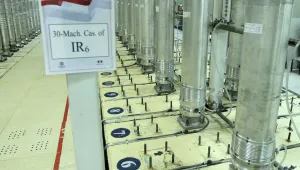
Third, and most consequentially, a threshold nuclear Iran may well become the region’s new reality. That does not mean an openly declared Iranian bomb tomorrow. It means a political and strategic condition in which Iran retains enough nuclear knowledge, infrastructure, and material capacity to remain permanently close to weaponization, even if formal weapon status remains ambiguous. IAEA reported that before the recent attacks Iran possessed 440.9 kilograms of uranium enriched to 60%, enough for roughly ten nuclear weapons if further enriched. Even if diplomacy now focuses on stockpile removal or enhanced monitoring, the war has likely strengthened Tehran’s belief that nuclear latency is indispensable to regime survival.
That is the central paradox of coercive war: it may damage facilities while deepening the strategic logic for retaining the option.
What is at stake, then, is larger than a ceasefire. It is whether the region evolves toward a mediated order of constrained rivalry, or slides into a permanent cycle of episodic war and nuclearized brinkmanship. Pakistan’s value lies in recognizing that durable stability will not come from humiliation narratives, absolutist demands, or the fiction that only direct belligerents have standing in the outcome. The region needs interlocutors who understand power, memory, and limits.
Pakistan is well placed because it has lived all three.