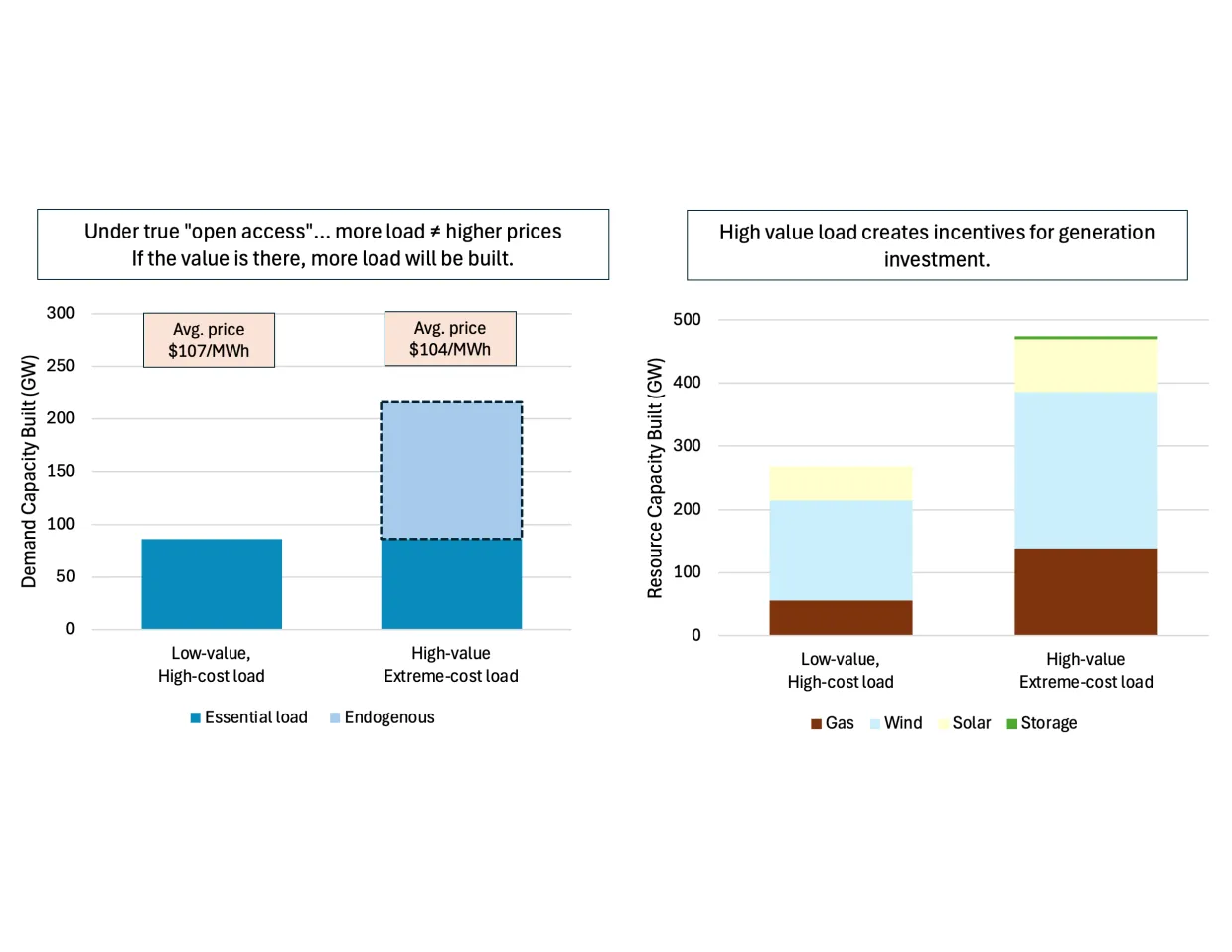
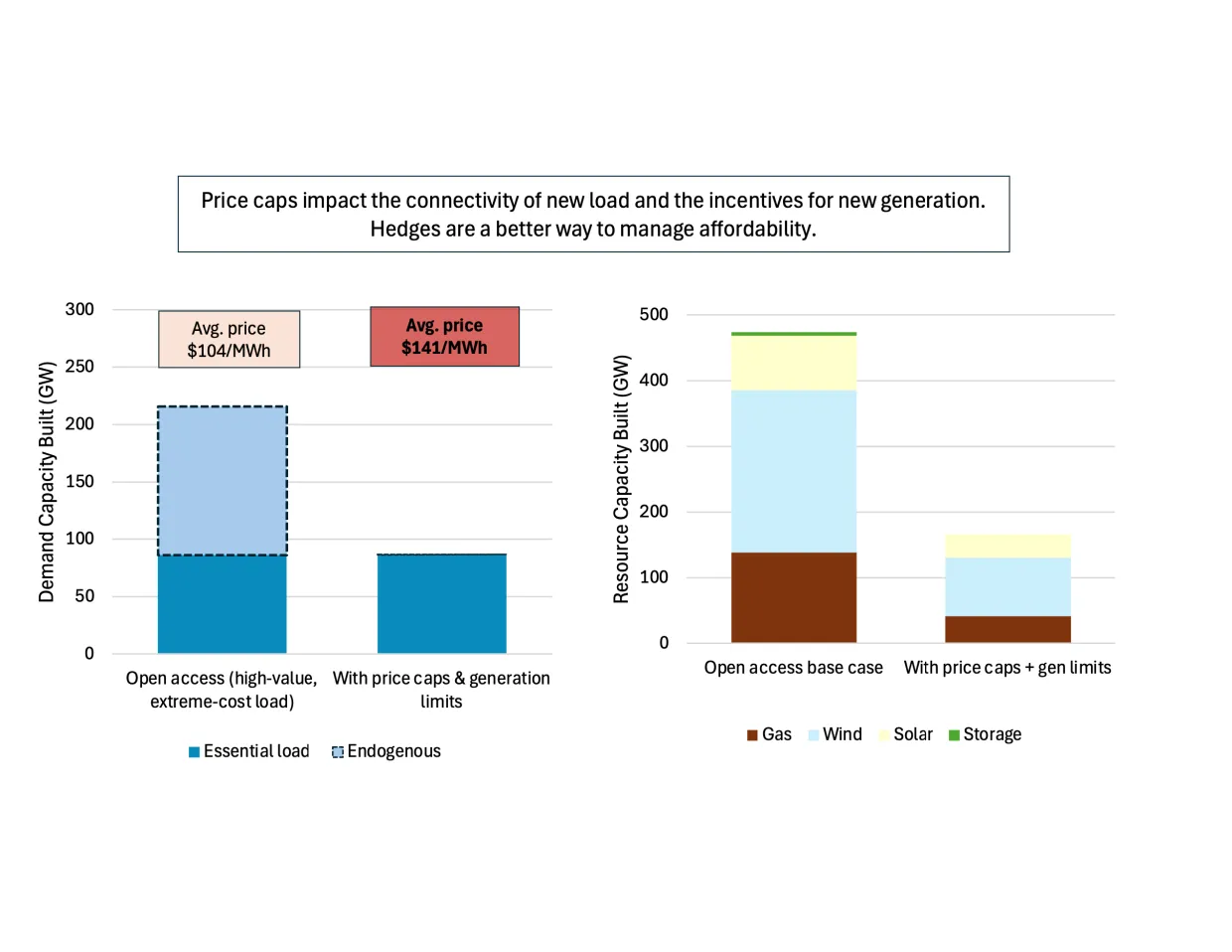
This policy brief reflects conclusions the authors draw from and extends the Policy Implications section of the study Electricity Market Design and Risk Trading with Flexible and Endogenous Demand.1
Growing electrification of the building and transport sectors, distributed energy resources, and new large loads like data centers for AI-driven computing demand raise the question of how demand should participate in electricity markets and the effect new demand will have on reliability and affordability. The fundamentals of markets do not change with increased participation of the demand side; price remains the crucial coordinating signal for optimal operational and investment decisions of both supply and demand. Different types of demand have different risk appetites, have different abilities to choose their size and location, and gain different value from electricity consumption. Key is to not require mass market consumers (e.g., residential/commercial) to cross-subsidize large industrial loads like data centers. Rather, expose new large loads to efficient price signals and incentivize them to hedge themselves appropriately. In the long run, even if new large loads are inflexible with extremely high willingness to pay for electricity, affordability and reliability are not diminished so long as sufficient supply can come online and parties are incentivized to share risk through contracting. In the short run, we advocate for hedging arrangements to protect existing consumers rather than blunt price caps that can lead to suboptimal rationing during times of scarcity and poor investment decisions in the long run.
Markets find optimal outcomes via efficient prices and hedging
The motivation for markets in electricity is the bet that we can achieve better outcomes — higher welfare — than with centralized planning.2 Welfare, or surplus, in an economics context means the difference between the benefit and the cost. Instead of a central planner, a market finds high-welfare outcomes via price as a coordinating signal. This price, which we will call the efficient price, allows many different participants across diverse regions to make decisions that lead to high total welfare. This price varies across time and location. If we distort the price (e.g., via a price cap), we distort the operating and investment decisions, leading to a lower-welfare outcome.
Because the efficient price in electricity markets can be highly volatile, many consumers (demand) and producers (suppliers of electricity) will wish to reduce their exposure to the price. Consumers and producers who are risk-neutral make decisions only based on the expected price. Market participants who are risk-averse make decisions to especially avoid downside-risk, or possible negative outcomes (e.g., very high prices for consumers or very low prices for producers). These consumers or producers can enter into hedging arrangements, or contracts in which they limit their exposure to negative outcomes. Importantly, these contracts are negotiated based on the expected future price, and any residuals (differences between the desired quantity and real-time and the contracted quantity) are settled on the spot market, using the efficient price. Many different types of hedging arrangements are possible.3 The optimal arrangement of contracts to suit different risk appetites depends on access to the efficient price as the coordinating signal.
Demand capacity investment is a variable
Planners and regulators must consider electric demand capacity investment as a variable that responds to supply economics and market design. Our results show that demand elasticity (or flexibility), endogeneity (the ability of demand to make investment decisions), and risk aversion both over the short term and long term have an impact on supply quantity and supply mix. Several important implications for market design follow. First, new industrial demand should not be treated as an exogenous shock but rather a dynamic part of the market. Second, there is not one equilibrium outcome, and many potential futures are possible. Contract design too can affect solutions. Market designers must consider the impact of both explicit risk trading (contracts) as well as implicit risk trading (tariff design, capacity markets) on resource adequacy, supply and affordability.
Particularly for demand investment, we should be skeptical of studies making broad claims using algorithmic (approximate) approaches. Multiple equilibria are a concern in market modeling, such that for the same parameters and contract availability there could be portfolio mixes with different emissions, reliability, or total demand built.
Focus on removing barriers to open access
The idealized market design would see load and generation contracting to make investments on both sides; finding an equilibrium between load-side and generation-side preferences. The investment equilibrium would thus reflect the short-run value and long-run cost of building new demand, the short-run and long-run costs of energy for different resources, the risk appetite of different market players, and the availability of hedge contracts. In such a situation, with regard to resource adequacy, new demand (even if that new demand has a high value of lost load and is inflexible) is not inherently harmful for reliability or average prices in the long run, provided supply is elastic and permitting/interconnection procedures allow new generation to be built and connected in commercial timeframes.
In reality, power markets in the United States limit interconnection. In many regions, generation interconnection is still linked to the somewhat dubious distinction between energy and resource adequacy (i.e., a bifurcation between an "energy resource" with as-available interconnection service and a "network resource" with firm interconnection service). Interconnection processes still focus on ensuring the "full MW" capacity of load is able to be served; or the "full MW" capacity of generation is deliverable. This is consistently problematic given the contract path fallacy; electricity does not follow a contract path but rather the path of least resistance determined by the laws of physics. Guaranteeing physical flows in an AC network with efficient dispatch is exceedingly difficult or impossible. True open access comes with the caveat of security-constrained dispatch, for both generation and load. Positive shifts appear underway in certain RTO/ISO regions with considerations of non-firm or constrained access. In an era of load growth, market reform should continue to focus on eliminating artificial barriers to open and non-discriminatory access in power markets.
Price caps lead to a mismanagement of scarcity
A real problem is in the short run; when large loads arrive before sufficient generating capacity and transmission, prices (correctly) spike, and unhedged mass-market consumers are exposed. In the short run, there is a political economy challenge where regulators are tempted to intervene to impose artificial constraints if prices do rise (e.g. through system price caps). This can result in inadvertent and potentially randomized quantity rationing — mass-market consumers potentially could be interrupted before industrial since price caps eliminate the ability to differentiate between types of demand for curtailment. The imbalances between supply and demand can also impact power system frequency and system security in rapid timescales where direct operator-led curtailment can be more difficult to implement. Price is the simplest, most transparent signal to determine a rationing rule; if scarcity cannot be expressed through high prices, some other rationing rule must decide who is curtailed. Alternatives such as demand response introduce additional concerns about determining a baseline demand, incentive compatibility, and compliance — ultimately only effective to the extent they approximate a price signal. Since market outcomes for new large loads depend on the interactions between supply and demand, price caps may reduce not only supply but also the quantity of new demand built.
Expose new large loads to price signals
Regulators can expose new large loads to market price signals and encourage them to self-hedge. Exposing demand to market price signals incentivizes flexibility (e.g. spatio-temporal load shifting in a data center) and bidding with price-elasticity matching the actual value of load that can result in lower overall system costs. Consider that for a load to truly be inelastic, it must have a value of consumption of electricity on the order of $10,000 for each MWh consumed. For a residential consumer, the value of electricity consumption may be greater than the ability to pay. However, for a large industrial load like a data center, the value of consumption is the ability/willingness to pay; the business proposition is that the revenue generated is at least as great as the cost of the input. Even if most new load is inelastic/inflexible, it may not take much elastic load to materially impact price extremes and volatility. Loads will also be incentivized to enter into forward contracts with new supply resources or bring their own generation. The efficient price enables the discovery of the optimal mix of own-generation, new contracted supply resources, and flexible operation.
Consider hedging over price caps to protect mass-market consumers
Regulators should focus on hedging arrangements rather than blunt price caps if measures are required to protect consumer bill exposure. However, hedging of consumers is itself a careful balance. On one hand, it can provide consumers with protection from the burden that arises from price volatility under extreme events (especially those who are vulnerable). On the other hand, such protections may mute or otherwise distort the natural price elasticity that may emerge from consumer flexibility and distributed technologies such as EVs and heat pumps. Hedges must be carefully designed to provide extreme rate protection while also preserving incentive compatibility. While many consumers are on fixed-rate tariffs, the period (e.g., annual) over which tariffs are reset could expose them to price volatility. Furthermore, with a fixed rate there are no incentives to respond to price. Tariff designs such as rate caps (or average-rate options) may provide alternatives for limiting exposure to high market prices, while maintaining incentives for price-based response. It is also important to note that currently a significant driver of high retail tariffs relates to transmission and distribution (and in some jurisdictions, capacity market) rather than energy charges.
Consider mandatory forward hedging where appropriate
Outcomes with contracting depend on who is risk-averse and the role of financial intermediaries. If demand is risk-neutral, then the existence of third parties that are willing to trade risk with the risk-averse producer are critical; in the absence of these financial risk-trading intermediaries, less generating capacity will be built. This study also shows that forward contracting is critical to high-welfare market outcomes. However, in many jurisdictions the the threat of high prices is not credible due to expected regulatory intervention, and consumers are indiscriminately curtailed during outage events — both factors create an incentive to under-hedge. Market designers may consider that assuming no risk of political intervention is unrealistic. This motivates mandatory or centralized forward energy markets/contracting as a way to ensure hedging and efficient capacity investment. However, efficiency losses should be expected with more reliance on administratively-determined mandatory quantity hedges rather than credible exposure to scarcity price signals that lead market participants to determine their own optimal hedging arrangements.
Capacity markets have downsides
Resource adequacy approaches relying on capacity markets or mechanisms may have downsides. A capacity market is a limited type of centrally administered forward contract around estimated capacity availability rather than energy, typically accompanied by energy market price caps. First, capacity markets may favor gas over renewables and storage. We find that even in an idealized version of a capacity market (a call option) in which energy prices are not suppressed, the portfolio mix tends to shift toward lower capital expenditure, higher variable-cost technologies like gas over renewables and storage. Second, in more realistic implementations of capacity markets with energy price caps, the capacity auction would have to administratively determine and encode the true value of lost load, as the contract market would otherwise not see the real scarcity value. Even so, there would not be a real-time market to settle residual quantity risk at the efficient price. Furthermore, recent price spikes in the PJM capacity auction indicate that capacity markets settled on an annual basis do not necessarily reduce consumer exposure to high prices.
Demand differs in risk appetite
Different types of demand (mass-market vs large industrial/data centers) have different risk preferences and care about different downside risks. Large industrial consumers may have greater risk appetites and not be as concerned with hedging against their own high demand scenarios corresponding to when business is good. These differences can result in significantly different generation capacity investment and demand investment decisions when appropriate market signals exist. Regulators concerned about protecting existing and small-scale consumers should seek to expose new large loads to market signals such that they are incentivized to hedge appropriately; the alternative, and often status quo, is to assume that all new demand is exogenous (completely indifferent to price signals) with the same risk profile as commercial and residential consumers. This can lead to socializing the risk across all customer classes.
Don’t cross-subsidize with electricity rates or transmission
Regulators should be wary of cross-subsidizing new large loads at the expense of mass market consumers. These cross-subsidies could come in the form of implicit time- and locational-hedges by not charging data centers the wholesale locational marginal price. If we externalize the externalities of local pollution, another cross-subsidy can occur with onsite generation of natural gas that negatively impacts the surrounding community. Another implicit subsidy is transmission and distribution upgrades that disproportionately benefit data centers socialized across all consumers. Regulators should use a more granular approach to beneficiary pays cost allocation. In the United States, FERC Order 1920 seems to provide the basis for more granularity, but this to date has been resisted by big data companies on the grounds of treating all consumers the same despite vast differences in risk appetite and capital between mass market consumers and large industrial load.
Restricting renewables raises prices
Limiting solar and wind does not mean that the same demand will be necessarily be served by more gas, and all else being equal, average prices will rise. Recent energy policy that has introduced constraints or blocked permitting for wind and solar may therefore result in less overall demand being built and served at higher prices.
Create environments for optimal supply and demand investment
Regulators should create environments that lead to optimal supply and demand investment decisions. This entails an efficient price at the core of the system from which investing and contracting decisions are made. It also requires a timely permitting and interconnection process. While optimal, this pathway is challenging, and short-run considerations must also be made to protect existing consumers from demand shocks where appropriate. We advocate this be done via hedging arrangements around the efficient price rather than blunt price caps. New large loads like data centers have the ability in the long-run to choose their size and location, and they should be incentivized to enter into their own hedging arrangements with producers. This can result both in greater demand investment and supply investment while preserving reliability and affordability.
This policy brief represents the authors’ work only and does not represent the views of any organization, company or institution. Any errors or misstatements remain our own. Contact: conleigh.byers@fticonsulting.com, farhad.billimoria@oxfordenergy.org

Byers, Conleigh and Farhad Billimoria. “Participatory Demand and New Large Loads in Electricity Markets.” Belfer Center for Science and International Affairs, March 25, 2026
- Byers, Conleigh and Billimoria, Farhad, Electricity Market Design and Risk Trading with Flexible and Endogenous Demand (December 12, 2025). USAEE Working Paper No. 25-662 Byers Billimoria, Available at SSRN: https://ssrn.com/abstract=5953921 or http://dx.doi.org/10.2139/ssrn.5953921
- In practice, the central planner is typically a vertically-integrated (transmission, distribution, and generation) monopoly utility that in exchange for being the sole provider must charge a rate approved by the regulator. Here we discuss the competitive market for energy, leaving distribution and transmission cost allocation (which maintain elements of natural monopoly) to future discussion.
- For instance, in a swap contract, two parties agree to pay each other the difference between an agreed strike price and the spot market price, foregoing benefits and avoiding downsides of higher or lower prices in exchange for price certainty. In a call option, the producer receives an upfront payment from the consumer in exchange for the right to buy power from the producer at the strike price. The consumer limits their downside exposure to high prices, and the producer foregoes potential higher prices on the spot market above the strike price in exchange for the certain upfront payment.