Report - United Nations
Chapter 2: Identities, Values and Civic Participation
Arab Human Development Report
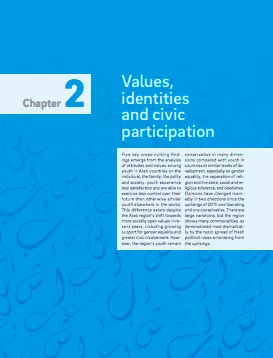
Five key cross-cutting findings emerge from the analysis of attitudes and values among youth in Arab countries on the individual, the family, the polity and society. Youth experience less satisfaction and are able to exercise less control over their future than otherwise similar youth elsewhere in the world. This difference exists despite the Arab region’s shift towards more socially open values in recent years, including growing support for gender equality and greater civic involvement. However, the region’s youth remain conservative in many dimensions compared with youth in countries at similar levels of development, especially on gender equality, the separation of religion and the state, social and religious tolerance, and obedience. Opinions have changed markedly in two directions since the uprisings of 2011: one liberating and one conservative. There are large variations, but the region shows many commonalities, as demonstrated most dramatically by the rapid spread of fresh political ideas emanating from the uprisings.

Want to Read More?
The full text of this publication is available via the original publication source.
For more information on this publication:
Belfer Communications Office
For Academic Citation:
Diwan, Ishac. “Chapter 2: Identities, Values and Civic Participation .” United Nations, December, 2016.
- Recommended
- In the Spotlight
- Most Viewed
Recommended
Book Chapter
- Oxford University Press
The Political Effects of Changing Public Opinion in Egypt: A Story of Revolution
Analysis & Opinions
- Project Syndicate
The Emancipation Gap in Arab Education
Analysis & Opinions
- Project Syndicate
Economic Growth After the Arab Spring
In the Spotlight
Most Viewed
Policy Brief
- Quarterly Journal: International Security
The Future of U.S. Nuclear Policy: The Case for No First Use
Discussion Paper
- Belfer Center for Science and International Affairs, Harvard Kennedy School
Why the United States Should Spread Democracy
Five key cross-cutting findings emerge from the analysis of attitudes and values among youth in Arab countries on the individual, the family, the polity and society. Youth experience less satisfaction and are able to exercise less control over their future than otherwise similar youth elsewhere in the world. This difference exists despite the Arab region’s shift towards more socially open values in recent years, including growing support for gender equality and greater civic involvement. However, the region’s youth remain conservative in many dimensions compared with youth in countries at similar levels of development, especially on gender equality, the separation of religion and the state, social and religious tolerance, and obedience. Opinions have changed markedly in two directions since the uprisings of 2011: one liberating and one conservative. There are large variations, but the region shows many commonalities, as demonstrated most dramatically by the rapid spread of fresh political ideas emanating from the uprisings.

Want to Read More?
The full text of this publication is available via the original publication source.- Recommended
- In the Spotlight
- Most Viewed
Recommended
Book Chapter - Oxford University Press
The Political Effects of Changing Public Opinion in Egypt: A Story of Revolution
Analysis & Opinions - Project Syndicate
The Emancipation Gap in Arab Education
Analysis & Opinions - Project Syndicate
Economic Growth After the Arab Spring
In the Spotlight
Most Viewed
Policy Brief - Quarterly Journal: International Security
The Future of U.S. Nuclear Policy: The Case for No First Use
Discussion Paper - Belfer Center for Science and International Affairs, Harvard Kennedy School
Why the United States Should Spread Democracy