Reports & Papers
Do Third-Party Frontier AI Evaluations Matter?
Analyzing publicly available evidence of company responses to evaluations.
Open Access
Research, ideas, and leadership for a more secure, peaceful world

Analyzing publicly available evidence of company responses to evaluations.
Government AI institutes and independent evaluators study frontier AI systems to identify, evaluate, and better understand potential risks. But do AI companies act on the risks identified by third parties? Here, we examine publicly documented company and policy responses to third-party evaluation findings of frontier AI systems. We identified 1,120 distinct findings about frontier models across 449 AI evaluation reports published by government institutes, academia, and evaluation organizations between March 2023 and August 2026. Of these, we classified 211 as adverse empirical findings concerning identifiable models or developers which may pose a credible safety hazard according to frontier developers' public safety frameworks. Among 179 findings that met predefined significant-risk criteria, 154 findings (86.0%) lacked a specific and proportionate publicly documented company response, which we define as a specific mitigation, such as a model change, new safeguard, or access restriction, publicly documented by the company with explicit attribution. Policy uptake was documented for 40 of 211 trackable findings, but only one case involved binding action. Collectively, the results suggest that, based on available information, there is limited public evidence that frontier AI developers consistently respond to risks discovered in third-party evaluations attributably and verifiably. Finally, we compare the accountability structures at third-party evaluation organizations with those of established oversight bodies in other industries, including food, drugs, energy, transportation, and finance. We conclude that formal mechanisms for access, response, remediation, verification, and follow-up inspired by governance in these other sectors could increase the consistency with which AI companies proportionately respond to risks identified in their systems.
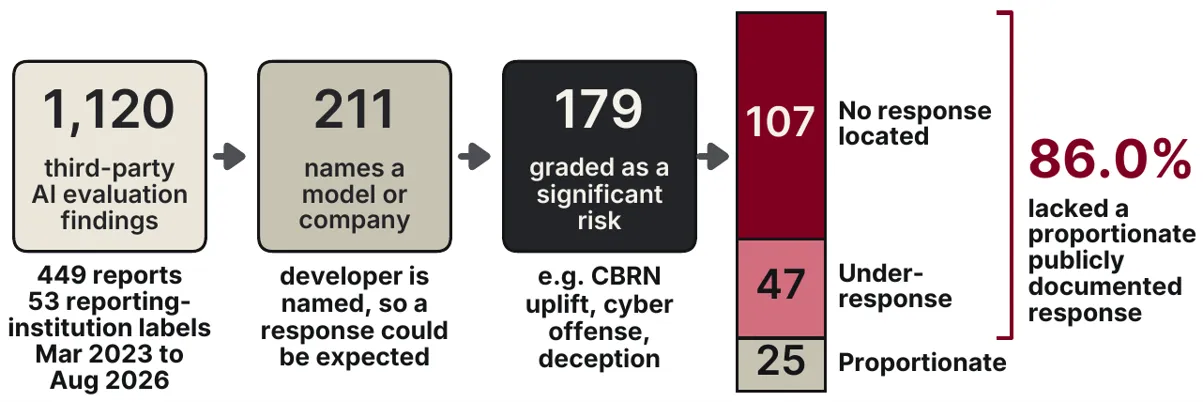
Table 1: Company-response outcomes for the 190 significant-risk findings. The first two rows make up the 80.0% shortfall. Section 3.5.4 and Table 4 define the proportionality criteria.
| Outcome | n (% of 179) | What it means |
|---|---|---|
| Accountability gap (no action) | 107 (59.8%) | No publicly documented company response was located. |
| Under-response | 47 (26.3%) | A public response was documented, but it fell below the required Action Level or lacked explicit attribution. |
| Proportionate | 25 (14.0%) | A specific, documented, and attributable response directed towards the risk mitigation. |
| Gap total (rows 1 and 2) | 154 (86.0%) | The central shortfall measured in this paper. |
Statements and views expressed in this commentary are solely those of the authors and do not imply endorsement by Harvard University, the Harvard Kennedy School, or the Belfer Center for Science and International Affairs.
Casper, Stephen, Kunal Singh and Max Kamachee. “Do Third-Party Frontier AI Evaluations Matter?.” November 18, 2026




From Intelligence Project