U.S. Marines hitting the beach on Iwo Jima, February 1945.
In strategy and statecraft, history is too often ignored or invoked superficially when making decisions. Scholars have sought to correct this tendency through what is often called applied history, which the Belfer Center’s project on the issue defines as the effort to “illuminate current challenges and choices by analyzing historical precedents and analogues.”1 A recent contribution to this area of research is the interdisciplinary scholar Francis Gavin’s 2025 book Thinking Historically, in which he argues that making better use of history for strategic decision-making requires two essential traits. The first is a historical sensibility, defined by an acceptance of and comfort with history’s incompleteness, uncertainty, and evolving revisions. The second is thinking historically, the ability to grasp the essence of a historical event or period. As Gavin succinctly puts it, “If historical sensibility is the temperament, then thinking historically is the practice.”2
As a military officer and National Security Fellow at the Harvard Kennedy School, I have wrestled with Gavin’s ideas alongside other frameworks presented by the historian Fredrik Logevall. In a recent discussion about his book, Gavin pointed to the U.S. military as an organization that often uses history effectively in its decision-making. Based on my experience leading organizations at the tactical and operational levels in support of strategic objectives, this observation felt intuitive to me, but it raises a larger question that warrants close examination. Militaries, including the U.S. armed forces, have certainly misused history and at times drawn the wrong lessons from it. Yet they have also long treated the study of the past as central to the development of strategic judgment. If the U.S. military generally uses history well in decision-making, why and how does it do so? And what useful tools or habits can others take away?
In this article, I argue that the U.S. military offers a useful model of applied history because it deliberately cultivates the habits of mind and institutional practices necessary to turn historical study into practical judgment. Historical thinking is, for military professionals, both a personal discipline and an organizational responsibility. We are expected to cultivate judgment through disciplined study of the past, mentorship, and reflection on historical cases. At the same time, the U.S. military embeds historical reasoning in doctrine, professional education, and planning processes that preserve organizational experience. These individual and institutional habits help make history a practical tool of judgment.
This article proceeds in three parts. First, I explore how military professionals develop the habits of mind associated with applied history at the individual level. Second, I turn to show how doctrine, professional military education, and institutional culture cultivate historical thinking across the force. Third, I offer recommendations for leaders and organizations seeking to strengthen their historical sensibility and capacity to think historically. The intent here is to highlight best practices that can help leaders and practitioners apply history more effectively in decision-making.
Developing the Individual Craft
Leadership development in the U.S. military has long emphasized the study and emulation of historical exemplars.3 For those in the profession of arms, Carl von Clausewitz is a familiar figure. His classic On War remains a foundational text, but what matters here is less his theory than his method. Before becoming a military theorist, Clausewitz was a historian with what the historian Peter Paret once described as an “undoctrinaire fascination with the past,” “skeptical of contemporary assumptions and theories.”4 He developed many of his theories “largely by way of historical study” and came to accept chance, uncertainty, and politics as central features of war.5 In this respect, Clausewitz embodies the characteristics that matter—and Gavin encourages—in a practitioner who can think historically: resisting convenient analogies and wrestling with the complexity of the past. This tradition carries forward in the U.S. military today through the sentiment that “History cannot tell us what to think. It teaches how to think.”6 Few scholar-practitioners match the discipline with which Clausewitz placed historical study at the center of professional judgment. His historical approach to the study of war continues to provide a model for the profession of arms to emulate.
Clausewitz, however, did not develop his ideas solely through self-study and personal experiences. He found a mentor in Gerhard von Scharnhorst, a soldier-scholar who reformed and oversaw the military education of Prussian officers at the start of the 19th century. Scharnhorst’s method of education rested on a foundation in military history and in the interdependence between theory and reality. Scharnhorst’s goal for his students was to develop analytical thought and imagination. As Army officer Bryan Jones describes in an essay on military mentorship, Scharnhorst’s central pedagogical focus was the use of historical study. “Scharnhorst believed every officer should possess a deep understanding of military history, for it would enable them to learn from past military experience and apply it to their present day.”7 Clausewitz gravitated toward Scharnhorst’s teachings, became one of his best students, and maintained a close relationship for the next decade, until his mentor’s death. Scharnhorst’s continued mentorship shaped Clausewitz’s thinking, fostering the intellect he displayed in On War.
A similar pattern appears in the American tradition through the career of Major General Fox Conner, an exemplar of the military mentor. A career soldier with experience as an instructor, commander, and staff officer to General John Pershing during World War I, Conner had a keen eye for identifying promising young officers and devoted time for their development. In the case of Dwight Eisenhower, Conner recruited him to serve on his staff for an assignment in Panama and placed him on a deliberate course of historical readings, writing, and self-study.8 Their mentor-mentee relationship lasted until Conner’s death in 1951. Eisenhower later called Conner “the ablest man I ever knew.”9
There is, of course, no way for Scharnhorst in the case of Clausewitz, or Conner in the case of Eisenhower, to know that their protégés would go on to achieve great feats. But as then as is now, mentorship is fundamental to improving the profession by transmitting the habits of judgment on which it depends. At its best, the mentor questions a junior officer’s ideas and assumptions, encouraging them to reflect and cultivate the historical sensibility and disciplined thinking required for success in the profession of arms. Junior officers, in turn, are exposed to various perspectives and histories, developing critical thinking skills early in their careers.
From these examples, a broader parallel emerges between how military professionals understand war and Gavin’s concepts of historical sensibility and thinking historically. Clausewitz distinguished between the enduring nature of war and its changing character. War, in his view, is always marked by danger, exertion, chance, and uncertainty, even if “its characteristics [adapt] to the given case” and “the events of every age must be judged in the light of its own peculiarities.”10 Contemporary military doctrine still reflects this distinction; for instance, U.S. doctrine asserts that “while the nature of war is immutable, its conduct and methodology continue to evolve.”11 A similar logic to the nature and character of war applies to history. A historical sensibility begins with an appreciation of the subject’s incompleteness, uncertainty, bias, and contradictions. In turn, thinking historically means recognizing the character of past events, contextualizing periods of time, and drawing out carefully useful lessons for the present.
The danger, in both history and the profession of arms, arises when these distinctions collapse. A soldier who dismisses the nature of war for its character risks chasing novelty while forgetting the fundamentals; conversely, the soldier who clings solely to enduring principles and past truths risks fighting the last war and overlooking new opportunities. Practitioners of applied history can make similar mistakes. Those who assume that a definitive understanding of the past is fully knowable may overlook uncertainty and competing perspectives, convincing themselves that the unprecedented has occurred. On the other hand, those who fail to discern the character of a particular moment will exclude important details or reach too quickly for a comforting analogy as a substitute for substantive analysis. The consequence of both is the misuse of history. Military professionals are trained to consider the relationship between the nature and character of their profession; when applied to history, that distinction offers a useful lens for judgment.
Building Historical Thinking at Scale
Having examined how military professionals approach individual study and development, it becomes clear that good judgment is often the product of collective effort at the organizational level. Effectively using history, therefore, is not only a requirement for senior decision makers but also for leaders and their teams at every level. The U.S. military does this by embedding historical thinking in doctrine and planning, encouraging professional education across all levels of the force, and investing in processes that help preserve organizational memory.
First, the U.S. military introduces its members early in their careers to a doctrine that provides common frameworks and theories on war, cultivating a historical sensibility and an ability to think historically across the force. Those shared conceptions help to define war as a political instrument and a human endeavor, with an enduring nature and ever-evolving character. The doctrine also places the enemy at the center of planning, encouraging empathy and sober assessments of capability and intent. From the platoon leader to the four-star general, this means that military professionals approach war through a common set of questions, concepts, and principles. In practice, these shared frameworks orient them toward the past as a guide for understanding present conditions and possible futures.12
Military planning turns this proclivity into a systematic process of inquiry. Joint Publication 5-0, for example, outlines a deliberate planning process for addressing assigned missions. This process starts with mission analysis, where the problem is defined and analyzed before developing options.13 Military planners identify and categorize the underlying facts, assumptions, limitations, and initial risks. Because information is often incomplete and interpretation uncertain, leaders across the force must continuously test facts and assumptions over time; for example, asking when a similar problem was faced before or whether the enemy has a history of acting in a certain way.14 These shared frameworks push military professionals toward the past to better understand the present and anticipate possible futures.
To guard against cognitive bias and groupthink, military planning also employs red teaming, placing military professionals at some distance from the detailed planning process in order to fully question its underlying logic and explore alternatives.15 The core question is simple: “Why do we think that?” Altogether, this helps to create a culture in which historical reasoning is not merely encouraged but expected in the development of plans and strategy.16
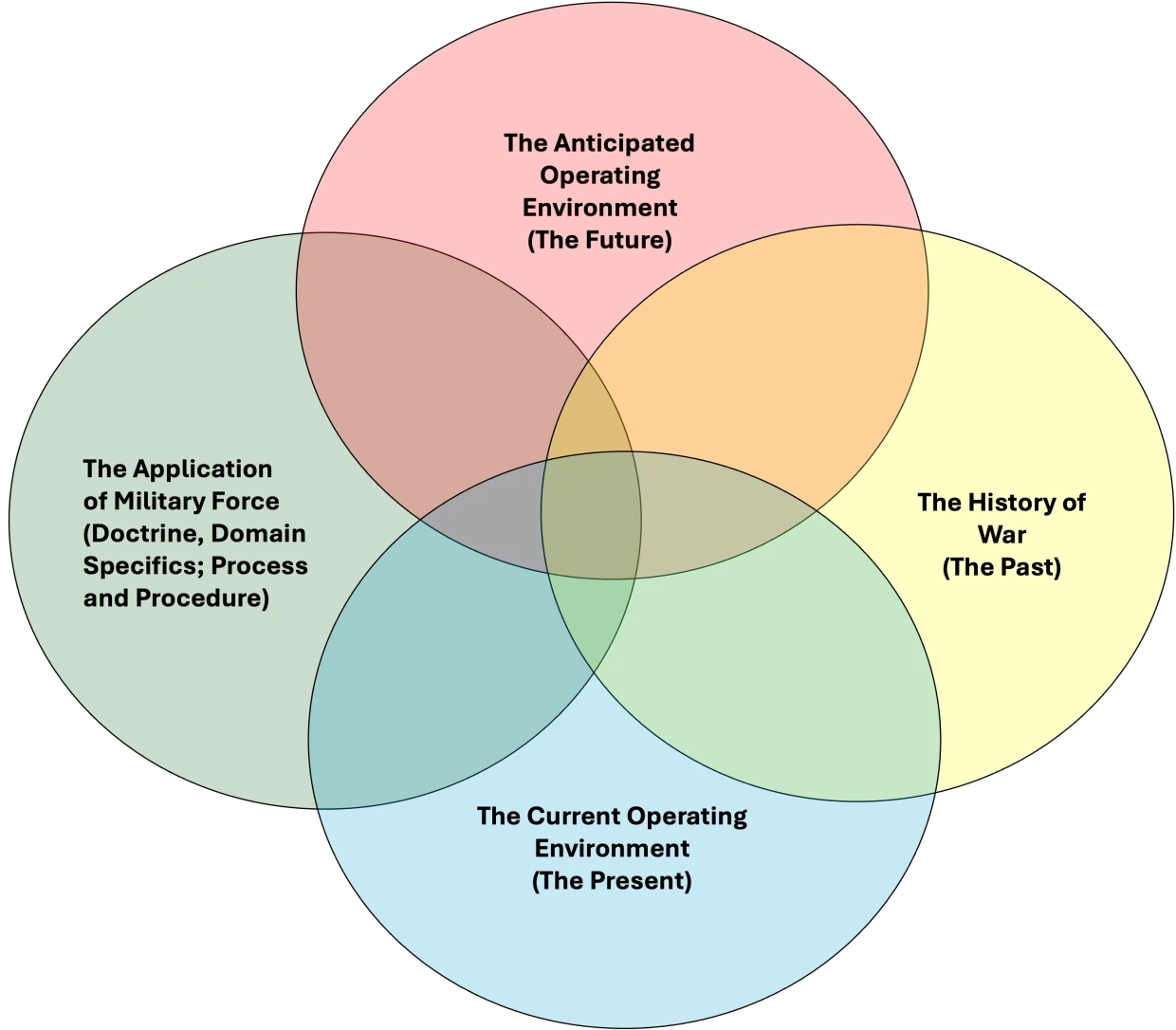
Second, the U.S. military places strong emphasis on the education of its members, much of which includes the deliberate self-study of the past. While the study of history is not novel for military professionals, what is distinctive is a culture that encourages the study of history from the rank of Private to General. This emphasis on lifelong learning helps develop a historical sensibility at scale. Self-study is expected; indeed, the Chairman of the Joint Chiefs and each military service treat self-improvement, including the study of history, as essential to developing leaders capable of joint-level warfighting.17 Further, service-published reading lists, professional journals, and an ecosystem of online educational resources provide opportunities for historical study, while the study of contemporary issues and future challenges provides a place to apply it.
Patrick Holland
Figure 1: A model of a self-study program for a military professional.
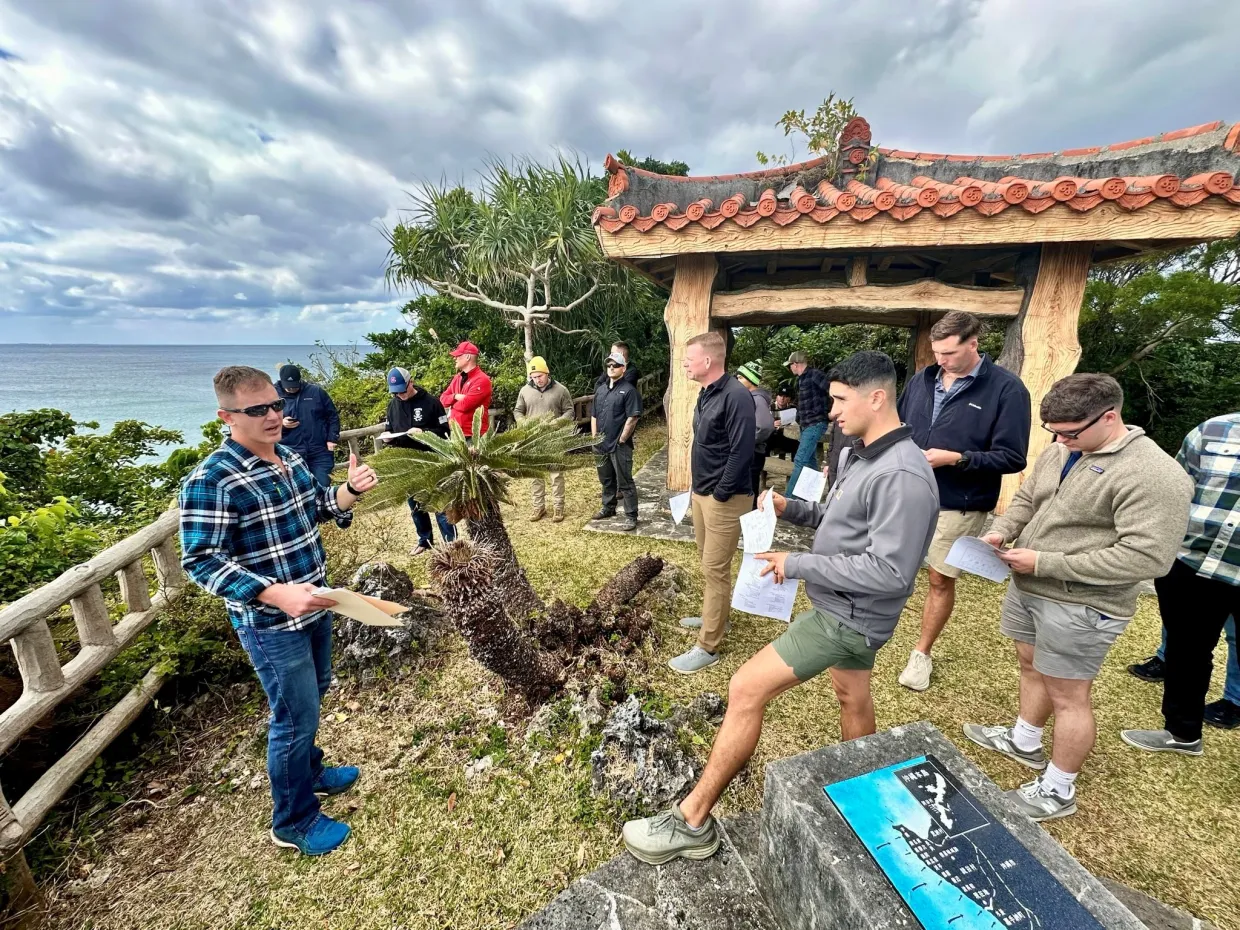
This commitment continues at the unit level, where commanders and leaders are expected to develop their subordinates through internally developed professional military education programs. Here, the study of relevant history remains central. A book assignment on a military campaign, followed by a focused discussion, allows leaders across a unit to reflect on their profession and draw out relevant lessons. Historical decision-forcing cases are also widely used, placing service members in the role of the decision maker and forcing them to wrestle with the relevant factors at hand before the historical outcome is revealed.18 When time and resources permit, units also sponsor battlefield visits. In these ‘staff rides,’ military professionals study a campaign or battle in detail and then ‘walk the ground’ to deepen their appreciation of the actors involved, the decisions they faced, and the circumstances in which they acted.
Patrick Holland
Image 1: U.S. Marines on a staff ride overlooking the landing beaches of Operation Iceberg, the amphibious invasion of Okinawa, Japan.
At the organizational level, formal education programs provide protected periods of study for military professionals over the course of their careers. These programs are progressive in nature: education for younger officers focuses on tactical and operational concerns, while senior officers attend programs centered on strategy and military integration with other parts of government.19 At each level, history remains a core component that helps officers contextualize and analyze today’s challenges. Each service also invests in more advanced formal education to sharpen the judgment of its most promising officers. These advanced schools represent the military’s most explicit commitment to history as judgment, preparing graduates for positions as strategic planners and advisors to senior decision-makers.20 In a profession characterized by persistent operational and training commitments and demanding sustainment requirements, time is still set aside for study. The cumulative effect is a cohort of leaders better able to wrestle with the complexity and uncertainty of the past as they address today’s challenges.
Third, the U.S. military relies on a set of processes that capture collective experience, give it coherent structure, and make it accessible across the force. Chief among them are After Action Reports (AARs) and a debrief culture that helps to anchor learning loops. Organizations of all sizes—from platoons to corps—generate AARs after training exercises, deployments, and combat operations. The explicit purpose is not to merely discuss what occurred, but to more critically capture what was learned. Organized by functional area or topic, these reports function as working histories, identifying noteworthy challenges, highlighting causal factors, and offering solutions for addressing similar circumstances in the future. Paired with the AAR is the debrief, an initial postmortem in which participants, regardless of rank or position, surface assumptions, clarify uncertainty, and identify coordination failures and mistakes. When done well, debriefs can be uncomfortable, but create a shared learning experience greater than any one participant’s view and generate lessons that later become part of the written record.
The U.S. military also curates and disseminates its experiences through service history departments and lessons learned centers. These institutions help preserve official organizational histories. More specifically, they collect primary evidence, preserve competing narratives, archive, and make histories, studies, and reports accessible for the entire force. This work helps create a space where military leaders and historians can conduct meaningful research and generate insight.
Recommendations
The effort to use history to make better judgments is not limited to heads of state or senior policymakers. As the discussion above suggests, several of the U.S. military’s most useful practices are transferable to a wider audience of leaders and organizations. The point here is not to militarize applied history, but to identify the conditions under which it can serve as an effective tool of judgment.
First and foremost, leadership matters. Leaders are responsible for creating an environment of historical inquiry. Organizations whose leaders emphasize understanding the nuances of the past create a climate in which their teams take history seriously. Leaders who think historically in this context ask open-ended questions: Has this occurred in our organization before? Why do we believe this to be true? Such questions direct an organization back to its own history and surface assumptions that might otherwise go untested. Because decision-making is largely leader-driven, leaders should also receive regular updates, ask follow-up questions, and hear competing perspectives. In the military, the commander is the decision-maker and is responsible for how the organization reasons toward a decision. The leader, who takes on responsibility for how an organization thinks, is transferable well beyond the military.
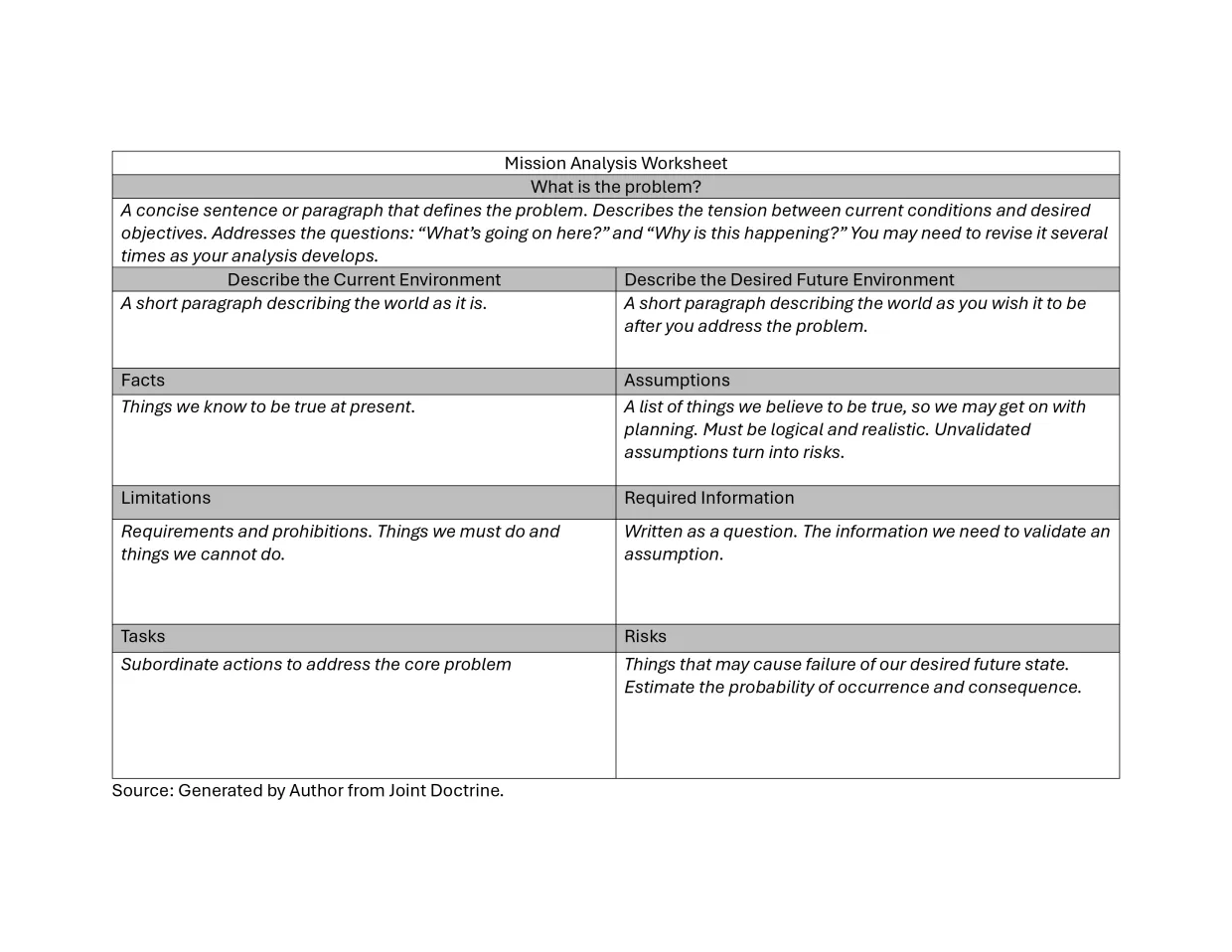
Organizations also need a deliberate process for approaching problems and making decisions. In the U.S. military, the start of this process is known as mission analysis. Its underlying goal—understanding the nature and character of a problem before developing options—applies more broadly. Core components of this framework, illustrated in Figure 2 below, include describing the current and desired future environment; identifying facts, assumptions, and limitations; generating questions to prove or disprove those assumptions; and identifying risks while assessing their likelihoods and consequences. This process is reinforced by the use of contrarians and devil’s advocates. As discussed earlier, the U.S. military uses red teaming to place a critical eye on an organization’s planning, assumptions, and options. Organizations of any size can employ a similar technique to question assumptions, expose flaws in logic, reveal bias, and test the plan.
Patrick Holland
Figure 2: Mission Analysis Worksheet.
Lastly, history becomes most useful when organizations both preserve experience and educate people to use it. The U.S. military is unusual in how it systematically records history through AARs, history departments, and centers for lessons learned. While not every organization is resourced enough to be so deliberate, any organization can still take steps to meaningfully record its own history. Long and exhaustive AARs are useful every once in a while. But shorter one- to two-page reports, when produced consistently, encourage broader contributions and are more likely to be read. Over time, such records can accumulate into a comprehensive organizational history that can guide future decisions and accelerate the learning of new members. Deliberate investments in education, mentorship, and self-study are also essential for developing judgment and critical thinking across a professional career. Not every organization can send its members to advanced external programs, but there are no barriers to building in-house educational opportunities. Creative leaders should develop case studies, curate professional reading lists, and organize events that promote thought and judgment outside one’s daily responsibilities.
Using history effectively to inform judgments is difficult, but well worth the effort. After all, the quality of those judgments will shape organizations and affect the people they serve. The point here is not to claim that military professionals always make the best use of history. It is instead to show how the U.S. military turns history into judgment at scale, and the suggestion of several practical recommendations that other leaders and organizations may take on. The stakes are high not only in war, but in all endeavors that affect the lives of the people we serve. Prudentia Prima Virtus. Good Luck!
The views in this article are those of the author and do not represent the policy of the Marine Corps, the Department of War, or the U.S. Government.
Holland, Patrick. “A Martial Approach to Applied History: How the U.S. Military Turns History into Judgment.” Belfer Center for Science and International Affairs, April 1, 2026
A Martial Approach to Applied History: How the U.S. Military Turns History into Judgment
Edward Cox, Grey Eminence: Fox Conner and the Art of Mentorship (Stillwater, OK: New Forums Press, 2011), 81-94.
Ibid. 94.
Carl von Clausewitz, On War, ed. and trans. Michael Howard and Peter Paret (Princeton, NJ: Princeton University Press, 1976), 89, 593.
Chairman of the Joint Chiefs of Staff, Joint Publication 1, Volume 1, Joint Warfighting (Washington, DC: Joint Chiefs of Staff, August 27, 2023), II-14.
Chairman of the Joint Chiefs of Staff, Joint Publication 1, Volume 1, Joint Warfighting (Washington, DC: Joint Chiefs of Staff, August 27, 2023); Director, Joint Force Development, Joint Publication 1, Volume 2, The Joint Force (Washington, DC: Joint Chiefs of Staff, n.d.).
It is important to note, though listed in seven steps, the military planning process is not linear. Early steps in the planning process, particularly Mission Analysis, are continuously revisited, revised, and updated. Chairman of the Joint Chiefs of Staff, Joint Publication 5-0: Joint Planning (Washington, DC: Joint Chiefs of Staff, July 1, 2025), IV-1.
An assumption provides “a supposition about the current situation or future course of events, presumed to be true based on an assessment of available facts.” Ibid., IV-15.
Ibid., Appendix G.
Ibid., J-1.
Chairman of the Joint Chiefs of Staff, Joint Publication 1, Volume 1, Joint Warfighting (Washington, DC: Joint Chiefs of Staff, August 27, 2023), VI-6; Department of the Army, Army Doctrinal Publication 6-22, Army Leadership and the Profession (Washington, DC: Department of the Army, July 31, 2019), 6-2; United States Marine Corps, Marine Corps Doctrinal Publication 1, Warfighting (Washington, DC: Department of the Navy, 1997), 3-13.
William M. Morgan, “A Case Can Be Made: The Value of Historical Case Studies to Contemporary Policy Analysis,” Marine Corps History 4, no. 1 (Summer 2018): 91–103.
Each military service has its own resident educational courses, including a respective War College for senior officers. The Chairman of the Joint Chiefs of Staff oversees the National Defense University and the associated National War College in Washington, D.C.
The Marine Corps’ School of Advanced Warfighting states its premise directly: “The study of military history develops the analytic mind of the officer… and facilitates the officer’s future decision-making efforts.” The U.S. Army’s School of Advanced Military Studies ensures graduates can “Integrate doctrine, history, theory and practice into war-winning solutions.” Marine Corps University, “School of Advanced Warfighting,” accessed March 21, 2026, https://www.usmcu.edu/SAW/; U.S. Army Command and General Staff College, “School of Advanced Military Studies (SAMS),” Army University, accessed March 21, 2026, https://www.army.edu/CGSC/SAMS/
Holland, Patrick. “A Martial Approach to Applied History: How the U.S. Military Turns History into Judgment.” Belfer Center for Science and International Affairs, April 1, 2026