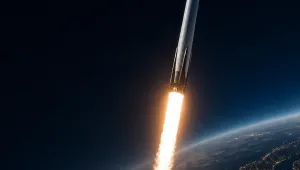
On April 10, the crew of Integrity splashed down in the Pacific Ocean, marking the end of the historic Artemis II mission—the first human mission to the moon since Apollo. Artemis II took three US astronauts and one Canadian farther from the Earth than humans have ever traveled before as they flew by the far side of the Moon. Just weeks before, on March 24, NASA Administrator Jared Isaacman announced a new $20 billion initiative to send US astronauts back to the lunar surface to establish a permanent lunar outpost. The initiative is intended to accelerate human moon landings and increase launch cadence with one clear goal: beat China back to the moon.
Unlike the United States’ first push to the moon with the Apollo Program, this time, the trip will be a partnership between government and commercial actors. A new space race has begun, but this one is not a sequel to the Cold War.
For most of the past seventy years, space activity followed a clear structure. The rules that governed behavior in orbit were created in the 1960s and 1970s when only governments could reach space and commercial satellites were rare. National space agencies led exploration. The United States, Russia, Japan, and the European Space Agency owned the big missions.
That world no longer exists. Private companies now launch more rockets than states, large parts of the global economy depend on satellite services, and a wider set of countries has advanced space programs. Yet, the key treaties that guide behavior in orbit have barely changed. The result is a crowded, commercially driven, and strategically tense environment that rests on an outdated legal foundation.
The 21st-century “space race” is a multipolar contest for economic, military, and scientific advantage, with ambitions that run from Mars missions to satellite mega-constellations and commercial exploration. At its core, the new space race is less about planting flags and more about who shapes the infrastructure and rules of space.
The most immediately visible symbol of this new contest is the Moon’s south pole, a region believed to contain significant water ice and other critical resources, including Helium-3. It has become a focal point of U.S.-China competition. But the new space race is not defined by the Moon alone. It is a broader, multipolar contest in which many states are pursuing their own missions, launch capabilities, military space assets, and satellite constellations. The race to the lunar south pole is best understood as the sharpest expression of a wider shift in how space is organized and used.
The stakes are high. Reaching strategic frontiers first, whether on the Moon or in Earth orbit, can confer scientific prestige, operational advantage, and influence over future access and resource use. More broadly, this new race, driven by commercial innovation, national security concerns, and shifting alliances, is already changing who can reach space, how operations are run, and how power is exercised in the space domain.
The Iran war has made the shift increasingly visible. Commercial satellite-imagery firms have restricted access to parts of the Middle East to prevent their data from being used tactically against allied forces, while U.S. commanders have said space and cyber forces were among the first movers in the campaign’s opening phase. Space is no longer just a backdrop to geopolitics. It is part of how wars are fought, seen, and managed in real time.
This explainer examines how the US arrived at this moment, why space matters strategically, who the major players are, and how cooperation and competition are evolving. The core argument is straightforward: the new space race for the US is not just about beating China to the Moon, it's about whether the US can and should maintain leadership when commercial companies have become as powerful as governments, and when a small body of rules governing space, such as the Outer Space Treaty, were written for an era that no longer exists.
History of the Space Race: From Sputnik to SpaceX
The industry has changed sharply over the past two decades. For the first half-century of spaceflight, access to space was a government monopoly. Only nations could afford the enormous costs and technical challenges. That monopoly has since shifted.
The First Space Race: Superpowers Only
The United States has not always been the global leader in space; the early years of the U.S. space program were dominated by Soviet successes with the US playing catch up. When the Soviet Union launched Sputnik 1 on October 4, 1957, a basketball-appsized satellite that did little more than broadcast a radio beep, it triggered a shock in the US. The Soviet Union had beaten the US to become the first nation to put a satellite in orbit and doing so during the height of Cold War tensions demonstrated technological capability with obvious military implications.
The "Sputnik crisis" reshaped American policy. Just a few months later, the U.S. launched Explorer 1, its answer to Sputnik, and established both NASA and the Defense Advanced Research Projects Agency (DARPA) for advanced research and innovation in space. The Soviet Union took the lead again in 1961 when Yuri Gagarin became the first human in orbit.
In response, President Kennedy’s “moonshot” set a crewed Moon landing and return as a national goal; less than a decade later Apollo 11 carried Neil Armstrong to the lunar surface, a milestone no other nation has matched. The Apollo program represented a massive national mobilization: it accounted for over 4 % of the federal budget in 1965 and directly or indirectly employed over 400,000 people across government, universities and other organizations. NASA is now trying to return astronauts to the Moon through the Artemis campaign, with significantly fewer resources—just 0.4% of the US federal budget. The first lunar landing now planned for Artemis IV is in early 2028.
The Shift: Selective Cooperation and Commercial Awakening
Even during the Cold War, space offered opportunities for cooperation. The Outer Space Treaty of 1967 established that space should be used for peaceful purposes. The Apollo–Soyuz docking in 1975 symbolized a thaw in superpower rivalry. This was later followed by the Shuttle–Mir program and eventually the International Space Station. Built over more than a decade by the United States, Russia, Europe, Japan, and Canada, the ISS has supported a continuous human presence in orbit since 2000.
However, by the late 20th century, government spending on the Space Shuttle and International Space Station Programs had increased significantly. When in 2003 the U.S. human spaceflight program was shattered by the loss of the Space Shuttle Columbia and her crew and the Space Shuttle was temporarily grounded, the US began to look seriously for commercial alternatives for access to space. In 2004, SpaceShipOne proved commercial human spaceflight was possible, winning the Ansari XPrize by successfully conducting repeated flights in a privately developed reusable spacecraft. In 2006, NASA accelerated the shift to commercial capabilities with the Commercial Orbital Transportation Services (COTS) program. Rather than telling companies what to build and how to build it, COTS funded private companies to deliver cargo and crew to the ISS through low earth orbit services and enabled the growth of companies like SpaceX. Just six years later, in 2012, SpaceX’s Dragon spacecraft became the first commercial vehicle to deliver cargo to the International Space Station
COTS accelerated the new commercial market for space launches, and in doing so significantly reduced launch costs. SpaceX’s Falcon 9, made reusable in 2015, made space accessible to a range of new customers. Even more important to US strategic interests, in 2020 after nearly a decade of reliance on the Russian Soyuz to send crews to the ISS, SpaceX restored the United States’ ability to launch its own astronauts with the Dragon vehicle. At the same time, Starlink, a SpaceX offering, began building a massive communication satellite constellation. Blue Origin, Rocket Lab, and Virgin Galactic added new commercial capabilities, while traditional space companies like Boeing, Lockheed Martin, and Northrop Grumman remained central to US government crewed missions and defense.
The Strategic Importance of Space
Space is no longer just a domain for science and exploration — it is critical infrastructure. Satellites underpin GPS navigation, global communications, financial network timing, and weather forecasting. They also support core military functions like surveillance, signals intelligence, missile warning, and precision strike. The loss or degradation of these systems would cascade across both the civilian economy and national defense.
That dual dependence has changed the strategic calculus. Commercial innovation has expanded access to capabilities once limited to major powers — broadband constellations, low-cost launch, and high-resolution imaging — allowing private firms to shape military planning, humanitarian response, and alliance dynamics in ways governments could not have anticipated two decades ago. Starlink's role in Ukraine is the clearest recent example: a commercial constellation became a decisive military communications asset, then a point of leverage and vulnerability.
The result is that space is a domain where civilian, commercial, and military activity are deeply entangled, and where the line between them is increasingly difficult to draw. As the number of countries and firms operating in space increase, the stakes for how space is governed rise with them.
Who are the major state players in global space today?
The first space race was a bipolar competition between the US and the Soviet Union. Today, the United States and China are the major rivals for space dominance, with Russia reduced to an important but junior role. Washington wields a unique mix of civil prestige, military dominance, and commercial capacity. Beijing counters with a tightly integrated state model that fuses exploration, defense, and industry. Moscow, weakened by sanctions and an extended war with Ukraine, leans on China for ongoing relevance.
While the European Space Agency (ESA), India, and Japan may not match the overall space capabilities or budgets of the United States and China, they each uniquely influence the global space landscape.
- The European Union and ESA have established themselves as regulators and standard setters, particularly through the General Data Protection Regulation (GDPR) impacting satellite data, the draft EU Space Act, and by developing the Galileo satellite navigation system, which serves civilian and governmental users worldwide as an alternative to the US-based GPS system. Additionally, ESA is a leader in climate monitoring via the Copernicus Earth Observation program, which provides critical data on global environmental change.
- India, through the Indian Space Research Organization (ISRO), has achieved significant milestones with highly cost-effective missions. Examples include the Mars Orbiter Mission (Mangalyaan) and the successful Chandrayaan-3 lunar lander, which demonstrated India’s growing technological sophistication. Most recently, in 2025, India successfully conducted an in-orbit docking demonstration, an advanced maneuver that had only previously been achieved by the U.S., China, and Russia, further underscoring ISRO’s increasing capabilities in space operations.
- Japan, through the Japan Aerospace Exploration Agency (JAXA), contributes leading-edge technology in space robotics and precision landings. Notably, JAXA’s Hayabusa2 mission returned material from asteroid Ryugu to Earth, and the Smart Lander for Investigating Moon (SLIM) demonstrated the most precise lunar landing to date.
Other emerging spacefaring nations are increasingly shaping the competitive landscape between the United States and China. Countries such as the United Arab Emirates, South Korea, Brazil, and Israel, among others, are each carving out increasingly influential roles by leveraging a combination of targeted investments, international partnerships, and progressive legal or regulatory frameworks. The UAE has made strategic investments in planetary exploration and science missions, while South Korea has ambitious plans for expanding its space program by advancing its technological capabilities and launching its own satellites. Brazil is expanding its regional launch infrastructure and fostering global collaborations. Luxembourg has carved out a distinctive role in space resources by pairing an early legal framework with commercial and research infrastructure. Its 2017 law made it the first European country to recognize rights over extracted space resources, and it has since backed that position through institutions such as ESRIC, a dedicated space-resources innovation centre. Collectively, these initiatives highlight a shift toward a multipolar contest, with nations competing and cooperating not just in technology, but also in pursuit of national prestige, commercial opportunities, and influence over emerging space markets.
How is space cooperation—and competition—evolving?
Private companies are now co-architects of space. The shift from government-dominated to commercially enabled space has created new capabilities and new points of vulnerability. SpaceX, Blue Origin, Sierra Space, and others no longer act only as contractors implementing U.S. government plans, but are designing constellations, vehicles, habitats, and services that shape global access to space. Governments increasingly depend on these firms, as seen in NASA’s reliance on commercial crew and cargo providers or Japan’s partnerships with iSpace for lunar missions. This diffusion of capability has blurred the line between public and private governance. Europe experienced this dependence when delays to its Ariane 6 rocket left it without a domestic launcher, leading agencies to buy flights on SpaceX’s Falcon 9 and showing how commercial capacity in one country can become the only path to orbit for another.
Commercial systems have come to play a direct role in terrestrial conflicts. In 2022, commercial satellites revealed Russian troop movements and supported Ukraine’s communications, even as outages and cyberattacks exposed system vulnerabilities. These functions were once reserved for states. Yet the treaty system that underpins space was written when commercial actors were marginal. As private access grows, gaps in that system are more exposed.
Emerging space technologies fielded by private companies will reshape the future of how we live and work in space. New capabilities are rapidly coming online like on-orbit satellite servicing, debris removal, in-space manufacturing, in situ resource extraction, mega-constellations, AI-driven spacecraft, and private space stations. These advances expand commercial potential and resilience but outpace governance, with fragmented licensing, unresolved property rights, and no binding global rules on servicing, debris, traffic, or long-term habitation.
Geopolitical blocs are emerging. The first space race was a two-nation race between the US and the Soviet Union. Today, both the United States and China are actively seeking allies to join their teams. The Artemis Accords, now signed by over 60 countries, promote U.S. principles for peaceful cooperation and lunar exploration. NASA’s Artemis program also rests on formal cooperation with partners including Europe, Japan, Canada, and the UAE. China and Russia are building support for their International Lunar Research Station (ILRS). Thailand and Senegal have hedged their bets by joining both the Artemis Accords and the ILRS. Similarly, ESA has partnered with both the US and China on space exploration.
Militarization is advancing. Space is central to modern defense, but it is increasingly shaped by emerging threats from adversarial nations. China reorganized its military space capabilities under a new force structure in 2015, and the United States established the Space Force in 2019. Today, we are in what was termed during the post-WWII arms race, “unmanaged competition,” where there are no restraints, framework, or enforcement mechanisms to constrain actors.
More broadly, these trends show up in how states test and demonstrate force in orbit. Both Russia and China have tested anti-satellite weapons: China’s 2007 test strike created more than 3,000 debris fragments that still endanger spacecraft, and Russia’s 2021 test added over 1,500 more fragments. The immediate danger was serious enough that the seven people aboard the ISS were told to shelter in their Crew Dragon and Soyuz vehicles for several hours. That matters because “shelter” in this context means getting into the station’s return spacecraft in case a strike forces an emergency evacuation, and because each debris-generating test adds long-lived fragments that can disrupt operations for years. NASA’s debris office reported that by late 2024 the ISS had carried out 41 collision-avoidance maneuvers since 1999. Beyond these kinetic threats, non-kinetic attacks are also frequent. The 2022 cyberattack on Viasat’s KA-SAT network caused communication outages in Ukraine and several EU member states, while European aviation authorities have reported a sharp rise in satellite system jamming and spoofing around conflict zones.
The Cold War-era UN framework no longer effectively governs today’s challenges. The 1967 Outer Space Treaty, once the bedrock for space governance, bans Weapons of Mass Destruction (WMDs) in orbit but is silent on ASATs, co-orbital threats, or cyberattacks. The UN has debated limits on space weapons for decades but talks remain stalled as major powers disagree on whether to pursue binding treaties or voluntary norms.
In civil space, norms and industry standards are filling some gaps, but they cannot match the speed of today’s activity. Satellites carry enormous strategic value for civilian infrastructure through GPS, weather tracking, communications, and timing for financial networks and other critical systems. Still, initiatives such as the U.N.’s Long-Term Sustainability Guidelines and voluntary rating systems encourage responsible behavior around emerging issues related to debris, warfare, and sustainability, but lack enforcement mechanisms. Recently, the EU and some of its member nations have begun to develop and pass laws that create more robust regulatory frameworks. In June 2025, the European Commission proposed the EU Space Act to create a harmonized Union-wide framework, while member states such as Italy have also passed national space laws. China has also tightened parts of its debris-mitigation and deorbiting rulebook. The US, in contrast, has made little progress toward reforming its fractured regulatory framework or promulgating new global norms. It has taken specific steps such as the FCC’s five-year deorbit rule, the Office of Space Commerce’s TraCSS civil space-traffic effort (who’s FY2027 funding may be in question), and a 2025 executive order aimed at streamlining commercial-space regulation, but the United States’ broader framework remains fragmented across multiple agencies.
Without binding rules, risks increase. Mega-constellations crowd orbits and raise collision chances. Satellites maneuvering near others create safety concerns and disputes over responsibility. Jamming and cyberattacks blur civilian and military systems. With no global traffic authority, data sharing is voluntary, leaving compliance to national rules and market pressure. In the absence of an accepted global framework, regulation defaults to varying national approaches and marketplace incentives. ESA’s Zero Debris Charter, the U.S. five-year deorbit rule for satellites, and early steps toward a civil space-traffic system point to practical standards that shape behavior even without binding international law. In short, cooperation persists through partnerships, accords, and voluntary standards, but military and commercial competition is intensifying without a robust governance framework.
Where will the space race lead?
In the near term, space governance will likely grow through national rules and voluntary norms rather than new treaties. The U.N. continues to set guidelines, but enforcement sits with states. In-situ resource extraction and use will test this model. The U.S., Luxembourg, Japan, and the UAE now recognize rights to extracted resources in their national laws. NASA staged small purchases of lunar regolith to build a legal record. A U.N. working group is debating whether a wider multilateral approach is needed. The 1979 Moon Agreement, which called lunar resources the “common heritage of mankind,” never gained support from major powers and failed to enter into force. The more likely path is states licensing commercial operators, backed by notice and coordination practices that have yet to be developed.
Permanent human presence on the lunar surface will sharpen questions of rivalry and cooperation. NASA’s Artemis campaign now places a low-Earth-orbit demonstration mission in Artemis III in 2027, with the first Artemis lunar landing shifted to Artemis IV in early 2028. China is planning its own lunar base by the mid-2030s. These projects will test how safety zones, data sharing, and resource activities are handled in practice.
Military planners are also adapting. The U.S. and its allies are integrating commercial services for communications and sensing into hybrid architectures. Norms against destructive anti-satellite tests are gaining support, but other behaviors—such as jamming, cyberattacks, and close approaches—remain outside binding law. Further, capabilities like on-orbit servicing are necessary for sustainable use of increasingly crowded orbits, but they are inherently dual use. If you can approach, capture, and repair a satellite, you can also disable it.
According to McKinsey, the space economy could triple to nearly $1.8 trillion by 2035. Broadband, launch, and data services will drive much of this growth. As a result, trade bodies and telecom regulators may end up shaping rules as much as space forums, and in some cases they already do. For instance, the ITU allocates spectrum and orbital slots.
Conclusion
The new space race is not a replay of the Cold War. It is faster, more crowded, and structurally different: commercial firms now hold capabilities that once belonged exclusively to states, a wider set of nations is fielding space programs, and their ambitions extend well beyond planting flags. The Moon's south pole, Mars, satellite mega-constellations, orbital data centers, and in-space resource extraction are all in play simultaneously.
What ties these contests together is a common problem: the rules governing space have not kept pace with the changing environment. The governance framework for space was built for a bipolar world of government actors and rare commercial satellites. It does not cover anti-satellite weapons beyond WMDs, does not address co-orbital threats or cyberattacks, and has no binding mechanisms for debris, traffic management, or resource extraction. The entities that shape the emerging norms will have long-term influence over how space is used, by whom, and on what terms.
The United States holds real advantages in the competition for leadership in space: an unmatched commercial sector, a broad alliance network, and the Artemis Accords as a foundation for building shared norms. Whether those advantages translate into durable leadership depends not just on who lands on the Moon first but on whether the U.S. can build a coherent, broadly accepted governance framework to match its technological and commercial reach. What comes next will depend on the ability of the international community to craft new rules, build trust, and ensure that space remains a domain for peaceful exploration and shared prosperity rather than unrestrained rivalry.