Event Summary
from Belfer Center for Science and International Affairs

Recent Developments in Energy and Nuclear Power in Japan

Video recording: 1 hour, 8 minutes

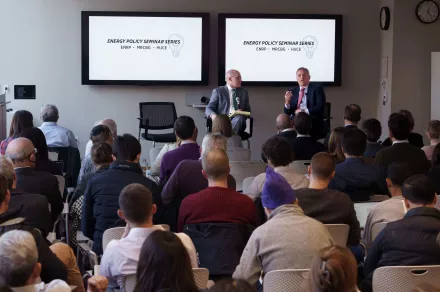
On October 19, 2026, the Belfer Center's Environment and Natural Resources Program hosted an Energy Policy Seminar exploring recent trends in Japan's energy policy. 

Moderated by Professor Joseph Aldy, speakers included Hisashi Yoshikawa, Project Professor of the Institute for Future Initiatives at the University of Tokyo, and Nobuo Tanaka, Executive Director Emeritus of the International Energy Agency.

Find the event recording and key discussion points below.

Nobuo Tanaka presents at a podium during a talk at Harvard Kennedy School on October 19, 2026.
Nobuo Tanaka, former Executive Director of the International Energy Agency, presents at a podium during a talk at Harvard Kennedy School on October 19, 2026.

Watch the Recording

Key Takeaways

  • Global events are pushing Japan toward becoming an "electro-state": Because Japan imports all of its gas and oil, it has been particularly hard-hit by shocks in global energy markets, including the COVID-19 pandemic, Russia's invasion of Ukraine, and the United States' war against Iran. Energy security concerns are accelerating electrification, but Japan still lags behind other Asian countries, particularly China.
  • Japan’s current energy policies are working against its decarbonization and energy security goals: 
    The conservative Takaichi administration has walked back many of the ambitious climate goals set out in the Suga administration's 6th Strategic Energy Plan, instead emphasizing economic competitiveness and the importance of a stable energy supply. Yoshikawa noted that the Takaichi administration continues to subsidize gasoline, perpetuating the country's dependence on imported fossil fuels. Tanaka asserted that the Japanese auto industry was too focused on the U.S. market due to historical inertia. As a result, by 2035 the electric vehicle share of new vehicle sales in Japan would be lower than than in all other countries except the United States, he said, citing an IEA forecast.
  • Japan’s nuclear industry is still struggling in the aftermath of Fukushima: Public acceptance of nuclear power remains very low. Citing the findings of a study group at the Canon Institute for Global Studies, Tanaka highlighted three conditions necessary to restore public confidence in nuclear power in Japan. First, the nuclear industry must improve its methods for managing radioactive waste, perhaps by processing fuel debris with pyroprocessing technology. Second, Japan must commit to international non-proliferation efforts by signing the Nuclear Weapon Ban Treaty and seeking permanent membership on the UN Security Council as a representative of non-weapon states. Third, the nuclear industry must double down on minimizing the risk of accidents, for example, by building smaller reactors or adopting passive safety design approaches. Tanaka was optimistic about small modular reactors because he sees in data centers the possibility of a dedicated market. 
Up Next