David Sanger:
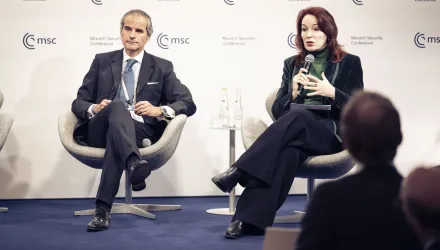
Thank you Meghan for that. And thank you for really remarkable leadership of the Belfer Center in these past couple of years. We have an incredibly invigorated program and it's largely due to Meghan's vision for how we can go explore many of these issues. And she's gathered really a great new collection of scholars mixed in with what was an existing terrific group. And then I do have one complaint, which is she brought me to this under false pretenses. She said, oh yeah, at lunchtime, why don't we just meet in the bar? She didn't tell me that everybody was coming up here and we were going to be leading a discussion.
So let me start if I can, in this discussion in middle powers with the Carney speech that Meghan referred to briefly, it was really remarkable in part because he was saying versions of what I think a lot of people in the audience had long felt, but were not willing to go out and say in public. And suddenly there was this delivery of and indictment of the existing system, but an indictment that the middle powers were living in a world of subordination. In fact, he said at one point, "you cannot live with the lie of mutual benefit through integration when integration becomes the source of your subordination."
So let me start first with Chrystia, who I'm delighted is here. And I was delighted actually when she left the FT to go into government because she could no longer beat us on stories, which was the most important thing from her life in the FT. But then she actually went on to prove that journalists can do other things. But I wanted to ask you first just to give us some guidance about why you think Mr. Carney did this at the time he did and what your read of the reaction has been and how it's flowed into this conference here.
Chrystia Freeland:
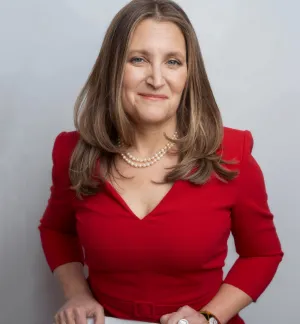
Okay, well thank you very much David and I am going to start by admitting my extreme bias. I am a proud Canadian. I'm wearing Canadian colors today on purpose, and I'm a proud team Carney fan. Mark actually is my son's godfather and I was really privileged to serve in two of his cabinets. So I think that what he has been doing leading Canada has been remarkable. And I think that speech was itself terrific, beautifully written, very powerful, but critically delivered at exactly the right moment. And David, the Kinsley definition of a gaff, it's when a politician makes the mistake of saying what he actually thinks. I guess this was an inverted Kinsley gaff. It was a politician having the courage to say what he actually thinks, what I think the vast majority of Canadians thinks, and I'm discovering what seems like the vast majority of the world thinks. And I think that made it incredibly powerful.
What I would also say is listening to Mark, as a Canadian, for us it very much is a piece of how Canada has always seen ourselves in the world. And sort of Meghan said, it's weird to think of us allies as middle powers. We've always thought of ourselves as a middle power. I felt that that Carney speech was very much in the tradition of a Lester B. Pearson. And at our best as Canadians, much of what I think we've done in the world has been acting in that space.
And I'll give you guys a specific example, which is the Lima Group on Venezuela. And that I think was an example of America and actually a Trump administration recognizing that a powerful way to lead was not being right at the center and letting the middle powers take the lead. So the Lima Group was something that was created during the first Trump administration. It was co-led by Peru and Canada. I was foreign minister at the time. And our objective was to support democracy in Venezuela and to support the democratic movement in Venezuela. And Mike Pompeo judged I think very correctly that it was better for us, the hemispheric partners to be taking the lead and that long-term would be more effective.
Final thing I'll say is, and maybe this is where I as a politician have a different perspective from the scholars here, but there can be a tendency for political scientists to talk about middle powers, to talk about great powers as though they are all created equal.
It's different for Canada, for sure a middle power, to have a relationship with a United States versus a China versus a Europe, and the EU, which I think is also a great power. Those are different relationships. The nature and degree of our own shared values and shared interests makes a difference. And that’s true among middle powers as well. I think the future of Canada, South Korea cooperation is going to be much more fruitful, much richer and much more impactful than Canadian cooperation with a Belarus. So I would kind of urge us to kind of break out of a notion that it’s just pieces on a chessboard. The nature of each piece makes a difference.
David Sanger:
Just one follow up side, you said timing made a difference. So tell us about the timing of this moment. The speech came almost exactly one year into the Trump presidency. It came at the moment that many countries were coming to the conclusion that just trying to keep your head down, wait out the Trump time wasn’t going to work. Was it a call for much of the world to push back or did he intend it more as a Canadian strategy?
Chrystia Freeland:
Okay, so I’m not a cabinet minister anymore and I’m not an MP anymore. This
David Sanger:
-Is why I knew I could ask!
Chrystia Freeland:
And that means I no longer have the responsibility for speaking for the prime Minister, but I'll speak for myself. I think you asked exactly, you made exactly the right point about the timing, my own judgment, and I'm now just speaking for Chrystia Freeland, not for Canada. My own judgment is we are at the moment where the great capitulation is ending. I think you're quite right, David, that there was a view taken at the beginning of the Trump Administration that the most effective strategy was just to try to get along and that involved a mixture of capitulation and flattery. And I think there was a hope that you could just kind of, in Canada we call it ragging the puck and that maybe you could do that for four years and you would be okay. I personally was never a big believer in that approach, mostly because of my own experience negotiating with Trump one.
And I think the mistakes of the great capitulation were actually an underestimation of President Trump. I think a lot of people, maybe particularly on the center left like to caricature him as not a very smart guy. There's all this notion of the angry toddler who's having a tantrum. And I think a lot of people felt both countries and companies that you could kind of outsmart him and sort of placate him in the way you might an angry child. I think that really underestimates him. I think that President Trump is a formidable leader and a formidable politician. You don't get elected president of the United States twice by accident. You don't remake the Republican party by accident and thinking you could kind of sweet talk him into doing what you wanted. I never thought was going to work. What I do think works actually, and I would turn here to the Chinese example, is an approach which is respectful, which is serious, which looks seriously at where are the shared interests, what can we do together that we actually want to do? Where and where is the leverage that can help me to get there?
And if you're thinking, wow, that kind of sounds like theoretical, but would it actually work with the actual Donald Trump? What I would say to people here is it worked in our NAFTA negotiation and I would say like the NAFTA negotiation, it was not easy. There were moments when Prime Minister Trudeau, I think it was Peter, it was either Peter Navarro or Kudlow who said there was a special place in hell for people like Justin Trudeau. Think about that for a minute. At one point President Trump said he didn't like their negotiator very much. That was me. So we had some rough times, but we got a deal. And at the end of the day, President Trump said It is the greatest deal ever. And it did. And by the way, it is a good deal and it's a deal that was supported by President Trump and by Nancy Pelosi.
And I would say the way we got that deal was by doing three things. First, we did identify areas of shared interest that Americans and the Trump Administration specifically cared about. This is a trade deal that actually supports high wages for manufacturing workers in North America for the first time in a trade deal. President Trump cares about that, we put it in. It's a deal that includes a common approach on China. He cares about it. We put it in, so find shared interest. Second, we recognize that we had leverage. And you guys, I hope, think Canada is a country full of nice people who are good at hockey and maybe have a tolerance for cold weather. But I bet you don't think of us as an economic be moth. But actually Canada is the largest export market for the United States. Canada is a larger export market for the US than China, Japan, the UK and France combined.
And when 232 tariffs were leveled on Canadian steel and aluminum, we retaliated a dollar for dollar retaliation. And there were rough moments, but ultimately it worked. And it worked because we had a market that mattered, but also we acted in coordination with Mexico and the EU. And then the third thing that we did, and here I think Prime Minister Carney's speech had a power that maybe was not expected by everyone, we employed something that we called a donut strategy. It was very conscious and the donut was that we talked to America, the hole was Washington and the donut was the rest of America. And we had a very conscious calculated strategy of reaching out to every single state of reaching out to governors, to mayors, to businesses, to trade unions. And it wasn't just the government, there was kind of like an obligation was put on all Canadians.
If you know an American, if you have an American client, if you have an American partner, if you have an American relative or an American friend, go and talk to them about why Canada is a great partner. Don't beat up on Canada, do a trade deal with Canada. And just to conclude, you asked me at the beginning, David, what was the impact of the speech? I think maybe the greatest impact and the most important impact for Canada was the impact in the United States. And look, this is a panel organized by an American institution. The Americans can say whether you think I'm right or not, but I think maybe it gave you guys a bit of a shake and it made you guys actually sort of say, what the heck, what have we done to make the Canadians be saying this? And I hope it will prompt some valuable reflection.
David Sanger:
Great, well speaking of valuable reflection on this. Ian, so you heard the speech, it was an interesting expression of where the Prime Minister thought countries should deal with the us, but it was sort of a strategy. And as you've written as Chrystia has said just now the middle powers are different. So is there emerging from this any kind of common strategy that you detect?
Ian Bremmer:
Not yet. But I agree it's a moment. It's an important moment. I think it's more of a moment for other countries than it is for the US.
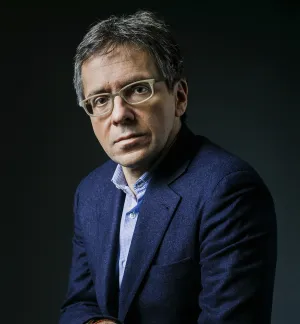
We're not very reflective. I want for the US to be more reflective—I don't see it Harvard, sure. But I mean this [panel] is not representative of the American population and there's a reason for that. Look, I think I would say in terms of reaction, and I agreed with almost everything you said, Chrystia, I will take it in a slightly different direction, which is first to have a strategy we need to unpack how much of what Mark and others are speaking to is structural and how much is actually about Trump. They're different things. Trump has many extraordinary qualities, and I mean that in a literal way. They are not ordinary. And one of them that is most dramatically different from other historic presidents is that he frequently represents himself on the global stage as opposed to the country.
That is not structural that will change when Trump goes. But it is the case now. And there are many countries in the world that have a very easy time doing that, many of them joined the Board of Peace for example, and there are others that did not. And middle powers to the extent that there is such a thing, we need to talk about are they countries that hedge or are they countries that care about the liberal international order, as Meghan put it? Because the latter group cannot and will not join with Trump when he represents himself on the global stage with staggering corruption, even in America's historical context, kleptocracy all of the rest. And that needs to be pushed back when Trump goes to Davos and says, I must have Greenland, and there is no national security negotiation because then they would've been talking to the Danes. It's purely his ego. And everyone in Europe and in Canada understands that it's about him personally. You can't engage with that. You have to hit back and you must do so collectively because otherwise he will become a predator and eat you.
There are other components of what is changing in the global order that is structural and that structural stuff is not going away when Trump leaves. That structural stuff is about the forever wars and is about the level of US commitment to collective security. That structural stuff is about the leadership and architecture on free trade. That structural stuff is about the willingness to commit to a certain level of openness and borders. That structural stuff is the willingness to promote democracy internationally. I think we've seen that has been coming for decades. Many of us have spoken about it and written about it including folks on the stage.
And that is a very different kind of response that is required. It is also a harder thing to respond to, but it is utterly urgent. And I think that both conversations need to be had, but they require different leadership, different formation, different levels of response, different urgency. And also there is different capacity to respond to the latter if you are in the economic sphere than if you are in the security sphere than if you're in the diplomatic sphere. The other thing I would say is in the same way that there are two different components of what the United States and Trump bring to the table here in the rupture. So two parts of rupture, but there's also different responses. So Chrystia, you said you think we've hit the tipping point on capitulation. I disagree. I think that Canada has hit the tipping point on capitulation. I agree with that.
This is not Justin Trudeau, right? No question. It's not 51st state. We're not talking about that anymore. China reached their tipping point on capitulation earlier last year. The Mexicans are full on capitulation, they're full on capitulation. They have decided they're part of USMCA, they've decided they don't have the leverage that the Canadians do. They don't have the options that Canadians do. And so therefore they are going to double down on everything the Americans want. And maybe even more than that. That is the TACO, FAFO scale. And there are a lot of countries that cannot afford, will not afford to push back to hit back. But one place I think that everyone needs to pay more attention. It's not just about how much we can hedge because let's face it, there's some limitations in being able to hedge even when you know it's the right thing.
The Europeans on defense, a whole bunch of countries economically, how much you can do, how much you're prepared to do your political cycle. Like Mark should be here. Mark should be giving a big speech that would help advance this. He can't. There was a big mass shooting, God forbid, in British Columbia. And so politics got in the way. That's going to happen a lot too. It's going to make life more difficult to do the things we need to have happen. Electoral cycles, weakness of the French leadership, the German leadership, the British leadership, all of these things are problems. But one thing we know is that the United States is not just acting unilaterally on a bunch of issues, it's also marching away from a lot of its own architecture. It's marching away from the UN. It's marching away from the world health organizations. It's marching away from the sustainable development goals from things that make the world better, better.
And I think that the Chinese understand why were the Chinese the first country to immediately say we're not joining board of peace. They understand they benefit from the vacuum, they understand that if they can be number one in the UN that's really good for China long term US polls out of World Health Organization, they get the Argentines to join them. China immediately says more money for the WHO. Well that's what the European should be doing is we're saying we are not going to seed these institutions to the Chinese. We have to do more with the institutions that matter. See, because we're not heading to World War III, right? This isn't about us versus China. This is about the United States pulling away from its own architecture and everyone else in the world saying, wait a second, we need a lot of that architecture. So that to me that should be core middle power strategy is how do we ensure that the stuff that the Americans are walking away from doesn't break. And that should be table stakes for this conversation in my view. So a few ideas.
David Sanger:
Oliver, let me turn to you now because we've heard the tipping point for Canada. Ian's just told us what the tipping point was for China, obviously no middle power there, but Brazil on which you have just written a really terrific piece for Belfer, that I recommend everybody here reads, finds itself in a really interesting spot here because it's seen the capitulation models, it's seen the pushback models, it's got a pretty good history dealing with President Trump. So tell us first what you think the Brazil strategy is, but then second, thinking about your Belfer essay, tell us a little bit about how we should think about the structure of different middle powers.
Oliver Stuenkel:
Sure. So first of all, I think from a resilient perspective that your action to Mark Carney was first of all that Brazil and several other countries in both Latin America and the Global South have basically been pursuing that for quite a long time. And a lot of the critiques, criticism of the rules-based order precede Trump of course, right? A lot of skepticism, unwillingness to commit fully to alliances in order to retain strategic autonomy throughout the early 2000s, the opposition to a free trade area of the Americas, precisely because this was the concern. I mean the reading is Mexico made a terrible mistake, thank God we didn't go Mexico because if we had gone Mexico you
Chrystia Freeland:
Mean free trade? Yeah.
Oliver Stuenkel:
Exactly. Because then our capacity to maintain our strategic autonomy now would be serially diminished. So a lot of people came back to me and say, see, I told you so because back in the day I said, why not do this? Right? Makes sense. So this thinking I think has been, is very deep seeded across South America. And the main reason why I think Brazil was able to stand up and take a fairly firm stance vis-a-vis tariffs was that it actually exports more to China than to Europe and the United States combined of course. Its economic exposure to the United States was much more limited and that now is of course seen as a crucial source of autonomy even though Brazil certainly doesn't want to depend on another great power. So Brazil is not part of the Belt and Road Initiative for example, because it doesn't want to depend on another power.
So the strategy right now is of course hedging on all fronts and we're having debates about avoiding that all the public data of our healthcare system is actually stored in Virginia right now. That is now beginning to be seen of course as a problem. So Trump has certainly emphasized the need to diversify, but it has been out there for a long time.
And the second issue about Carney, I think Trump is so disruptive and we're in the midst of this, I heard a couple of South American policy makers react initially to Carney and saying, he is becoming way too popular. This is like winning the Nobel Peace Prize right now. So I really hope that we'll see this as a case two years from now because it could be that he's shining way too bright for Trump, that Trump wants to go after him because you don't want to put Trump in the shadows. So that's I think some concern there.
But I think that from a middle power perspective, I mean Brazil of course a foreign policymaker in Brazil would not use the term because Brazil would see it as not sufficiently ambitious. Brazil secretly or not so secretly thinks of itself as more than that because there's a couple of other countries say now we don't want to be in a category with those countries. We do have regional ambitions even though other Latin American countries certainly do not see Brazil as a leader. But so I think there's a lot of variation there. But something I learned during this project talking to authors of other chapters was that the conversations right now are remarkably similar about hedging in the technology space, hedging in the defense space, investing in the domestic industrial defense space, hedging on commerce, and the tension that Ian, as you mentioned, how can we hedge and yet at the same time somehow preserve structures that until this point have depended on the United States.
And there of course I have a lot of concerns because when you look at global public goods, it's not like you have that many middle powers willing to pick up the tab. I mean both financially, also sending peacekeeping troops and things like that. I have a lot of doubts about whether this plan can somehow work out. I think there'll be a lot of cooperation on particular issues. So for example, Brazil is happy to work with the Europeans on standing up to big tech. It is on a very different page when it comes to Gaza for example. This I think will make it difficult to have a middle power coalition. But certainly on specific issues, I think there is some hope that this vision articulated by Carney can somehow be put in practice and have middle powers actually collaborate more in part because they're also in the process of getting to know each other more. So for example, if you look at Lula's foreign policy itinerary right now, it's like to Vietnam, it's to India. Basically, he's going through all these countries seeking the Mercosur, seeking to approve a free trade deal with Canada. So this is sort of happening, but I think it's important to also see the limits of that.
David Sanger:
So Oliver, I wanted to ask you a question. I want to ask this of Ivan as well. Who's been the most patient among our panelists here? I'm not from a middle power. You're
Chrystia Freeland:
From a great power, the EU.
David Sanger:
That's right. And so the question I wanted to ask Oliver and Ivan, you can jump right in on this too, is what we haven't discussed yet is China and the concept that China is a competitor for the middle power influence role here and that they would be the natural beneficiary should other countries join in the Canada strategy. Do you believe that? Do you see that within the Brazilian context? I'm going to ask you the same about Europe.
Oliver Stuenkel:
Yeah. So I think the Donroe doctrine is going to, and you alluded to that, is going to increase US influence in Mexico, in Central America and the Caribbeans because these countries have no wiggle room basically. So the Panamanian Supreme Court needed to kick out the Chinese from the Panama Canal because Panama is way too exposed. Now the next test is going to be Chancay, the port in Peru and the State Department just put out a note saying it's very concerned about the Peruvian supposedly losing their sovereignty because the Chinese are there. That's a different ball game because this is first of all South America, it's much less dependent on the United States. There will be pressure to repeat the Panama model. I don't think the Chinese will allow that to happen. I think that could actually imperil the truth that has been established between Washington and Beijing.
Now I do think that south of Venezuela, China is the big winner of the Donroe doctrine because even the most fervent anti-China diplomats and policy makers I've spoken to, they're like is clearly our relationship to powers other than the United States is helping us right now retain our autonomy vis-a-vis Washington. Now it also helps the Europeans also helps the Canadians, but I think the most intuitive winner of that in several countries is China because the whole rhetoric of "be careful with the Chinese", "this may be detrimental down the road" now of course rings hollow when that comes from a US policymaker.
David Sanger:
So Ivan, your thoughts on China and then your about whether Europe is indeed going to push back, capitulate something in between. What pattern do you see emerging?
Ivan Krastev:
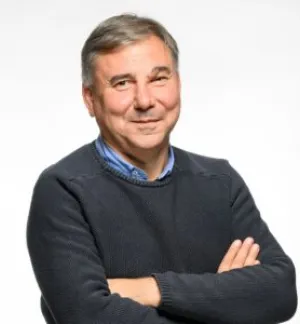
I'll start slightly different interpretation in my view of what Carney was doing because in a certain way he was not talking about the new order being established. He said it's rupture, not a transition. From this point of view, how we are going to adjust and manage a probably decade long period of disorder. So from this point of view, I don't believe that he's suggesting that middle powers can sustain the liberal order. I don't believe this. I don't believe he believes it too.
But then in a certain way the problem is how you can sustain it. And then he does two things, which in my view are really interesting because when we talk about rupturing, probably my metaphor is not going to be the most accelerating one. But what is happening now in the international relations, basically it was what dating apps did in the family life.
This is a rupture, this is a rupture. You are kind of a marrying in a different way. You're divorcing in a different way. There is opportunity, there is a lot of anxiety, and in certain way this is what a rupture is. A rupture is not simply shift of power. When he talk about 1989, for him it was not ruptured, it was a transition, In this certain type of a power relationship, somebody basically shifted, the institutions were there, and when you look at Carney, his major story is why the middle powers are not defending liberal orders. And then he said because it was hypocritical. So he sided with the non-Western powers in the way they were seeing the liberal order. And it's quite interesting because neither for Trump nor for Carney in this period of disorder there is West.
For him, the only way to do this is basically having a coalitions. And the second thing which was radical about Carney is he didn't say defend UN. He didn't say defend the World Trade Organization simply because he does not believe that we can do it. If the Americans decided to get out of it, he said, in order to be powerful, go also this type of ad hoc coalitions, show to the Americans that you have power, show to the Chinese that you have power. And then of course you are trying to defend these institutions, not basically telling how good they are, but basically making others, demanding them to do this and that. And here's the problem of Europe. Europe is in a way too big to be a medal power. But on the other side, Europe is lacking one of the major characteristics of the middle power at this moment.
And the problem of the middle power was that when they see this new world, they see much more opportunities than risks. Listen, not that they like it, but look at the Turks, look at the Indians, they see what they can gain out of it, by the way, quite often wrongly. But they believe they're hyperactive, they're doing this and that European Union is still very much preoccupied of what we are losing with the end of the liberal order. And to be honest, for good reasons. Because in a certain way European Union was very much anchored into liberal water as a political project. And I'm saying this because for the European Union, it's going to be a great middle power in making middle power is not just a characteristic objective characteristics, middle power is an attitude towards the world. What you decided to do, why you are doing this with, whom you're doing this?
And on your questions, are we going basically to resist? Are we going to capitulate? I say it's always going to be in between, but European Union is facing something that is much more difficult than anybody else. And this is keeping the unity. European Union is not a nation state. And from this point of view, the split, the crisis of the liberal order is a much bigger existential crisis for the European Union than for anybody else. And I believe people should have slightly understanding of this. This is why it was much easier for Carney to make this speech than for any European leader because when Carney is speaking, he's speaking to his voters and he knows that they're going to like the speech. When a European leader is speaking, he's speaking to 27 electoral cycles and at least some of them are not going to like the speech.
And this is why I do believe for Europe is going to be much more difficult. But of course Europe has a major advantage of size. And I'm just going to end on something very funny. If President Trump was going to be here, he was also going to the idea of the middle powers. But he's going to like the idea of the middle because his view of the world is that there is one power which is exceptionally powerful. This is the United States. And he also don't believe that he see order, but he see this disorder very much being organized around constant negotiations with other countries playing much more as a middle man, this is middle powers. You are using, for example, the Saudis to do something in the Middle East. You're going to use basically Europeans here and there. So the real story is do you want to be a middle power, which is hedging and trying to have a role of your own or do you want to be a middle man in a very much kind of a Trumpian world?
David Sanger:
Sure. Chrystia?
Chrystia Freeland:
I'd just like to make a few quick responses to actually a totally excellent conversation. I want to start with Ian and I'm going to give you a little add to begin. If people don't read Ian's weekly newsletter, I urge you to a lot of the things he said I read in his newsletter and I start my week with it. I may be one of the few people who would like you to punctuate to have capitals. Yeah, because of my you to punctuate like you capitalize just because of my own editor thing. But it's absolutely brilliant.
David Sanger:
It is a great read. I figured that the caps key just wasn't working on his computer. But no,
Chrystia Freeland:
But I just having said that, I wanted to say two very Canadian liberal politics. Quick points to Ian. One is just on Prime Minister Trudeau. Obviously I have had a complicated history with him, but I don't think it's fair to in any way describe him as having capitulated to the United States. And I think the entire time that he was prime Minister, including after the election of President Trump for the second time, I think Prime Minister Trudeau behaved really well. And actually he started to become much more popular in Canada because of the positions he was taking. So I want to defend his honor there.
And I agree with you, it's a real shame that Mark isn't here and I think he would be the dominant figure if he were here. But I also wouldn't dismiss his absence as kind of annoying politics. I think it's true leadership and we've had this huge trauma in Canada and I think Mark would've loved to be here. He loves this kind of stuff. He's really good at it and he's acting like a true leader in being with Canadians at a time of real pain. And why do I emphasize that?
Because I actually think it's very easy when you're in this kind of chess board, like political scientists talking to each other world, to feel like the democratic aspects of democracy are kind of annoying and kind of constrain you and mean you can't give the great speech at the right time. I would say the opposite. One of the reasons that Mark is able to be effective internationally is because he is forging a very strong bond with the Canadian people. And when he speaks here, it's not just a guy, it's actually a whole country. It makes it more complicated to be a democratic leader on an international stage, but if you do it right, it gives you a tremendous power.
And then I just want to respond to one thing that Oliver said about the middle powers, which I think is absolutely right, the limit even of what like-minded middle powers can do for each other. And to me, sure, we can do agreements with each other, we can do plurilateral deals, we can do statements about digital policy, we can have trade zones, all those things. And those are all good. But at the end of the day, if you're a middle power, you have to ask yourself, who's going to have my back if I get attacked, if something bad happens to my country, who's actually going to stand up and support me? And so far the only entity that has shown an ability to do that, not really the UN, not any of our great truly international institutions so far, it's only NATO that's been able to be an entity where if you're a member of it, actually you get actual protection.
David Sanger:
A really good point. Although many of the NATO members would say it's NATO with the United States in the middle of it, right? With the nuclear capability to it.
So Ian, I wanted to ask you two questions in the intro. Meghan made the very good point that there's a lot of definitional back and forth about what the middle powers are. I mean obviously we have treaty allies, we have middle powers that have considerable trade and economic capabilities. We have middle powers that don't. So in the spirit of your great newsletter in what I love about it is it does some really interesting rankings and thinking about the order of things. How would you rank or categorize the middle powers now as we sort of struggle with this definitional issue? And then I just wanted to ask you if you feel like you don't have the United States at the center of NATO anymore, that it will be relying on NATO for its own conventional defenses. Does the question that Chrystia asked us, who's got your back? How does that alter?
Ian Bremmer:
So I'm less concerned about the latter. I'm closer to Rutte than I am to Macron, broadly speaking on all things NATO, not stylistically. I don't think Rutte really does the organization favors long-term by acting as if he only has an audience of one. I don't think that's true, and I think Europe has shown a lot of capabilities. They also have leverage. There's zero chance that Trump is going to stop American defense companies from allowing them to sell to the Europeans, and that actually gives them a seat at the table that matters. And I think Rutte should talk more about that as opposed to just, oh, we need the Americans at the center, but that means that I'm less concerned about existential threat to NATO than some of the headlines.
The first question's a hard question, and I guess I'll start by taking off of what Ivan had to say, which is that there are countries that see this as a problem. There are others that see as an opportunity, but he focused on Europe in the first category. I would extend it. Canada's in the first category, of course it is. Oh my God. I mean look at Canada. All of their infrastructure goes to the United States. You would barely think they were a country if all you looked at was pipelines and railways, you would think, oh, they're just kind of an appendage. How do you fix that? The answer is slowly and over a long period of time, especially in a decentralized country, it's really hard. I think for Mexico. Mexico would be a middle power, but they can't be for the reasons that we talked about. I think Japan and South Korea and Australia, maybe not New Zealand, I would put all of them in that other camp. So hold on. Now we're talking about almost everyone that really is out there defending the Western quote liberal international order except for the United States, which isn't right now.
Is California middle power? Gavin Newsom says it is right on a couple things. They have capability. The donut strategy is super important because the reality is when we think about middle powers, it is a mistake to just have our traditional geopolitical hat on. The reality is that hedging for those that can help you on issues, especially when you can't be a middle power on everything, you can only be a middle power in certain themes in certain areas, whoever can help you. So some of that is American states, some of whom are here, some of that is going to be technology companies. I mean, Anthropic has a very different view of the world and of European model and governance than it does of the United States. X is rather different. If I were a middle power thinking about how to hedge, I would put myself very much in the former camp and not the latter.
The latter is actually exporting tools that destroy democracy. They're very dangerous to middle powers. Why did France go after them but not all of them. Why is Elon upset about that? That's super important. If JD becomes the leading candidate or if he essentially starts taking over big parts of policy, if Trump really implodes over the next couple of years, with a group of those tech companies around him, that kind of hedging for middle powers, for certain middle powers will matter a lot. But what about middle powers like the UAE that actually just sees transactionally? I can work with Trump as a commercial entity and his family. I was just talking to my friend Hina, the former Pakistani foreign minister was like, we're doing so well as Pakistan right now. Why? Well, because there are lots of ways that Pakistanis can directly buy off Trump. That's a very different middle power opportunity. So we'd have to think about these very, very differently. I know she didn't want me to say that, but then this is off the record, it's Chatham. So that's how I would begin to start to do that. And Ivan might have other ideas on top of that.
Ivan Krastev:
No, no. I very much agree that middle powers can be companies that start thinking like states and states that start thinking like companies and this is different than the other that we are talking about.