Policy Brief - PacNet Newsletter
The United States, China, and Nuclear Arms Control: Time for a Creative Spark
Pacific Forum CSIS
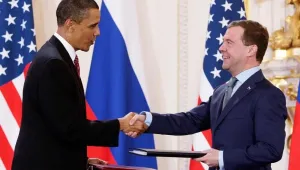
Earlier this summer, President Barack Obama gave a landmark speech in Berlin to reinvigorate a nuclear arms control agenda that has languished since the ratification of the New Strategic Arms Reduction Treaty (New START) in late 2010. If Obama puts his words into action, the next step will be a follow-on treaty between the United States and Russia. This new treaty would cap deployed strategic warheads at approximately 1,000, and could tackle weapons systems that have not been addressed before, including tactical nuclear weapons and missile defense, though there is thus far little agreement on scope.
While the United States and Russia have a responsibility to draw down their arsenals, these bilateral nuclear reductions will be increasingly difficult if other nuclear powers do not join in. President Vladimir Putin has expressed Russia's reluctance to participate in further reductions with the United States without the participation of other nuclear powers. To break the existing deadlock, it is time to engage the so-called "second tier" nuclear powers, especially China. The evolution of the US-China strategic relationship can affect the next stages of international arms control, even if China does not directly participate....
Download the entire policy brief here: http://csis.org/files/publication/Pac1363.pdf

Want to Read More?
The full text of this publication is available via the original publication source.
For more information on this publication:
Please contact
Managing the Atom
For Academic Citation:
de Koning, Philippe and Tong Zhao. "The United States, China, and Nuclear Arms Control: Time for a Creative Spark." PacNet Newsletter 63, August 8, 2013.
- Recommended
- In the Spotlight
- Most Viewed
Recommended
Journal Article
- Quarterly Journal: International Security
The Stopping Power of Norms: Saturation Bombing, Civilian Immunity, and U.S. Attitudes toward the Laws of War
Analysis & Opinions
- Foreign Policy
Is the Blob Really Blameless?
Journal Article
- CSS Policy Perspectives
Arms Control: For and By Europe
In the Spotlight
Most Viewed
Policy Brief
- Quarterly Journal: International Security
The Future of U.S. Nuclear Policy: The Case for No First Use
Discussion Paper
- Belfer Center for Science and International Affairs, Harvard Kennedy School
Why the United States Should Spread Democracy
Earlier this summer, President Barack Obama gave a landmark speech in Berlin to reinvigorate a nuclear arms control agenda that has languished since the ratification of the New Strategic Arms Reduction Treaty (New START) in late 2010. If Obama puts his words into action, the next step will be a follow-on treaty between the United States and Russia. This new treaty would cap deployed strategic warheads at approximately 1,000, and could tackle weapons systems that have not been addressed before, including tactical nuclear weapons and missile defense, though there is thus far little agreement on scope.
While the United States and Russia have a responsibility to draw down their arsenals, these bilateral nuclear reductions will be increasingly difficult if other nuclear powers do not join in. President Vladimir Putin has expressed Russia's reluctance to participate in further reductions with the United States without the participation of other nuclear powers. To break the existing deadlock, it is time to engage the so-called "second tier" nuclear powers, especially China. The evolution of the US-China strategic relationship can affect the next stages of international arms control, even if China does not directly participate....
Download the entire policy brief here: http://csis.org/files/publication/Pac1363.pdf

Want to Read More?
The full text of this publication is available via the original publication source.- Recommended
- In the Spotlight
- Most Viewed
Recommended
Journal Article - Quarterly Journal: International Security
The Stopping Power of Norms: Saturation Bombing, Civilian Immunity, and U.S. Attitudes toward the Laws of War
Analysis & Opinions - Foreign Policy
Is the Blob Really Blameless?
Journal Article - CSS Policy Perspectives
Arms Control: For and By Europe
In the Spotlight
Most Viewed
Policy Brief - Quarterly Journal: International Security
The Future of U.S. Nuclear Policy: The Case for No First Use
Discussion Paper - Belfer Center for Science and International Affairs, Harvard Kennedy School
Why the United States Should Spread Democracy