Debating U.S. Commitments to Taiwan
What a Shift from Strategic Ambiguity Would Require.
-
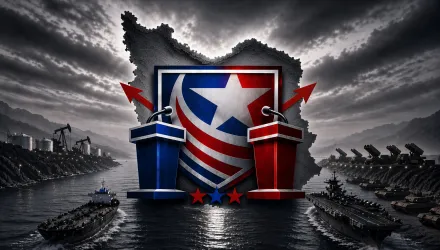
The Harvard Kennedy School Armed Forces Committee (AFC), in partnership with the Defense, Emerging Technology, and Strategy (DETS) Program, convened a closed-door, structured debate to surface candid, well-informed disagreement on a contentious national security question in a disciplined and respectful format. The session brought together two teams of Harvard students to examine the implications of a shift from Washington’s long-held “strategic ambiguity” policy.
The debate centered on the proposition: Should the United States make a public, advance commitment to the military defense of Taiwan if the People’s Republic of China (PRC) attempts to seize the island by force.
The pro team argued that the United States should commit to Taiwan’s military defense, while the against team argued that the United States should not, instead maintaining strategic ambiguity.Both teams quickly framed the discussion as a choice between a move toward strategic clarity of a defense commitment versus the strategic ambiguity status quo, setting the stage for four core themes that emerged over the course of the debate.
-
A multitude of interests arise for the prevention of an attack on Taiwan, including preservation of democracy, denial of Chinese regional hegemony, avoiding large-scale combat operations, global economic fallout, loss of access to semiconductors, human rights violations, or potential strikes on American assets. Strategic ambiguity allows the United States to refrain from tying interests to trigger conditions, which preserves the ability to similarly keep red lines undefined. However, participants argued this position risks undermining domestic cohesion and allied reactions to a Chinese invasion.
Confusion over which interests are paramount can produce hesitation, internal discord, and delayed signaling in a fast-moving crisis. A democracy-centered frame may not hold with American citizens unless paired with concrete stakes, like trade disruption, international credibility, and American casualties. For Indo-Pacific partners, democracy can be important, but they will align most reliably around preventing Chinese regional dominance and protecting their own safety. If strategic clarity is adopted, stakeholders need explicit acknowledgment of U.S. interests, which would enable opportunities for voters and allies to be aligned with the predetermined response.
-
Publicly specifying a commitment to defend may immediately result in uncertain reactions from Beijing, which could include gray-zone coercion, blockades, nuclear saber-rattling, or a kinetic response. Further, a spelled-out tripwire might also invite the PRC to test limits up into the threshold if no repercussions are stated.
A main benefit of strategic ambiguity is that it does not actively escalate in and of itself, but allows for proportional responses. However, since flexibility makes backing down easier, it leads to a weaker deterrence value and signaling to allies. Strategic clarity, on the other hand, may create escalation without leaving room for off-ramps. The removal of de-escalatory options can result when rejecting the flexibility to calibrate responses to different scenarios. This approach may bind Americans, not just currently, but into the foreseeable future, where the situation might be different.
Without knowing China’s exact response, a shift from the status quo is a gambit that can end with drastic action from the PRC. Even under strategic ambiguity, the U.S. can strengthen deterrence through accelerated arms sales, operational training, intelligence sharing, sanctions planning, and coalition diplomacy, while mitigating immediate risks of escalation. A mixed commitment approach might also be feasible, with ambiguous reactions to Chinese gray-zone operations or blockades, with a hard red line drawn on kinetic invasion.
-
Strategic ambiguity enables the U.S. to maintain flexibility on response triggers. Abandoning it will require specific, non-negotiable limits in place (i.e., boots on the ground vs. naval blockade). This red line, or multiple red lines with scaled responses, must be well thought out, intentional, clearly defined, and published. The responsibility to determine these definitions calls for precision from U.S. policymakers; if a blockade or cyberattacks cause mass loss of life over time without triggering the definitions laid out by the U.S., the red lines are ineffective. Red lines with predictable responses may allow China to plan accordingly, giving it the option to invade if it doubts the United States can enforce its own commitment to protect Taiwan.
Currently, uncertainty is the restraint, and clarity would add teeth to America’s security guarantee, further supporting deterrence effects. Ambiguity invites the testing of postures and misreading of intent, where vagueness could lead to a dangerous miscalculation. A commitment may allow for preparation without escalation, while pre-positioning in ambiguity can unintentionally trigger conflict.
The United States would need to determine how to formalize any pledge, including how it is enacted and whether it should be defined through a treaty rather than a public pledge. A treaty-based commitment can carry greater credibility, but it is not the only mechanism through which the U.S. has used force, as demonstrated by the 1999 intervention in Kosovo without a formal defense treaty. At the same time, the failure to enforce the 2012 Syrian chemical weapons red line underscores that declarations without follow-through can weaken credibility and invite future testing.
If the United States adopts red lines, it can develop them by forming coalitions, projecting force, planning economic sanctions, and gaining domestic popular support. Moreover, these stances may be attacked internally, possibly even by Chinese efforts in the United States.

-
Strategic ambiguity aims to deter China from unilaterally annexing Taiwan, but it also forces the Taiwanese government to invest in its own defense and adopt a delicate de-escalatory messaging strategy. A formal U.S. commitment may weaken Taiwan’s own incentives to invest in defensive capabilities. America’s shield can reduce restraints for Taiwanese citizens to push for a formal declaration of independence or a more aggressive tone from Taiwan toward China. Similarly, a U.S. guarantee could likewise harden Beijing’s posture by signaling that peaceful reunification is off the table, empowering hawks and reducing incentives for restraint. These effects all might increase the odds that China invades.
Taiwan must continue to invest in its own defense, regardless of whether Washington chooses clarity or ambiguity. It must also maintain the same disciplined, de-escalatory tone that preserves international sympathy and denies Beijing an easy pretext for coercion. The United States should pair any posture change with clear expectations: concrete defense reforms, asymmetric capability benchmarks, and messaging guardrails that reinforce deterrence without inviting recklessness.
-
These themes point to a central takeaway: the strategic ambiguity versus strategic clarity decision is about careful execution. If the United States wants to switch from strategic ambiguity, it has a lot of prerequisites to address beyond a public pledge. Any shift toward clarity would require defining specific contingencies and triggers (especially gray-zone and blockade scenarios), specifying what response is actually promised, while backing pledges with credible capabilities, allied role alignment, and domestic political durability. It would also need guardrails that limit Taiwan moral hazard by pairing stronger U.S. assurance with concrete defense-investment expectations and disciplined messaging. Conversely, maintaining ambiguity still demands disciplined signaling, sustained deterrence investments, coalition planning, and clear expectations for Taiwan’s defense posture and tone.
Special thanks to our moderator, National Security Fellow Nicole Tesoniero and our participants:
Haonan Tian
Pete Kirkendall
Sarah Zheng
Joe Chiang
Luke Bienstock
Disclaimer: All participants named above consented to having their names referenced in connection with this debate; names are listed for attribution only and do not indicate which team any individual was assigned to. Team assignments were made for the purposes of the exercise and may not reflect any participant’s personal views. These views are not endorsed by, nor representative of, Harvard University, Harvard Kennedy School, the Armed Forces Committee, or the Defense, Emerging Technology, and Strategy Program.
Workman, Caleb. “Debating U.S. Commitments to Taiwan: What a Shift from Strategic Ambiguity Would Require.” Belfer Center for Science and International Affairs, February 26, 2026
Debating U.S. Commitments to Taiwan: What a Shift from Strategic Ambiguity Would Require
Workman, Caleb. “Debating U.S. Commitments to Taiwan: What a Shift from Strategic Ambiguity Would Require.” Belfer Center for Science and International Affairs, February 26, 2026
Nicole Tesoniero
Caleb Workman
Nils Olsen
Debating the U.S. National AI Strategy: Is Privatized Acceleration Sufficient or a Risky Gambit?
From Defense, Emerging Technology, and Strategy