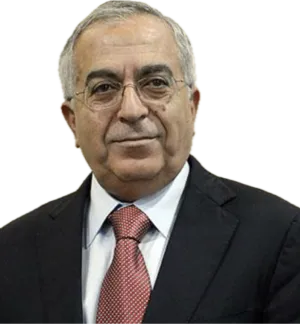
“How can one move from conflict management to conflict resolution?” This was the central question that a diverse group of 25 Harvard students explored over three sessions in a Middle East Initiative (MEI) study group led by MEI Senior Fellows Ambassador Edward Djerejian, former US Ambassador to Israel, and Dr. Salam Fayyad, former Prime Minister of the Palestinian Authority. Held during the Spring 2026 term, the study group was motivated by a core idea: that finding a lasting solution to the Israel-Palestine conflict is essential to secure peace and stability across the Middle East.
First Session: Palestinian Perspectives, with Dr. Fayyad
In the first session, Dr. Fayyad provided a Palestinian perspective on the way forward based on his extensive experience as prime minister of the Palestinian Authority. After providing an overview of the current political situation in Gaza and the West Bank, he focused the session on how the conflict can be resolved. Fayyad stressed the importance of Palestinian agency in building a strong state, arguing that the more robust a Palestinian state is perceived, the more likely Palestinian statehood will come to fruition.
One central tension throughout the study group was how to reconcile the long-term political horizon with the short-term practical steps needed to get there. While all negotiations require parties to agree on a shared vision of long-term peace, Fayyad encouraged the study group to focus on the first steps needed to reach this vision. For instance, if the end-goal is a two-state solution, the question should be: “What would it take for the Palestinian state to come into being?”
A key theme of this session was the idea of pluralism. Within the Palestinian context, the notion that different groups and beliefs can coexist within a shared power structure is often discouraged both by the international community and the Palestinian leadership itself. However, as long as the actors can agree on core principles, including in the security domain, Dr. Fayyad argued that embracing pluralism is the only way to achieve a lasting Palestinian coalition for peace.
As long as the actors can agree on core principles, including in the security domain, Dr. Fayyad argued that embracing pluralism is the only way to achieve a lasting Palestinian coalition for peace.
Second Session: Israeli Perspectives and US Perspectives, with Ambassador Djerejian
In the second session, Ambassador Djerejian provided an analysis of the conflict from an American diplomat's perspective. He began his presentation by emphasizing that the fundamental task of diplomacy is moving from “what is” to “what if”. To exemplify this process, Djerejian drew on lessons from past Arab-Israeli negotiations. In particular, he extolled the 1991 Madrid Peace Conference, facilitated under the leadership of President George H.W. Bush and Secretary of State James A. Baker III, as a positive example of American statecraft. The most challenging part of these negotiations was bringing the different parties to the table. However, by combining a deep understanding of each party’s interests with the strategic use of leverage, the United States succeeded in creating a political environment that left each actor with little choice but to enter negotiations. This exercise of “principled pragmatism” by the Bush Administration led to tangible results.
As for the “what is” in the Israeli-Palestinian context, Djerejian argued that the core issue is the lack of either side fully recognizing the self-determination of the other. Between the Jordan River and the Mediterranean Sea, there are approximately 7.2 million Israeli Jews and 7.2 million Palestinian Arabs living side by side. Neither group is going anywhere else. There can be no military solution to this conflict, only a political one. The ambassador further connected the Israeli-Palestinian conflict to the Iran war. The Hamas attack on Israel on October 7, 2023, and the Israeli military response, have led to an expanded war involving Lebanon, Syria, Iran, and the region as a whole. Without a clear “political horizon” that includes a resolution to the Palestinian issue, military successes that are not followed by political objectives focused on peace and security remain as purely tactical victories. Similarly, while Israel claims it has strengthened its military position since October 7th, it is open to question whether its citizens have become more secure in the absence of conflict resolution.
Finally, as for the “what if”, Ambassador Djerejian discussed the possibility of a “grand bargain” that simultaneously resolves the Israel-Palestinian conflict and addresses Iran’s regional influence. While the current situation might appear dire, history has shown that the most significant change often comes on the heels of the deepest crises. In order to capitalize on this moment, leadership change is needed in both Israel and Palestine, and the United States must exert more of its leverage while engaging with regional partners with an interest in ending the conflict, such as the Gulf Cooperation Council (GCC) states. According to the Ambassador, the Middle East is juxtaposed between actors who seek to advance their goals “by the sword” and those who seek to do so “by geoeconomics”. American foreign policy should firmly support the latter approach.
According to [Ambassador Djerejian], the Middle East is juxtaposed between actors who seek to advance their goals “by the sword” and those who seek to do so “by geoeconomics”. American foreign policy should firmly support the latter approach.
Third Session: Open Discussion on Possible Paths to Conflict Resolution
In the third and final session, study group participants debated four core questions, building on the discussion and reading material of the past two sessions.
First, “Is peace possible? If so, what are the options?” Participants emphasized the need for the US and international community to combine the usage of carrots and sticks to ensure that both actors perceive the status quo as untenable. On the Israeli side, the biggest carrot is further normalization with its Arab neighbors – an economic incentive that the US and Arab states should use wisely to achieve the desired policy change. As for options, the group discussed a range of possible scenarios: a one-state solution with equal rights, a one-state solution with unequal rights, confederal options between Palestine, Jordan, and Israel, and a two-state solution. Nearly all students favored the two-state solution; however, some argued for alternative solutions, such as a confederation.
Nearly all students favored the two-state solution; however, some argued for alternative solutions, such as a confederation.
Second, “What is required from the Israeli side? What is required from the Palestinian side?” For Israel, participants stressed that Israelis must believe peace will improve their security – a conviction that drove the peace efforts in the 90s, but one that has faltered after the Second Intifada and October 7th. Israel has shown in the past that it is willing to depart from land if it believes it will improve its security situation, such as the case of the Sinai Peninsula. Furthermore, participants identified government change, reform of military conscription laws, and a demilitarized Palestinian state as key conditions for any shift in the Israeli position. On the Palestinian side, leadership change, broad political consensus, and a sustained focus on economic development were seen as essential steps toward peace.
Third, “How has the Iran war changed the geopolitical landscape for possible conflict resolution?” In answering this question, participants envisioned the new security architecture bound to emerge after the Iran war and the role that regional actors such as Turkey, Syria, and the GCC countries will play within this. Furthermore, political leaders should focus attention on ongoing negotiations such as those between Israel and Lebanon.
Finally, “What is the role of the United States and the international community?” Participants highlighted how conflict resolution in the past usually has come through pressure by foreign governments. For instance, the Good Friday Agreement in Northern Ireland required sustained involvement from the United States, Ireland, and Britain; and Apartheid in South Africa ended only when international sanctions combined with domestic resistance made the status quo untenable. With growing sentiment against the Netanyahu government’s policies across the world, particularly in Europe and the Global South, political pressure from the international community may again come to play a crucial role in bringing actors to the negotiation table.
Conclusion
The study group allowed participants to grapple with a multitude of perspectives on how to arrive at a resolution of the Israel-Palestine conflict while learning from two distinguished public leaders with decades of experience working on the issue. While participants largely believed that a grand bargain could emerge from the current hostilities, several steps must be taken to achieve this: more forward-thinking leadership on all sides, a stronger Palestinian focus on governance and self-empowerment, an Israeli belief that security can again be achieved through diplomacy and geoeconomics, and a coherent U.S. strategy for the region as a whole.