Europe is facing its most dangerous security environment in decades. Russia has been utilizing a mix of gray zone tactics and open threats of military action to weaken NATO and assert a practical veto over its neighbors’ geopolitical alignments. Shifts in U.S. foreign policy priorities and alliance politics under the Trump administration make the scale and credibility of U.S. support less certain. Some European states have taken important steps to strengthen their security in response to these developments, but major shortfalls in readiness and capability still persist across the continent.
This report uses scenario-based analysis to assess the most dangerous Russian actions on NATO’s northeastern flank. More specifically, the analysis updates and examines two key contingencies: Russia escalating its gray zone activity to culminate in an incursion to seize a limited amount of territory, or a large-scale military offensive to isolate the Baltic states by seizing the Suwałki Gap. Both of these cases use publicly available information to map potential Russian actions, thus clarifying the assumptions and priorities summarized in the Key Judgments below.
Key Judgments:
Russian President Vladimir Putin’s core strategic objective is to fracture the NATO alliance. Moscow’s use of coercion and conflict in Europe reflects enduring drivers in Russian foreign policy, particularly a perceived need to shape the domestic and foreign policies of its neighbors. Russia today is unlikely to attempt, through conventional conquest, the full reconstitution of the former Soviet or imperial Russian space; instead, Moscow is more likely to seek to undermine confidence in the North Atlantic Treaty and peel off vulnerable states through separate diplomatic accommodations aligned with Putin’s worldview.
Within the next three years, Russia will likely escalate its ongoing gray zone campaign against NATO member states, culminating in a limited military incursion into NATO’s northeastern flank. Over the next three years, the Trump administration’s reliability as a member of NATO will likely continue to diminish. Perceiving a unique window of opportunity to fracture NATO’s security architecture, Russia will be more likely to pursue more limited operations rather than a full-scale conventional offensive, such as the invasion of Ukraine. This effort could culminate in Russia attempting to seize a small but symbolically significant area, such as regions in or around the Estonian border city of Narva, using unmarked forces and unmanned systems to obscure attribution and complicate NATO’s response.
A fast-moving Russian operation to seize a symbolically significant border area could result in a fait accompli before NATO can reach political consensus. Using unmarked troops and proxies equipped with new capabilities honed on the battlefields of Ukraine, Moscow could move quickly to outgun local forces and seize key nodes before leaders can mount meaningful resistance. Russia could then exploit the time required for NATO members to reach consensus on whether to invoke and operationalize an Article 5 response to consolidate control and fortify its positions. To reduce the risk of such a scenario, European states should intensify efforts to disrupt proxy, sabotage, and influence networks necessary for conducting such operations and ensure that local and quick reaction forces have the capabilities to decisively defeat such an incursion.
NATO member states should also plan to defend against a full-scale Russian conventional offensive in a brute force attempt to cut off the Baltics. In this more dangerous—and much less likely—case explored in the report, Russia could launch a large conventional assault to seize the Alliance’s only overland corridor into the Baltics, triggering a fast-moving, high-intensity conflict against the Alliance. This type of attack becomes more likely if Putin sees NATO’s unity as fragile, or if a large-scale conflict in another part of the world pulls Washington’s attention away from Europe.
European governments should plan and build forces for Baltic contingencies under conditions of reduced, delayed, or inconsistent U.S. support. Shifts in U.S. priorities and alliance politics, including acute disputes with European capitals over issues such as Greenlandic sovereignty, amplify doubts about the scale, speed, and reliability of U.S. intervention in a Baltic contingency. European capitals should thus avoid binary assumptions about U.S. involvement in any future conflict and create plans for situations in which American military support is delayed, limited, or withheld altogether.
Europe’s collective ability to deter or defeat aggression on NATO’s eastern flank will hinge on fielding critical indigenous capabilities and streamlining the political decision-making and policy processes necessary to employ them effectively. In both of the scenarios explored in this report, NATO member states would face constraints such as fragmented command arrangements, limited stockpiles, and political decision-making processes that require cross-national coordination. European states should therefore work together to build faster, more agile frameworks for multinational defense coordination. In addition, for European states to exercise full agency over their security, they must accelerate efforts to field critical capabilities indigenously, particularly in areas such as integrated air and missile defenses, logistics and sustainment, and counter-unmanned systems.
European security will hinge, in large part, on public resilience and underlying levels of political resolve. A crisis in the Baltics would immediately test European resolve, particularly if Russia combines massive force at the front with sabotage, hacking, and information operations in Europe’s rear. Accordingly, governments across the continent must make substantial investments in strategic communications, civil defense, and mobilization infrastructure. While the Baltics, Poland, and the Nordics have moved further and faster on many of these fundamentals, Europe’s broader readiness will depend on whether they are institutionalized across the continent.
With the rising prospect of war between great powers, the risks could not be greater for Europe. The 2022 Russian invasion of Ukraine shattered fundamental assumptions that had anchored the post–Cold War status quo: that authoritarian powers such as Russia could integrate into the West, that large-scale interstate wars were a relic of the past, and that peace on the continent was ironclad. At the same time, shifts in U.S. politics and foreign policy have introduced new uncertainty into the foundations of European security.1 Europe now faces a geopolitical environment increasingly shaped by competition, coercion, and conflict. Most urgently, Europe faces a determined geopolitical adversary that is trying to weaken NATO and the political solidarity behind European security, thus making it harder for neighboring states to resist coercion and enabling Moscow to shape their domestic politics and foreign policies.2
Across Europe, strategic competition is now frequently pursued through gray zone tactics, with militaries and intelligence services finding creative ways to confront adversaries below the threshold of overt conflict. On September 9, 2025, for example, Russia “accidentally” launched nearly two dozen drones into eastern Poland.3 This was soon followed by additional incidents across the continent, such as Russian fighter jets crossing into Estonian airspace, unexplained drone sightings over airports and military facilities, and suspected sabotage of critical infrastructure on land and at sea.4 These incidents, limited as they were on a case-by-case basis, were likely Russia’s way of poking at European defense vulnerabilities and unsettling NATO countries short of full-scale military conflict.
Since the end of the Second World War, Washington has supplied the bulk of NATO’s conventional and nuclear deterrent, underwritten by decades of bipartisan support in the U.S. Congress for maintaining American forces in Europe.5 Today, however, U.S. President Donald Trump has at times signaled a positive view of Russian President Vladimir Putin’s leadership and has repeatedly questioned the value of defending Europe, at one point telling reporters that he would “encourage them [Russia] to do whatever the hell they want” to NATO allies that fail to meet defense spending targets.6 His administration’s 2025 U.S. National Security Strategy ranks Europe below other regional priorities and warns of “civilizational erasure” driven in part by migration.7 According to The Wall Street Journal, the document casts Europe, not Russia, as the primary object of concern in U.S. security policy.8 Trump has also repeatedly threatened to take control of Greenland—warning that the United States would act “whether they like it or not”—an extraordinary signal that Washington is prepared to treat even allied sovereignty as negotiable in pursuit of perceived U.S. interests.9 And recent polling suggests that there is growing skepticism among some critical groups of Americans toward NATO; while a majority view the alliance favorably, a majority of Republicans now believe that the United States does not benefit from NATO membership.10
With Europe increasingly on the margins of U.S. strategy and foreign policy, individual governments on the continent—and the European Union itself—have adjusted and strengthened their approach to security. Over the past few years, Europe has launched the Permanent Structured Cooperation framework, introduced Security Action for Europe loans, and established the European Defence Fund.11 Individual states have ramped up defense spending and investment, also improving readiness and releasing new strategies to coordinate defense against Russia’s various threats.12 Yet these steps alone are insufficient to ensure that Europe can fully meet the challenges of the current moment. As one example, European defense budgets largely remain weighted towards personnel costs, constraining investment in the warfighting capacity needed to sustain large-scale, high-intensity operations—air power, reserves at scale, and enablers for sustainment, among others.13 In addition, European governments still struggle to coordinate rapid, cross-border responses to gray zone activity; for example, a European Commission report identified vulnerabilities to gray zone activity stemming from misaligned counterintelligence practices, legal authorities, and information-sharing arrangements.14
The limits of Europe’s indigenous defenses are most evident on its eastern flank. By many metrics, the Baltic states of Estonia, Latvia, and Lithuania occupy the Alliance’s most exposed strategic position; their lack of geographic buffer space for maneuver makes it more difficult to mount a defense in depth, and alliance members cannot readily reinforce them after any large-scale conflict breaks out. These states also symbolize the post–Cold War expansion of democracy, making them appealing targets for Russia to stress-test the North Atlantic Treaty’s collective defense clause. Europe must therefore be prepared—potentially with reduced, delayed, or inconsistent support from the United States—to confront some of the most dangerous contingencies on its eastern flank, including scenarios ranging from a covert ground incursion by unmarked Russian troops and local proxies, such as an attempt to seize Narva, to a larger conventional offensive aimed at severing the Suwałki Gap. (For the purposes of this report, the term “covert” is used in accordance with the U.S. Department of Defense definition to describe activities designed to permit deniability of state sponsorship, rather than to imply concealment.15) Either scenario would test NATO’s credibility and force the Alliance to confront the defining challenge of its existence: defending the sovereignty and territorial integrity of its member states.
Belfer Center
Map of the Baltic region showing Estonia, Latvia, and Lithuania, with surrounding countries, major cities, and the Baltic Sea labeled.
Europe’s Security Problem
Russia poses a significant military threat to Europe. Despite some claims that Moscow’s conventional military power has been “overstated,” Russian forces nearly reached Kyiv in the opening phase of the 2022 invasion of Ukraine.16 Moscow only failed to capture the capital at the start of the conflict because of Ukrainian resolve, Western military support and intelligence disclosures, and Russian operational failures.17 Ukraine’s survival since then has continued to depend on substantial external support, particularly through the provision of munitions and intelligence.18 Ukrainians have also paid an immense price in their fight against Putin’s regime. The country has suffered heavy casualties and lost over 100,000 square kilometers of territory, leaving over a million civilians in those areas under occupation.19 European states should not assume, by default, that they could replicate Ukraine’s performance under comparable pressure, nor should they regard such a grinding war of attrition as an optimal policy goal.20
Recent analysis from governments and think tanks has largely coalesced around a familiar, wide-ranging agenda for strengthening European security. One recent example is a Belfer Center task force report from February 2025, which contended that Europe must rebuild the conventional military mass, readiness, and key enablers it has long relied on the United States to provide.21 Doing so will require higher and better-targeted spending to close critical gaps in capability and to expand and modernize defense stockpiles.22 The European Commission has offered a similar diagnosis through the Readiness 2030 initiative’s accompanying white paper.23 It makes the case that the continent, as a whole, needs to pair higher levels of spending with changes that help governments work together and move faster on defense procurement and innovation.24
There is broad agreement that European militaries must strengthen their conventional military capabilities to conduct joint, multi-domain operations sans outdated assumptions about U.S. policy. Still, that agreement has not translated into a clear consensus, in part because European governments have largely not publicly articulated clearly defined scenarios or strategic risks to guide a collective approach to security. To address this gap, this report uses scenario-based analysis to update and examine two well-established contingencies on NATO’s eastern flank—one more plausible, one more dangerous—to inform defense planning. These cases are not meant as precise forecasts of future events; instead, they are intended to clarify assumptions about Russian objectives and the broader geopolitical environment, and to help identify the political, organizational, and capability constraints that affect Europe’s ability to defend itself. They thus provide a shared baseline for assessing allied interests, clarifying goals and objectives, and identifying priority concerns for European governments.
To exercise greater agency over their own security, European governments should collectively plan for defense under conditions of reduced, delayed, or inconsistent U.S. support. Doing so will require substantially greater investment, not just new capabilities, readiness, and stockpiles, but also in the defense industrial base needed to sustain prolonged operations and surge production in a conflict. Russia’s approach will likely center on gray zone escalation, at least initially, in an attempt to slow political consensus among the governments of NATO member states and establish effective control over new territory before the Alliance can respond. Europe’s ability to deter or defeat such actions will thus hinge largely on questions of policy and process: the agility and cohesion of multinational decision-making, intelligence sharing and attribution, military mobility and sustainment, cross-border operational authorities, and coordinated procurement and innovation. This must also be matched by government investments in societal resilience and efforts to sustain the domestic political resolve necessary to address these shortfalls and support a defense effort in any future crisis or conflict.
Following this introduction, Section Two outlines assumptions and illustrates two potential contingencies in the Baltic region. Section Three defines allied interests, goals, and objectives across both cases presented in the report. Section Four concludes with recommendations and priorities, highlighting political, organizational, and capability challenges that Europe must address to ensure deterrence and security in the years ahead.
Scenarios
Overview and Key Assumptions
This report’s analysis is organized around two scenarios on NATO’s eastern flank. One focuses on a more likely contingency of escalation, centered on a continuum of gray zone activities that could culminate in a limited, covert incursion to seize territory.25 The other depicts a more dangerous—albeit less likely—contingency, involving a large-scale Russian offensive to cut the Suwałki Gap.
These cases are intended to serve as reference points for assessing Russian objectives and capabilities. Indeed, in neither case would Moscow likely seek to dismantle NATO outright, an objective that likely falls far beyond the scope of any single operation. Russia would instead be more likely to pursue a limited incursion pursuant to the objective of fracturing NATO, an outcome that would advance its broader goals of discrediting the Alliance, weakening cohesion among member states, and peeling off vulnerable members into separate security arrangements reminiscent of Soviet and imperial Russian practice.26 A larger assault through the Suwałki Gap, an action far riskier and more escalatory, would likely seek to cut the Baltic states off from the rest of NATO and force submission through geographic isolation and brute force.
These scenarios are based on several critical assumptions. The first is that Moscow’s use of coercion and conflict against its neighbors, aimed at weakening and fracturing NATO and the broader Western coalition, reflects a broad continuity in Russian foreign policy. Russia’s behavior towards its neighbors reflects several enduring drivers, including longstanding concerns about geographic vulnerabilities, a self-conception of great-power status, and a desire to keep political control centralized for regime security.27 Accordingly, Russia has and will likely continue to seek to preserve a practical veto over its neighbors’ geopolitical alignments; create a buffer to block the spread of Western-backed democracy on its borders; and advance a nationalist vision of a “Greater Russia” in the near abroad.28 Far from changing course, the war in Ukraine has only strengthened these drivers. The conflict has created economic and ideological pressure for Russia to stay locked in security competition with the West. At the same time, Moscow has expanded military recruitment and sped up weapons production.29
The second assumption is that, notwithstanding the U.S. forward military presence on the continent, the United States may be unable or unwilling to intervene in Europe, or at least not to the extent traditionally expected.30 There are several pathways through which such a circumstance may materialize. One possibility is a large breakdown in the transatlantic relations, potentially driven by the Trump administration’s approach to alliance politics or disputes with European capitals over the status of Greenland.31 A second possibility is that a Russian limited incursion or large-scale offensive could emerge as a war of opportunism.32 At present, the international system is being strained by a growing constellation of interconnected conflicts and security competitions, from the Caribbean to the Middle East.33 If a large-scale interstate conflict in another part of the world were to curb Washington’s capacity to project power in Europe, Moscow could find an opening to move preventively against perceived threats on its periphery.34 In other words, Russian action against the Baltic states could occur as a new front in the next global war.
Third is the assumption that Moscow’s future risk tolerance will likely fall somewhere between its 2022 invasion of Ukraine and the more covert operations it has conducted in Europe since. Russia’s escalation towards full-scale war in Ukraine followed a gradual escalation of gray zone tactics—for example, its suspected involvement in poisoning Ukrainian political figures.35 Over time, these actions grew increasingly audacious, leading to Russia’s covert seizure of Crimea, proxy war in the Donbas, and 2022 full-scale invasion of Ukraine.36 But the war in Ukraine has exposed limits on Putin’s domestic political power, including the political costs of large-scale compulsory mobilization, which has pushed Moscow toward “covert mobilization” to contain public backlash, along with growing problems with elite loyalty and command cohesion, as highlighted by the Wagner mutiny.37 Still, over the course of the war, Moscow has expanded its military-industrial base to sustain prolonged conflict and continued to conduct gray zone activities across Europe, including cyberattacks, sabotage, the weaponization of migration, and targeted assassinations.38 Russia will likely pursue a middle course in the years ahead, more cautious than its 2022 invasion but still opportunistic, seeking a “Goldilocks zone” of aggression that allows it to incrementally erode European security without triggering a full-scale NATO counterattack.39
Putin’s Policy Process
From a Western perspective, it is tempting to mirror-image Russia’s national security process by portraying the Kremlin as analogous to institutions such as the U.S. White House. Such an understanding of Russian policymaking, however, is outdated. Based on what can be observed publicly, the Kremlin has become more of a ceremonial venue, with Putin conducting most of his day-to-day national security decision-making with a small team of security service insiders at places such as his Novo-Ogaryovo residence.40 Putin does not receive an integrated intelligence brief comparable to those used in Western capitals. Instead, he receives information and delivers orders to various ministries and agencies through disparate channels of communication.41
A fourth assumption is that Russia could build enough military capability to carry out a limited, covert ground operation fairly quickly. But reconstituting the capacity for a large conventional offensive would likely take approximately a decade after the cessation of large-scale operations in Ukraine. Indeed, the military analyst Michael Kofman argued in early 2025 that Moscow might regain the capacity for a smaller-scale incursion in as little as two to three years after the Ukraine war, with full-scale operations possible in seven to ten years.42 Other commentary has contended, however, that unless Kyiv fully capitulates, such projections overlook how Russia would remain constrained by the need to secure a long, hostile border against Ukrainian attempts to retake occupied territory and to suppress insurgency and unrest within those territories.43 Through a gray zone confrontation, Moscow would likely avoid a direct fight with NATO. It would likely aim to undermine confidence in Article 5 and exploit divisions within the Alliance, with the ultimate goal of peeling off vulnerable members into security arrangements in the Russian orbit. Even with limited time to rebuild, Moscow would retain important advantages. For example, Russia would be able to draw on units with recent combat experience and its large arsenal of unmanned systems, backed in part by outside help from countries such as North Korea.
Limited Incursion
Russia’s most plausible near-term course of action against NATO would be to continue escalating gray zone activities, culminating in a limited, covert ground incursion along the Alliance’s eastern flank. The point of such an incursion would be to raise uncomfortable questions inside NATO: whether a limited violation of territory, critical to some allies but less so to others, would be worth the risks of collective military action.44 As confidence in NATO weakens, some countries might then begin looking for their own deals with Moscow, starting small but growing over time as Russia presses to reshape the regional balance in its favor.
This approach would build on an already existing pattern of behavior.45 Russia could continue to probe European borders with unmanned aerial systems, unmanned surface vessels (USVs), and unmanned underwater vehicles, also sabotaging critical infrastructure such as undersea cables.46 On land, it could escalate the weaponization of migration through Belarus, which serves to amplify political polarization and strain governance in states such as Poland and Lithuania. Together, these actions could serve to stretch the defenses of NATO member states, amplify public concern among members of the Alliance, and gradually desensitize Western policymakers to persistent, low-level coercion.47
CSIS analysis
Bar chart showing the number of reported Russian-linked attacks in Europe from 2022 to 2025.
At some point, Russia might choose to raise the stakes by moving to seize a border city such as Narva with unmarked forces or proxies, gambling that it can seize symbolically significant ground while also keeping NATO divided and escalation manageable.48 Before anything else, Moscow would need to build a clear picture on the ground by carefully surveilling the area to build a picture of local security, infrastructure, and communications. In parallel, Moscow could quietly move equipment, supplies, and personnel into nearby staging areas. Russian intelligence services could also more aggressively fill the information space with foreign propaganda—for example, intensifying public condemnation of the “systemic repression” of Russian minorities in Latvia and Estonia.49
Belfer Center
Street-level map of Narva, Estonia, and Ivangorod, Russia, separated by the Narva River, with roads and rail lines shown.
To create a pretext for a “local rebellion,” Moscow could initiate the operation with a false-flag incident around the target area. Russian operatives might, for example, frame local security forces for attacking ethnic Russian residents.50 The kinetic phase of the operation would follow shortly after. Unmarked fighters and local proxies could then move to knock out electricity, disrupt communications, and interfere with navigation systems.51 Russian fighters could also seize critical nodes such as police and border guard stations, local government and communications centers, and armories or military depots. These attackers would likely present themselves as local insurgents rather than Russian forces.
To outgun any immediate government response, Russia would likely augment its unmarked forces with advanced military systems. Russian teams could, for example, launch unmanned aerial systems pre-positioned within the Baltics to conduct tactical surveillance and reconnaissance, as well as strike and interdict opposing forces.52 Fighters could move in civilian vehicles, complicating allied forces’ efforts to distinguish them from noncombatants, and could utilize electronic warfare and man-portable air defense systems. In a matter of hours, local authorities could be sidelined, communications knocked out, and major intersections taken over, leaving proxy forces free to patrol the city as a so-called people’s militia.
Once effective control is established, Moscow’s priority would be to consolidate its gains and deter or repel any immediate counterattack. In the first 24–48 hours after establishing effective control over the area of operations, the unmarked force would establish layered defenses, including checkpoints, roadblocks, and ambush positions along key approaches. Behind the scenes, additional unmarked personnel could filter in under the cover of darkness for reinforcement and resupply. Together, these measures could impede efforts by the host state’s military, police, and territorial defense forces from maneuvering into the area.
Moscow could then move quickly to frame the incursion as a grassroots uprising. Russian forces would likely install a puppet local authority, who would likely claim that “volunteers” in the town had risen against repression and appeal to Putin for protection. Concurrently, key ministers, senators, and deputies in Moscow would likely claim that Russia had a humanitarian responsibility to protect vulnerable ethnic minorities. These claims would then likely serve as a thinly veiled normative justification for a so-called humanitarian intervention. Under the banner of humanitarian assistance, Russia could roll in “aid” convoys that would actually resupply its forces and slip additional personnel into the area.53 Diplomatically, Moscow would insist that no Russian troops were involved in the initial operation while also calling for an immediate ceasefire, mediation, or even an international peacekeeping mission.
The “Little Green Men” Playbook
Unmarked Russian troops, later known as the “little green men,” led Russia’s effort to seize Crimea in the spring of 2014 with support from Russia’s conventional forces and intelligence services. At dawn on February 27, 2014, armed men seized the Crimean parliament, clearing the way for the installation of Sergey Aksyonov as prime minister.54 Elsewhere across the peninsula, additional units moved quickly to take control of government offices, communications, and transport routes.55 Aksyonov then publicly requested Russian protection, with the Federation Council officially authorizing the use of force.56
By early 2022, Ukraine had adjusted its defenses based on what it had learned from the events prior. Over time, reforms at home and help from Western partners made the Ukrainian military stronger, and in 2021, Kyiv created the country’s Territorial Defense Forces to safeguard key infrastructure.57 Meanwhile, the United States and its allies blunted Moscow’s plans by declassifying intelligence on false-flag operations in advance.58 When fighting eventually broke out, Ukrainian troops and security forces reacted quickly, securing critical points and preventing Russia from repeating the fast and unexpected takeover it had carried out in Crimea earlier.59
Under the auspices of protecting its humanitarian mission just across the border, Russia might then posture its forces in an attempt to deter an intervention by NATO member states.60 Moscow could place conventional Russian forces in Kaliningrad and western Russia on high alert, also readying long-range fires and air defense batteries to interdict or strike supporting military assets from NATO member states. For example, S-400 and S-300 surface-to-air missile batteries could deny allied warplanes access to Baltic airspace; K-300P Bastion-P missile systems armed with dual-capable supersonic cruise missiles could hold naval vessels and forward logistics hubs at risk; and Krasukha-4 electronic warfare systems could degrade allied radars and communications.61 The strategic logic would be to threaten vertical escalation while remaining below the threshold of open conflict, raising the perceived costs and risks of an allied counterattack, exposing the limits of Article 5, and fracturing NATO’s cohesion.
A Russian operation of this kind would almost certainly trigger Article 4 consultations among NATO member states. But such consultation would not guarantee the invocation of Article 5. The Alliance can do so only by consensus, after all members agree that an incident constitutes an “armed attack.” Even then, Article 5 leaves the nature and scope of any response to each ally’s judgment.62 If unmarked forces and proxies moved very quickly, securing control of a small area before local authorities could mount meaningful resistance, Moscow could seek to exploit the time required for Allies to reach political agreement on the invocation of Article 5.
Seizing the Gap
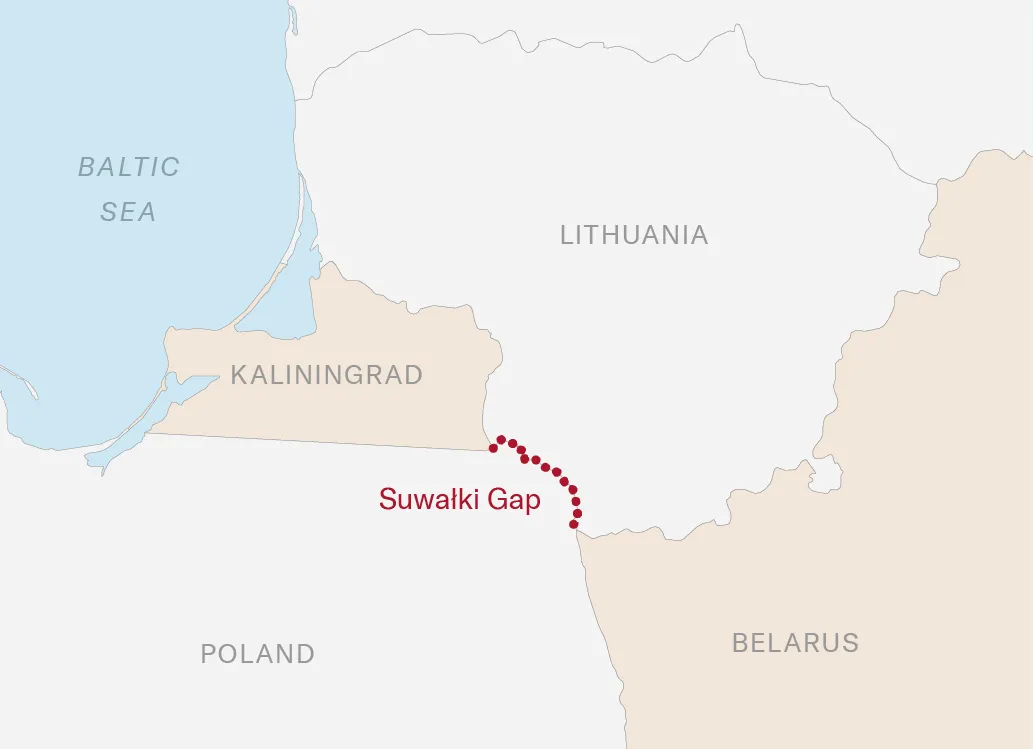
Moscow could instead launch an overt military attack against NATO’s eastern flank, after an initial covert effort collapsed or by design from the beginning. Among all such possibilities, a dangerous—and, though less likely, still plausible—scenario would be a large-scale Russian offensive. Such an aggressive option becomes more conceivable if, for example, the war in Ukraine stabilized on terms favorable to Moscow, if Putin judged NATO’s political cohesion and U.S. resolve in Europe to be brittle, or if Moscow had an increased ability to mobilize and employ conscripts on a large scale. In that context, the Kremlin might launch a major military operation aimed at isolating the Baltic states, most notably by severing or effectively closing the Suwałki Gap linking Poland and Lithuania. (Indeed, this scenario conflicts with the report’s earlier assumption that Russia is less likely to pursue high-risk actions after its failures in Ukraine. It is also conceivable that Moscow could seek to isolate the Baltics by concentrating offensive operations from Belarus through Lithuania, rather than pushing through Poland directly or striking more broadly across Europe, in an attempt to keep the political focus initially on Lithuania, Latvia, and Estonia.)
Belfer Center
Map highlighting the Suwałki Gap between Poland and Lithuania, bordered by Kaliningrad and Belarus.
Even if Moscow planned such an assault from the outset, it would almost certainly begin by employing some of the lower-intensity gray zone tactics described earlier in an attempt to shape perceptions and disrupt infrastructure, logistics, and governance.63 These measures, combined with the massing of forces, would likely provide a clear signal of an impending invasion. The run-up to Russia’s 2022 invasion of Ukraine is a reminder, however, that warning and visibility do not automatically translate into timely, decisive decisions collectively made by relevant stakeholders. Russia’s troop buildup in Russia and Belarus, framed at the time around the Zapad 2021 military exercise, was clearly visible to outside observers, with American and British officials publicly declassifying intelligence weeks in advance and many militaries preparing accordingly. Yet several European capitals still chose a convenient interpretation of the buildup as coercive signaling until it was too late.64 As Richard K. Betts puts it, “miscalculation and sluggishness in political decisions are more the sources of surprise than lack of information.”65
If allied leaders failed to treat intelligence indicators as a legitimate warning or hesitated to coordinate defense planning, and if Belarus were compelled to serve as a staging ground, Russia could initiate a rapid military assault in the area, seeking to achieve surprise at the outset. During the opening hours of a Suwałki offensive, Russian forces would likely strike military targets across Europe to paralyze allied command, control, and communications.66 Western-style militaries often utilize interconnected communications and navigation systems to coordinate among sensors, shooters, and commanders. Accordingly, Russia would almost certainly use electronic warfare systems in an attempt to blind allied military sensors and sever communications links, while also utilizing long-range fires—including Iskander short-range ballistic missiles or Kh-101 cruise missiles fired from Kaliningrad—to target critical nodes outside of the immediate area of operations.67 Integrated air defenses and electronic warfare systems based in Kaliningrad and Belarus would further complicate NATO efforts to operate in the air domain over the Baltic region.68
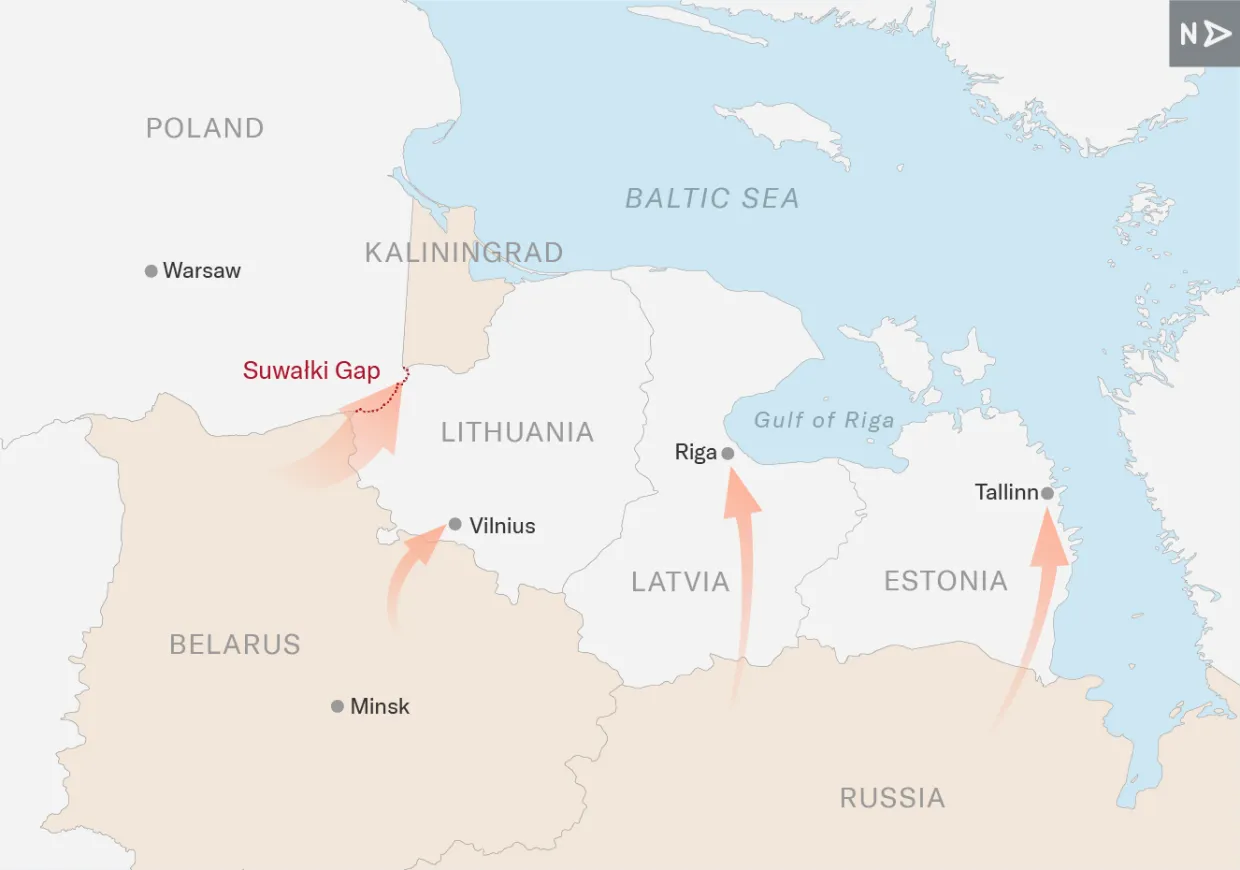
Russian forces might then launch a rapid, two-pronged mechanized thrust into the Suwałki Gap.69 To squeeze the corridor from both directions, Russian forces could push in from Belarus in the east, planning to link up with a smaller, complementary advance launched from Kaliningrad in the west. Division-level formations—combining tanks, infantry fighting vehicles, self-propelled artillery, tactical air defenses, and unmanned systems—would spearhead this assault.70 The advance would likely follow major roads and cut straight across the region’s open farmland, where there are few natural areas for cover. From the air, Russia might insert paratroopers and special operations forces to sever avenues of retreat and block the main routes by which Western reinforcements would arrive. The goal would likely be to overrun the roughly 65-kilometer corridor in a matter of days; after all, during the opening phase of the 2022 invasion of Ukraine, Russian forces advanced well over 100 kilometers along major road routes toward Kyiv.71
The twin thrusts of the Russian advance could link up somewhere along Expressway S61 inside Polish territory, creating a land bridge between the Kaliningrad exclave and Belarus.72 Once the corridor was secured, Russian forces would quickly consolidate by entrenching defensive positions, emplacing mines and obstacles, and extending air defense and fires coverage over the new front. From there, Moscow could push deeper into the Baltic states. Russian forces could move on parallel lines toward Tallinn and the Gulf of Riga, pushing toward urban centers—including Rēzekne in Latvia, Marijampolė in Lithuania, and the Lithuanian capital of Vilnius—each located within roughly 60 kilometers of Russian or Belarusian borders.73 In parallel, Moscow could widen the fight against NATO farther west, employing systems such as Kinzhal ballistic missiles and Kalibr cruise missiles to attack targets from Germany to the United Kingdom.74 For the war at sea, Russia could employ anti-air and anti-ship missile systems to deny access to the Baltic region, also seeding naval mines, employing unmanned surface vessels and unmanned underwater vehicles against shipping, and attempting limited landings on Sweden’s Gotland island.75
Belfer Center
Map illustrating a hypothetical Russian military advance to cut off the Suwałki Gap, with additional arrows indicating a broader offensive into the Baltic states.
If Moscow moved quickly, Russian forces could get ahead of NATO’s decision-making processes. The situation on the ground would evolve hourly, yet it could take days for all NATO member states to come to a unified decision on invoking Article 5, especially if certain capitals hesitated to take decisive military action or quietly tested diplomatic options. During this window, Western militaries would be constrained by geography and logistics. The few thousand troops that Alliance members have forward deployed as part of multinational battle groups would fight back against an attack, but they are meant as tripwire forces.76 On their own, these forces lack the manpower, equipment, training, and coordination needed to hold out against a full-scale Russian offensive.77
The initial phases of such a war would also pose an unprecedented test for the Alliance’s politics. Once the number of dead and wounded began to reach the hundreds and then the thousands in certain countries, sustaining domestic political support would become far more difficult in some European capitals. That risk would grow if Moscow tried to split the Alliance with tailored ceasefires or guarantees, or if the United States hesitated, held back, or stayed out of the conflict. In such circumstances, even temporary disagreement over the invocation or scope of Article 5 could slow coordination, fragment responses, or push willing states toward ad hoc arrangements rather than unified action. To turn the tide, NATO member states would need to collectively mobilize enough forces to fight as a whole, rather than feeding small units into the fight piecemeal. All of this would make it harder for NATO to build up its forces quickly for a counteroffensive, giving Russia the upper hand at a critical moment.78
If this Russian military operation succeeded—a tall order indeed—and Europe continued fighting what would almost certainly become a total war, Moscow would face the near-impossible task of holding its gains against a full-scale NATO counteroffensive. To offset this imbalance, the Kremlin would almost certainly need to threaten vertical escalation. Early warning signs could emerge as Russia shifted its nuclear posture. For example, Moscow could forward deploy dual-capable missile forces in places such as Kaliningrad and Belarus. This would be consistent with Russia’s “escalate to de-escalate” doctrine: threatening limited nuclear use to deter conventional defeat and freeze the conflict.79 Through such a course of action, Moscow would likely seek to convince Western capitals that any attempt to retake the corridor would risk uncontrollable escalation, thereby buying time to consolidate its political gains and lock in a new status quo in Eastern Europe.
Interests, Goals, and Objectives
All allied European countries share a common interest in maintaining the sovereignty of all NATO and EU members, as well as shielding their citizens from attack. Beyond that, allies need to keep NATO’s security commitments credible and ensure that the forces protecting Europe are effective. Equally important is ensuring that the Alliance stays united and can move quickly together before acts of aggression can establish a new status quo. Allies also need to protect the foundations of Europe’s economy: energy grids, ports, air corridors, and undersea cables, among others.
Protecting these interests will require allied governments to focus on two immediate goals. The first is to prevent Russia’s gray zone activity from coercing European governments and shaping political conditions across the continent, with subsidiary objectives of blocking or degrading the networks that enable such operations. The second is to deter Moscow from escalating to limited, covert ground incursions or full-scale war. If deterrence failed, allied goals would need to shift from prevention to response. This would mean stopping Russia from seizing and controlling new territory, or at least slowing the advance long enough for NATO forces to reconstitute and launch a successful counterattack.
In the event of a limited, covert ground incursion by Russia, allied objectives would focus on contesting control on the ground and in the information space. In practice, this would involve breaking up networks of proxies and irregular forces, preserving government control over crucial areas of territory and lines of communication, protecting civilian populations and critical infrastructure, and sustaining political support at home and abroad. In a large-scale Russian push to sever the Suwałki Gap, allied objectives would involve slowing the Russian advance, holding key terrain and transportation nodes, establishing air superiority, and degrading the invading forces’ combat power and logistics. In parallel, Alliance members would need to work together to deny occupying forces the ability to consolidate control, protect remaining population centers in the areas of operation, and set the conditions for a coordinated counteroffensive to retake lost territory, all while deterring Russian vertical escalation to nuclear use.80
Recommendations and Priorities
As underscored by other policy reports and white papers, Europe’s future security will largely hinge on whether it can acquire and field the capabilities that matter most on the modern battlefield. They should, for example, leverage the European Defence Fund to field new Intelligence, Surveillance, and Reconnaissance platforms across all domains.81 Governments on the continent should also work to strengthen cyber resilience for critical civilian and military networks, accelerate the production and stockpiling of unmanned systems, strengthen logistics and sustainment pipelines, and develop layered counter-drone and electronic warfare networks that combine kinetic and non-kinetic effects.
Addressing this security challenge will require a wider mix of systems and platforms than any single report can cover. Still, at the heart of all these challenges, and much of what follows, are questions of policy process. Europe’s collective ability to deter attack and defend itself will largely depend on whether allied governments make the necessary investments and preparations during the current moment. In both of the scenarios presented in this report, Moscow would likely use ambiguity at first to slow allied decision-making and then move quickly to achieve its objectives. The strategic and political challenge for European governments, then, is to build multilateral mechanisms for coordination that can operate with agility, to demonstrate their credibility before a crisis unfolds, and ensure that coalition forces can move quickly enough to keep pace.
NATO member states’ intelligence services should be prepared to work multilaterally, through Alliance channels or ad hoc arrangements, to use timely intelligence disclosures to speed up attribution and—by extension—allied decision-making during crises. This will require, in part, prior agreement on what indicators would justify public attribution, as well as how to declassify intelligence without compromising sources and methods. A related variable is the degree of U.S. involvement. Planning for a Baltic contingency should account for the fact that U.S. support may arrive later, come in smaller quantities, or taper off sooner than European allies have typically assumed. In this context, European capitals should avoid treating U.S. involvement as an all-or-nothing proposition and instead account for several plausible levels of American support.
Attribution, however, is only a first step to security competition in the gray zone. European states also need to take steps to directly counter and raise the costs for the networks behind Moscow’s gray zone operations. This will require clearer thresholds for consultation, along with a standing set of response options coordinated through NATO. Alliance member states need to clearly communicate that when a gray zone attack puts lives at risk or causes serious damage to critical infrastructure, they are prepared to respond with the overt force necessary to stop the attack and forestall similar actions in the future.82 In practice, this means improving how counterintelligence services, law enforcement, territorial defense units, and military forces integrate together, since interagency coordination by all of these entities is needed to counter Russian gray zone operations. The earlier these networks are identified, the better positioned local and quick reaction forces will be to disrupt planned acts of aggression. Finland and the Baltic states have made significant progress in strengthening resilience against gray zone threats, investing early in civil preparedness and closely linking civil preparedness with defense planning.83 What comes next is spreading those lessons beyond the Nordics and Baltics: tightening cross-border coordination among agencies, and making sure forces at the local and national level can match the capabilities unmarked Russian units may bring to the fight.84
Another major problem is readiness at the principal level. NATO regularly runs exercises to prepare senior staff for crises and worst-case scenarios. Yet during a fast-moving contingency, the binding constraint is more likely to be political decision-making among key policymakers.85 To reduce the risk of paralysis, European governments should make greater use of scenario-based exercises that bring foreign and defense ministers face-to-face with existing military plans. By doing this, principals would stay familiar with the real-world operating constraints, assumptions, and trade-offs that they would need to face during a conflict or crisis.
Alliance cohesion could pose an additional coordination challenge. European militaries need to practice large-scale, rapid deployments of forces from across the Alliance. In addition, governments across the continent must have the necessary legal authorities and policy coordination processes in place to act with agility, even if political consensus lags. The point here is not to go around NATO, or to suggest that the Alliance cannot deliver. Instead, policymakers on the continent need to recognize that they can engage in collective self-defense, on a bilateral basis and in ad hoc multilateral forums, before waiting for NATO’s formal green light. Indeed, early action by even a handful of countries can strengthen the cohesion of the Alliance and help generate momentum towards invoking Article 5 in fast-moving contingencies.
The scenarios in this report assume that, in a large-scale conflict with NATO and faced with the prospect of defeat, Moscow could seek to deter the Alliance from launching a large-scale counteroffensive by threatening vertical escalation to limited nuclear use. A related concern is that if European leaders’ foremost objective is to retake allied territory, they should assume that a successful counteroffensive would require sustained Allied forces to conduct long-range strikes deep into Russia, including against targets that are dual-capable or otherwise linked to the Russian nuclear enterprise. Such intra-war deterrence dilemmas are largely unprecedented. European policymakers should, accordingly, treat the resulting trade-offs in escalation as integral to operational planning and political decision-making.
Last but not least, deterrence and defense depend in large part on whether societies will support and sustain their governments during moments of crisis or conflict. A contingency in the Baltics would be an immediate and severe test of public resolve, particularly if casualties mount quickly and Russia simultaneously targets critical infrastructure. The challenge would be to sustain political support across Europe and the broader Western coalition, especially among publics that may experience the war as geographically distant but its costs as economically and emotionally immediate. In order to build public support for difficult next steps, including efforts to strengthen civil defense, readiness, and broader societal resilience, governments will need to clearly explain what is at stake and the costs of moving too slowly.
Putin’s objectives, and the methods Moscow has demonstrated it is willing to use in pursuit of them, pose an enduring challenge to security in Europe and the West at large. While much work remains to strengthen readiness and restore greater agency over the continent’s defense, Europe collectively has the economic strength, institutional capacity, and military potential to meet this challenge head on. If Europe fails to build the foundation necessary to prevail, its shortfalls will not reflect Russian strength, but rather an inability to marshal its sources of resilience and power.
Recommended citation
Rosenbach, Eric, Carlo Giannone, Slavina Ancheva, Luc Hillion, Ethan J. Lee and Lukasz Kolodziej. “Russian Threats to NATO’s Eastern Flank: Scenarios, Strategy, and Policy for European Security.” Belfer Center for Science and International Affairs, February 5, 2026
Russian Threats to NATO’s Eastern Flank: Scenarios, Strategy, and Policy for European Security
Footnotes
Robert E. Kelly and Paul Poast, “How Much Abuse Can America’s Allies Take? Longtime Partners Will Soon Start to Drift Away,” Foreign Affairs, December 8, 2025, https://www.foreignaffairs.com/united-states/how-much-abuse-can-americas-allies-take.
Stephen Kotkin, “Russia’s Perpetual Geopolitics: Putin Returns to the Historical Pattern,” Foreign Affairs 95, no. 3 (May/June 2016): 2–9, https://www.foreignaffairs.com/articles/ukraine/2016-04-18/russias-perpetual-geopolitics; Robert Person and Michael McFaul, “What Putin Fears Most,” Journal of Democracy 33, no. 2 (April 2022): 18–27, https://www.journalofdemocracy.org/articles/what-putin-fears-most/; James Fearon, “What Is Contemporary Interstate Conflict About?” MIT Security Studies Program, YouTube video, streamed live February 26, 2025, https://www.youtube.com/live/TWGTmjpJcBY?si=5TQzCIeJHs3W7uLl.
Steven Erlanger, “Drone Barrage Over Poland Was a Test for NATO, and the U.S.,” New York Times, September 11, 2025, https://www.nytimes.com/2025/09/11/world/europe/poland-russia-ukraine-nato.html; Matthew Mpoke Bigg, “Drones Over Poland Are Latest Violation of Countries Near Ukraine,” New York Times, September 10, 2025, https://www.nytimes.com/2025/09/10/world/europe/drones-russia-poland-violation.html; Andrew E. Kramer, “Russia’s Strategy Against the West: Escalate Slowly and See if It Responds,” New York Times, September 11, 2025, https://www.nytimes.com/2025/09/11/world/europe/russia-ukraine-europe-poland-drones.html.
Andrius Sytas and Gram Slattery, “Russian jets enter Estonia’s airspace in latest test for NATO,” Reuters, September 20, 2025, https://www.reuters.com/business/aerospace-defense/nato-member-estonia-says-three-russian-jets-violated-its-airspace-2025-09-19/; Jenny Gross, “What We Know About the Drone Sightings in Europe,” New York Times, October 22, 2025, https://www.nytimes.com/2025/10/22/world/europe/drone-sightings-airports.html; Anna Wlodarczak-Semczuk, “Poland Charges Third Ukrainian With Helping Russia in Railway Sabotage,” Reuters, November 24, 2025, https://www.reuters.com/world/europe/poland-charges-third-ukrainian-with-helping-russia-railway-sabotage-2025-11-24/; Gabriela Pomeroy, “Finnish Police Seize Ship Suspected of Sabotaging Undersea Cable,” BBC News, December 31, 2025, https://www.bbc.com/news/articles/c62040np372o.
Mark Rutte, The Secretary General’s Annual Report (Brussels: NATO Public Diplomacy Division, April 2025), https://www.nato.int/nato_static_fl2014/assets/pdf/2025/4/pdf/sgar24-en.pdf; “Fact Check: US Contributes 16% of NATO Annual Budget, Not Two-Thirds,” Reuters, May 31, 2024, https://www.reuters.com/fact-check/us-contributes-16-nato-annual-budget-not-two-thirds-2024-05-31/; Mila Tanghe, “Going, Going . . .? The US Base Network in Europe,” Center for European Policy Analysis, April 14, 2025, https://cepa.org/article/going-going-the-us-base-network-in-europe/.
Trevor Hunnicutt and David Brunnstrom, “Trump: If NATO Members Don’t Pay, US Won’t Defend Them,” Reuters, March 6, 2025, https://www.reuters.com/world/trump-if-nato-members-dont-pay-us-wont-defend-them-2025-03-07/.
The White House, National Security Strategy of the United States of America, December 4, 2025, https://www.whitehouse.gov/wp-content/uploads/2025/12/2025-National-Security-Strategy.pdf.
Daniel Michaels, David Luhnow, and Max Colchester, “US Flips History by Casting Europe—Not Russia—as Villain in New Security Policy,” Wall Street Journal, December 5, 2025, https://www.wsj.com/world/europe/u-s-flips-history-by-casting-europenot-russiaas-villain-in-new-security-policy-cbb138fa.
Eli Stokols and Felicia Schwartz, “With Greenland Push, Trump Once Again Thinks He’s Got the Cards,” Politico, January 9, 2026, https://www.politico.com/news/2026/01/09/trump-greenland-strategy-push-nato-00720196; Aamer Madhani, “After Maduro, Who’s Next? Trump Spurs Speculation About His Plans for Greenland, Cuba and Colombia,” Associated Press, January 4, 2026, https://apnews.com/article/trump-venezuela-greenland-cuba-571aac35e259857fd512c46f5af11e4d; Stacie E. Goddard, “The Rise and Fall of Great-Power Competition: Trump’s New Spheres of Influence,” Foreign Affairs 104, no. 3 (May/June 2025): 8–23, https://www.foreignaffairs.com/united-states/trump-rise-and-fall-great-power-competition.
Moira Fagan, Jacob Poushter, and Sneha Gubbala, “How Americans view NATO and U.S. NATO membership,” Pew Research Center, April 17, 2025, https://www.pewresearch.org/2025/04/17/how-americans-view-nato-and-u-s-nato-membership/.
European Commission, EU Member States Endorse €150 Billion SAFE Defence Loan Instrument to Boost European Defence Capabilities, press release IP/25/1340 (Brussels, May 27, 2025), https://ec.europa.eu/commission/presscorner/api/files/document/print/en/ip_25_1340/IP_25_1340_EN.pdf; European Commission and High Representative of the Union for Foreign Affairs and Security Policy, A New European Defence Industrial Strategy: Achieving EU Readiness Through a Responsive and Resilient European Defence Industry, Joint Communication JOIN(2024) 10 final (Brussels, March 5, 2024), https://defence-industry-space.ec.europa.eu/document/download/643c4a00-0da9-4768-83cd-a5628f5c3063_en; “Permanent Structured Cooperation (PESCO),” European External Action Service, March 29, 2022, https://www.eeas.europa.eu/eeas/permanent-structured-cooperation-pesco_en; Directorate-General for Defence Industry and Space, “European Defence Fund (EDF): Developing Tomorrow’s Defence Capabilities, European Commission,” accessed September 10, 2025, https://defence-industry-space.ec.europa.eu/eu-defence-industry/european-defence-fund-edf-official-webpage-european-commission_en.
France 24, “Germany’s Merz Inaugurates New Brigade in Lithuania, Saying Russia ‘Is a Threat to Us All,’” May 22, 2025, https://www.france24.com/en/europe/20250522-germany-merz-inaugurates-new-brigade-lithuania-bolster-nato-eastern-flank-russia; Kateryna Kvasha, “’Security, Europe!’: Poland’s Rise as NATO’s Defense Spending Leader,” Across Karman (Wilson Center), March 6, 2025, https://acrosskarman.wilsoncenter.org/article/security-europe-polands-rise-natos-defense-spending-leader; Olivier Gras, “French Military Programming Act 2024–2030,” EuroDéfense – France, September 19, 2023, https://www.eurodefense.fr/articles/143351-french-military-programming-act-2024-2030; Noah Sylvia, “European Digital Defence Priorities in an Uncertain World,” Emerging Insights (Royal United Services Institute), March 25, 2025, https://www.rusi.org/explore-our-research/publications/emerging-insights/european-digital-defence-priorities-uncertain-world; “Baltic States Ramp Up Air, Missile Defences,” Central European Times, April 28, 2025, https://centraleuropeantimes.com/baltic-states-ramp-up-air-missile-defences/; “Countering Hybrid Threats,” North Atlantic Treaty Organization, last updated May 7, 2024, https://www.nato.int/cps/en/natohq/topics_156338.htm; “Hybrid Threats,” Council of the European Union, last reviewed May 20, 2025, https://www.consilium.europa.eu/en/policies/hybrid-threats/.
Statistics Explained, “Government expenditure on defence,” March 21, 2025, https://ec.europa.eu/eurostat/statistics-explained/index.php?title=Government_expenditure_on_defence; Dorothy Neufeld, “Ranked: The 15 Largest Defense Budgets in the World,” Visual Capitalist, February 25, 2025, https://www.visualcapitalist.com/largest-defense-budgets-in-the-world/; R. D. Hooker, Jr., with Max Molot, Building a Stronger Europe: A Companion to the Belfer Center Task Force Report on a New Transatlantic Bargain (Cambridge, MA: Belfer Center for Science and International Affairs, February 2025), https://www.belfercenter.org/research-analysis/building-stronger-europe-companion-new-transatlantic-bargain; Minna Ålander, “Death by a Thousand Paper Cuts: Lessons from the Nordic-Baltic Region on Countering Russian Gray Zone Aggression,” Carnegie Endowment for International Peace, November 14, 2024, https://carnegieendowment.org/research/2024/11/russia-gray-zone-aggression-baltic-nordic?lang=en.
Sauli Niinistö, Safer Together: Strengthening Europe’s Civilian and Military Preparedness and Readiness (Brussels: European Commission, 2024), 113, https://commission.europa.eu/document/download/5bb2881f-9e29-42f2-8b77-8739b19d047c_en?filename=2024_Niinisto-report_Book_VF.pdf; Klaudia Maciata, “Fortifying the Baltic Sea: NATO’s Defence and Deterrence Strategy for Hybrid Threats,” NATO Review, May 5, 2025, https://www.nato.int/docu/review/articles/2025/05/05/fortifying-the-baltic-sea-natos-defence-and-deterrence-strategy-for-hybrid-threats/index.html; Seth G. Jones, Russia’s Shadow War Against the West (Washington, DC: Center for Strategic and International Studies, March 18, 2025), https://www.csis.org/analysis/russias-shadow-war-against-west; Emmanuel Grynszpan and Cédric Pietralunga, “Russia’s GPS Jamming Intensifies over the Baltic Sea,” Le Monde, May 2, 2024, https://www.lemonde.fr/en/international/article/2024/05/02/russia-s-gps-jamming-intensifies-over-the-baltic-sea_6670151_4.html; “Why Are Tensions Mounting on the Belarus-Poland Border?” BBC News, August 10, 2023, https://www.bbc.com/news/world-europe-66410230; “Estonia Names Russia’s Military Intelligence in a First-Ever Attribution of Cyberattacks,” Estonian Ministry of Foreign Affairs, September 5, 2024, https://vm.ee/en/news/estonia-names-russias-military-intelligence-first-ever-attribution-cyberattacks; Ashish Khaitan, “Cyber Infiltration and Influence: Baltic States in Russia’s Crosshairs,” The Cyber Express, March 11, 2024, https://thecyberexpress.com/cyberattacks-on-baltic-states/; John Irish, “European Election: How the EU Says Russia Is Spreading Disinformation,” Reuters, June 3, 2024, https://www.reuters.com/world/europe/european-election-how-eu-says-russia-is-spreading-disinformation-2024-06-03/; Oana Popescu-Zamfir, “Russian Interference: Coming Soon to an Election Near You,” Carnegie Europe, February 13, 2025, https://carnegieendowment.org/europe/strategic-europe/2025/02/russian-interference-coming-soon-to-an-election-near-you?lang=en.
“clandestine — Any activity or operation sponsored or conducted by governmental departments or agencies with the intent to assure secrecy and concealment… covert operation — An action of activity that is planned and executed to conceal the identity of, or permit plausible deniability by, the sponsor.” Office of the Chairman of the Joint Chiefs of Staff, DoD Dictionary of Military and Associated Terms (Washington, DC: The Joint Staff, June 2025), 29, 43.
Fox Business Clips, “’A VERY SERIOUS VIOLATION’: Whitaker Warns NATO Ready to Strike Back at Russia,” YouTube video, September 19, 2025, https://www.youtube.com/watch?v=bn1Lf7w31kM; Natalia Zinets and Polina Devitt, “Russian Helicopters Attack Military Airport near Kyiv — Ukrainian Officials,” Reuters, February 24, 2022, https://www.reuters.com/world/europe/russian-helicopters-attack-military-airport-near-kyiv-ukrainian-officials-2022-02-24/; “A Timeline of Territorial Shifts in Russia’s War on Ukraine,” AP News, updated August 18, 2025, https://apnews.com/article/russia-ukraine-war-territory-control-timeline-9eb40089dfb402d273b47b7930199d89; Paul Sonne, Isabelle Khurshudyan, Serhiy Morgunov, and Kostiantyn Khudov, “Battle for Kyiv: Ukrainian Valor, Russian Blunders Combined to Save the Capital,” The Washington Post, August 24, 2022, https://www.washingtonpost.com/national-security/interactive/2022/kyiv-battle-ukraine-survival/; David V. Gioe and Michael J. Morell, “Spy and Tell: The Promise and Peril of Disclosing Intelligence for Strategic Advantage,” Foreign Affairs, May/June 2024, 138–52, https://www.foreignaffairs.com/united-states/spy-and-tell-gioe-morell.
Stephen Kotkin, “Ukraine, Russia, China, and the World,” in War in Ukraine: Conflict, Strategy, and the Return of a Fractured World, ed. Hal Brands (Baltimore: Johns Hopkins University Press, 2024), 17–33; Imperial War Museums, “Russian Invasion of Ukraine: How Putin Lost in 10 Days,” YouTube video, March 15, 2023, https://www.iwm.org.uk/history/how-putin-lost-in-10-days; Liam Collins, Michael Kofman, and John Spencer, “The Battle of Hostomel Airport: A Key Moment in Russia’s Defeat in Kyiv,” War on the Rocks, August 10, 2023, https://warontherocks.com/2023/08/the-battle-of-hostomel-airport-a-key-moment-in-russias-defeat-in-kyiv/; Liam Collins and John Spencer, “Urban Warfare Project Case Study #12: Battle of Kyiv,” Modern War Institute, February 21, 2025, https://mwi.westpoint.edu/urban-warfare-project-case-study-12-battle-of-kyiv/; Corky Siemaszko, “U.S.-Made Javelin Missiles Are ‘Vital’ to Ukraine’s Fight Against Russia, Experts Say,” NBC News, March 22, 2022, https://www.nbcnews.com/news/world/us-made-javelin-missiles-are-vital-ukraines-fight-russia-experts-say-rcna20878; David Hambling, “Reassessing ‘Saint Javelin’: Crunching Anti-Tank Missile Numbers,” Forbes, November 8, 2024, https://www.forbes.com/sites/davidhambling/2024/11/08/re-assessing-saint-javelin-crunching-anti-tank-missile-numbers/.
Stockholm International Peace Research Institute, “Ukraine the World’s Biggest Arms Importer; United States’ Dominance of Global Arms Exports Grows as Russian Exports Continue to Fall,” March 10, 2025, https://www.sipri.org/media/press-release/2025/ukraine-worlds-biggest-arms-importer-united-states-dominance-global-arms-exports-grows-russian; Kateryna Kuzmuk and Lorenzo Scarazzato, “The Transformation of Ukraine’s Arms Industry amid War with Russia,” Stockholm International Peace Research Institute, February 21, 2025, https://www.sipri.org/commentary/topical-backgrounder/2025/transformation-ukraines-arms-industry-amid-war-russia; Belfer Center for Science and International Affairs, “U.S.-Ukraine Intelligence Sharing: A Conversation with Calder Walton,” March 12, 2025, https://www.belfercenter.org/research-analysis/us-ukraine-intelligence-sharing-conversation-calder-walton.
The Economist, “How Many Ukrainian Soldiers Have Died? Three Charts Show the Country’s Losses,” November 26, 2024, https://www.economist.com/graphic-detail/2024/11/26/how-many-ukrainian-soldiers-have-died; “The Russia-Ukraine War Report Card, July 16, 2025,” Russia Matters, July 16, 2025, https://www.russiamatters.org/news/russia-ukraine-war-report-card/russia-ukraine-war-report-card-july-16-2025;
John B. Gilliam and Ryan C. Van Wie, “Interim Security Insights and Implications from the First Two Months of the Russia-Ukraine War,” Brookings Institution, May 2022, https://www.brookings.edu/articles/interim-security-insights-and-implications-from-the-first-two-months-of-the-russia-ukraine-war/; “The Russia-Ukraine War Report Card, Jan. 7, 2026,” Russia Matters, Belfer Center for Science and International Affairs, January 7, 2026, https://www.russiamatters.org/news/russia-ukraine-war-report-card/russia-ukraine-war-report-card-jan-7-2026.
Ivo Daalder, Camille Grand, and Daniela Schwarzer, A New Transatlantic Bargain: The Case for Building a Strong European Pillar, Belfer Center for Science and International Affairs, February 2025, https://www.belfercenter.org/transatlantic-bargain.
Daalder, Grand, and Schwarzer, A New Transatlantic Bargain, 7–13.
European Commission, White Paper for European Defence – Readiness 2030 (Brussels: European Commission, 2025), https://commission.europa.eu/document/download/e6d5db69-e0ab-4bec-9dc0-3867b4373019_en.
European Commission, White Paper for European Defence – Readiness 2030, 3–14.
For analysis of scenarios of Russian gray zone activities other than one outlined in this report, see Andrew Radin, Hybrid Warfare in the Baltics: Threats and Potential Responses (Santa Monica, CA: RAND Corporation, 2017), 14–30, https://www.rand.org/pubs/research_reports/RR1577.html.
Kotkin, “Russia’s Perpetual Geopolitics: Putin Returns to the Historical Pattern”; Stephen Kotkin, “The Cold War Never Ended: Ukraine, the China Challenge, and the Revival of the West,” Foreign Affairs 101, no. 3 (May/June 2022): 64–78, https://www.foreignaffairs.com/reviews/ukraine-cold-war-never-ended-russia-ukraine-war; Stephen Kotkin, “The Five Futures of Russia: And How America Can Prepare for Whatever Comes Next,” Foreign Affairs 103, no. 3 (May/June 2024): 64–83, https://www.foreignaffairs.com/russian-federation/five-futures-russia-stephen-kotkin; Suvi Kansikas, “Dismantling the Soviet Security System: Soviet–Finnish Negotiations on Ending Their Friendship Agreement, 1989–91,” The International History Review 41, no. 1 (2019): 83–104, https://doi.org/10.1080/07075332.2017.1398177; Ruud van Dijk, The 1952 Stalin Note Debate: Myth or Missed Opportunity for German Unification?, CWIHP Working Paper No. 14 (Washington, DC: Woodrow Wilson International Center for Scholars, May 1996), https://www.wilsoncenter.org/sites/default/files/media/documents/publication/ACFB54.pdf; Geoffrey Roberts, “Ideology, Calculation, and Improvisation: Spheres of Influence and Soviet Foreign Policy 1939–1945,” Review of International Studies 25, no. 4 (1999): 655–73, https://doi.org/10.1017/S0260210599006555; Albert Resis, “The Baltic States in Soviet-German Relations, 1939,” Nationalities Papers 17, no. 2 (1989): 115–54, https://doi.org/10.1080/00905998908408110; Nikolas K. Gvosdev, “The Treaty of Georgievsk (1783) and Its Aftermath,” in Imperial Policies and Perspectives towards Georgia, 1760–1819, St Antony’s Series (London: Palgrave Macmillan, 2000), 46–62, https://doi.org/10.1057/9781403932785_4.
Kotkin, “Russia’s Perpetual Geopolitics”; Kotkin, “The Cold War Never Ended”; Stephen Kotkin, “The Five Futures of Russia: And How America Can Prepare for Whatever Comes Next,” Foreign Affairs 103, no. 3 (May/June 2024): 64–83, https://www.foreignaffairs.com/russian-federation/five-futures-russia-stephen-kotkin.
Kotkin, “Russia’s Perpetual Geopolitics”; Fearon, “What Is Contemporary Interstate Conflict About?”; H.R. McMaster, Battlegrounds: The Fight to Defend the Free World (New York: HarperCollins, 2020), 25–84; Robert Jervis, “Do Leaders Matter and How Would We Know?” Security Studies 22, no. 2 (2013): 153–79, https://doi.org/10.1080/09636412.2013.786909.
Thomas Grove, “The Russian Military Moves That Have Europe on Edge,” Wall Street Journal, April 27, 2025, https://www.wsj.com/world/russia/russia-military-nato-europe-finland-ff53b912.
For more on the current posture and recent adjustments to the U.S. military presence in Europe, see U.S. Army Europe and Africa, “U.S. Army Europe and Africa Operations,” accessed February 1, 2026, https://www.europeafrica.army.mil/Operations/; U.S. Army Europe and Africa, “Press Release: Department of War Announces Change to Army Unit Rotation in Europe,” October 29, 2025, https://www.europeafrica.army.mil/ArticleViewPressRelease/Article/4326550/; Lorne Cook and Stephen McGrath, “The U.S. Draws Down Troops on NATO’s Eastern Flank as Europe Frets about a Security Vacuum,” Associated Press, updated October 29, 2025, https://apnews.com/article/40a1c731a866ce84d5c7721fe12c380e; Mark Heeter, “Army Establishes Permanent Garrison in Poland,” U.S. Army, March 21, 2023, https://www.army.mil/article/265027/; U.S. Department of State, “U.S. Security Cooperation with Poland,” January 20, 2025, https://www.state.gov/u-s-security-cooperation-with-poland/.
Lara Jakes, “If US Were to Invade Greenland, ’NATO Would Be Stuck,’” New York Times, January 14, 2026, https://www.nytimes.com/2026/01/14/world/europe/trump-greenland-nato.html; Adam Entous, “The Separation: Inside the Unraveling U.S.-Ukraine Partnership,” New York Times, December 30, 2025, https://www.nytimes.com/interactive/2025/12/30/world/europe/ukraine-war-us-russia.html.
Andrea Kendall-Taylor, Jim Townsend, Kate Johnston, and Greg Weaver, Understanding Russia’s Calculus on Opportunistic Aggression in Europe (Washington, DC: Center for a New American Security, September 4, 2025), https://www.cnas.org/publications/reports/understanding-russias-calculus-on-opportunistic-aggression-in-europe.
Hal Brands, “The Next Global War: How Today’s Regional Conflicts Resemble the Ones That Produced World War II,” Foreign Affairs, January 26, 2024, https://www.foreignaffairs.com/united-states/next-global-war. For more on enduring debates among U.S. policymakers over the appropriate weighting of American foreign policy priorities, particularly the balance between competition with China in the Indo-Pacific and commitments to Europe and the Middle East, see Alex Horton and Hannah Natanson, “Secret Pentagon Memo on China, Homeland Has Heritage Fingerprints,” Washington Post, March 29, 2025, https://www.washingtonpost.com/national-security/2025/03/29/secret-pentagon-memo-hegseth-heritage-foundation-china/.
Department of War, 2026 National Defense Strategy, 10–13, https://media.defense.gov/2026/Jan/23/2003864773/-1/-1/0/2026-NATIONAL-DEFENSE-STRATEGY.PDF.
Roman Petrenko, “Russia Was Likely Behind Poisoning of Former Ukrainian President Yushchenko in 2004 – US Intelligence,” Ukrainska Pravda, November 23, 2024, https://www.pravda.com.ua/eng/news/2024/11/23/7485985/; Ron Synovitz, “Ukraine: Yushchenko Convinced He Was Poisoned by ’Those in Power,’” Radio Free Europe/Radio Liberty, December 13, 2004, https://www.rferl.org/a/1056378.html; BBC News, “Roman Abramovich Suffered ’Suspected Poisoning’ at Talks,” March 28, 2022, https://www.bbc.com/news/world-europe-60904676.
AP News, “How Russia’s Grab of Crimea 10 Years Ago Led to War with Ukraine and Rising Tensions with the West,” March 18, 2024, https://apnews.com/article/russia-putin-ukraine-crimea-seizure-8245aec572fb71236febfa8735c42879; International Crisis Group, “Conflict in Ukraine’s Donbas: A Visual Explainer,” https://www.crisisgroup.org/visual-explainers/conflict-ukraines-donbas-visual-explainer; Michael Kofman, “Putin’s Wager in Russia’s Standoff with the West,” War on the Rocks, January 24, 2022, https://warontherocks.com/2022/01/putins-wager-in-russias-standoff-with-the-west/; Andrea Kendall-Taylor and Michael Kofman, “Putin’s Point of No Return: How an Unchecked Russia Will Challenge the West,” Foreign Affairs 104, no. 1 (January/February 2025): 72–87, https://www.foreignaffairs.com/russia/putins-point-no-return.
Margarete Klein, How Russia Is Recruiting for the Long War: Covertly Mobilising Volunteers While Preparing for a New Round of Compulsory Mobilisation, SWP Comment 2024/C 24 (Berlin: Stiftung Wissenschaft und Politik, June 27, 2024), https://doi.org/10.18449/2024C24; Paul Goode, “Spinning Prigozhin: How Russian Television Managed the Wagner Mutiny,” Online Papers no. 5 (July 2023), The Russia Program at George Washington University, https://therussiaprogram.org/onlinepaper_5; Stephen Kotkin, “The Weakness of the Strongmen: What Really Threatens Authoritarians?,” Foreign Affairs 105, no. 1 (January/February 2026): 8–29, https://www.foreignaffairs.com/china/weakness-strongmen-stephen-kotkin.
Jones, Russia’s Shadow War Against the West; Ministry of Foreign Affairs of the Republic of Estonia, “Estonia Names Russia’s Military Intelligence in a First-Ever Attribution of Cyberattacks,” September 5, 2024, https://vm.ee/en/news/estonia-names-russias-military-intelligence-first-ever-attribution-cyberattacks; International Trade Administration, “Poland ICT the Most Cyber Attacked Country in the World,” February 28, 2024, https://www.trade.gov/market-intelligence/poland-ict-most-cyber-attacked-country-world; Cecilia Vega et al., “He Defected by Flying a Russian Helicopter into Ukraine. He Was Found Dead in Spain,” CBS News, November 10, 2024, https://www.cbsnews.com/news/russian-defector-maxim-kuzminov-killing-60-minutes/; George Scutaru and Andrei Pavel, “Weaponization of Migration: A Powerful Instrument in Russia’s Hybrid Toolbox,” Hoover Institution, September 17, 2024, https://www.hoover.org/research/weaponization-migration-powerful-instrument-russias-hybrid-toolbox.
Mark Galeotti, “No, Nato: Brits Had Not ’Better Learn to Speak Russian,’” The Spectator, June 11, 2025, https://www.spectator.co.uk/article/no-nato-brits-had-not-better-learn-to-speak-russian/; Mark Galeotti, “The ’Gerasimov Doctrine’ and Russian Non-Linear War,” In Moscow’s Shadows, July 6, 2014, https://inmoscowsshadows.wordpress.com/2014/07/06/the-gerasimov-doctrine-and-russian-non-linear-war/; Charles K. Bartles, “Getting Gerasimov Right,” Military Review (January–February 2016): 30–38, https://www.armyupress.army.mil/Portals/7/military-review/Archives/English/MilitaryReview_20160228_art009.pdf.
Celeste A. Wallander, “How the Putin Regime Really Works,” Journal of Democracy 32, no. 3 (July 2021): 178–83, https://www.journalofdemocracy.org/articles/how-the-putin-regime-really-works/; Fred Weir, “Vladimir Putin Joins Pajama Workforce, Decides to Work from Home,” Christian Science Monitor, October 18, 2012, https://www.csmonitor.com/World/Global-News/2012/1018/Vladimir-Putin-joins-pajama-workforce-decides-to-work-from-home; Fred Weir, “In Russia, with Love? Ukraine President Meets Putin as Options Dwindle,” Christian Science Monitor, October 23, 2012, https://www.csmonitor.com/World/Europe/2012/1023/In-Russia-with-love-Ukraine-president-meets-Putin-as-options-dwindle; Timothy Frye, Weak Strongman: The Limits of Power in Putin’s Russia (Princeton, NJ: Princeton University Press, 2021); Neil MacFarquhar, “What Is the Kremlin, the Heart of Putin’s Security Bubble in Russia?,” New York Times, May 3, 2023, https://www.nytimes.com/2023/05/03/world/europe/kremlin-russia-putin.html; Ilia Rozhdestvenskii and The Dossier Center Team, “Succession: The Secret Lives of Vladimir Putin’s Sons,” Dossier Center, September 4, 2024, https://dossier.center/succession-en/; Maxim Kireev and Jannik Deters, “Here, Putin and His Inner Circle Reside in Pure Luxury,” LiveEO, January 26, 2023, https://www.live-eo.com/article/luxury-houses-putin.
Mark Galeotti, “The Role of the Siloviki in Russian Society,” Monterey Initiative in Russian Studies, YouTube video, July 25, 2022, https://www.youtube.com/watch?v=hrs9S-aISlQ.
Grove, “The Russian Military Moves That Have Europe on Edge.”
William Spaniel, “Gambling from Behind: Why the Kremlin Is Trying to Bait NATO,” YouTube video, October 10, 2025, https://youtu.be/Bh_mNKg5mvY.
Julia Vassileva, “Living on the Edge: NATO’s Eastern Frontier, Article 5, and Russia’s Motive,” Belfer Center for Science and International Affairs, September 22, 2025, https://www.belfercenter.org/research-analysis/living-edge-natos-eastern-frontier-article-5-and-russias-motive.
Linus Höller, “Researchers Home in on Origins of Russia’s Baltic GPS Jamming,” Defense News, July 2, 2025, https://www.defensenews.com/global/europe/2025/07/02/researchers-home-in-on-origins-of-russias-baltic-gps-jamming/; Emma Burrows, “What to Know about Russia’s GPS Jamming of a European Official’s Plane,” PBS NewsHour, September 2, 2025, https://www.pbs.org/newshour/world/what-to-know-about-russias-gps-jamming-of-a-european-officials-plane; Jennifer Rankin and Oliver Holmes, “Russia Suspected of Jamming GPS on Plane Carrying Ursula von der Leyen,” The Guardian, September 1, 2025, https://www.theguardian.com/world/2025/sep/01/russia-suspected-jamming-gps-plane-carrying-ursula-von-der-leyen-eu.
Jean-Pierre Stroobants, “In the North Sea, Russia Conceals Espionage Activities with Commercial Ships,” Le Monde, June 22, 2024, https://www.lemonde.fr/en/international/article/2024/06/22/in-the-north-sea-russia-conceals-espionage-activities-with-commercial-ships_6675426_4.html; Jon Henley, “Finland Recovers Ship’s Anchor Close to Damaged Baltic Sea Pipeline,” The Guardian, October 24, 2023, https://www.theguardian.com/world/2023/oct/24/finland-recovers-ships-anchor-close-to-damaged-baltic-sea-pipeline; Neil Vigdor and Johanna Lemola, “Sabotage Suspected in Cutting of Undersea Cable, Finnish Police Say,” New York Times, December 31, 2023, https://www.nytimes.com/2025/12/31/world/europe/underwater-cable-damaged-sabotage-finland-estonia.html.
Rafal Niedzielski and Czarek Sokolowski, “Why Poland Says Russia and Belarus Are Weaponizing Migration to Benefit Europe’s Far-Right,” Associated Press, June 4, 2024, https://apnews.com/article/poland-belarus-migrants-russia-ukraine-59d6050c2ea6853de3154150e8c9dcb5.
Julian McBride, “How Russia Could Test NATO’s Article 5 Pledge,” National Security Journal, July 1, 2024, https://nationalsecurityjournal.org/how-russia-could-test-natos-article-5-pledge/; Andrew Higgins, “In a Baltic Nation, Fear and Suspicion Stalk Russian Speakers,” New York Times, December 18, 2023, updated December 20, 2023, https://www.nytimes.com/2023/12/18/world/europe/russian-speakers-latvia.html.
Martin Fornusek, “Putin Threatens Latvia with Consequences over Russian Minority Policies,” Kyiv Independent, December 5, 2023, https://kyivindependent.com/putin-latvia/.
Ian J. Courter, “Russian Preinvasion Influence Activities in the War with Ukraine,” Military Review (September–October 2022), https://www.armyupress.army.mil/Journals/Military-Review/English-Edition-Archives/September-October-2022/Courter/; Martin Fornusek, “Putin Threatens Latvia with Consequences over Russian Minority Policies,” Kyiv Independent, December 5, 2023, https://kyivindependent.com/putin-latvia/.
Robert Dalsjö, Christofer Berglund, and Michael Jonsson, Bursting the Bubble: Russian A2/AD in the Baltic Sea Region—Capabilities, Countermeasures, and Implications, FOI-R–4651–SE (Stockholm: Swedish Defence Research Agency, March 2019), https://www.diva-portal.org/smash/get/diva2%3A1410288/FULLTEXT01.pdf.
Gregory C. Allen, Kateryna Bondar, and Samuel Bendett, “The Russia-Ukraine Drone War: Innovation on the Frontlines and Beyond,” Center for Strategic and International Studies, May 28, 2025, https://www.csis.org/analysis/russia-ukraine-drone-war-innovation-frontlines-and-beyond.
Alec Luhn and Dan Roberts, “Ukraine Condemns ’Direct Invasion’ as Russian Aid Convoy Crosses Border,” The Guardian, August 23, 2014, https://www.theguardian.com/world/2014/aug/22/russian-convoy-crosses-border-ukraine-without-permission.
Harriet Salem, Shaun Walker, and Luke Harding, “Crimean Parliament Seized by Unknown Pro-Russian Gunmen,” The Guardian, February 27, 2014, https://www.theguardian.com/world/2014/feb/27/crimean-parliament-seized-by-unknown-pro-russian-gunmen; Corey Flintoff, “Now That Russia Has Crimea, What Is Moscow’s Plan?” NPR, June 5, 2014, https://www.npr.org/sections/parallels/2014/06/05/318870835/now-that-russia-has-crimea-what-is-moscows-plan.
Harriet Salem and Shaun Walker, “Russian Armoured Vehicles on the Move in Crimea,” The Guardian, February 28, 2014, https://www.theguardian.com/world/2014/feb/28/gunmen-crimean-airports-ukraine; Andrzej Wilk, “Russian Military Intervention in Crimea,” Centre for Eastern Studies, March 5, 2014, https://www.osw.waw.pl/en/publikacje/analyses/2014-03-05/russian-military-intervention-crimea; Mansur Mirovalev, “Ukrainians Question the Ease of Russian Capture of Kherson,” Al Jazeera, May 27, 2022, https://www.aljazeera.com/news/2022/5/27/residents-question-ease-of-russian-capture-of-ukraines-kherson; Paul Kirby, “Ukraine Strikes Chonhar Bridge to Crimea, Says Russia,” BBC News, June 22, 2023, https://www.bbc.com/news/world-europe-65982817; Oksana Grytsenko, “Russian Troops Firmly in Control of Ukraine’s Gas Extraction Station in Kherson Oblast’s Arabat Spit,” Kyiv Post, March 27, 2014, https://www.kyivpost.com/post/9329.
Kathy Lally, Will Englund, and William Booth, “Russian Parliament Approves Use of Troops in Ukraine,” Washington Post, March 1, 2014, https://www.washingtonpost.com/world/europe/russian-parliament-approves-use-of-troops-in-crimea/2014/03/01/d1775f70-a151-11e3-a050-dc3322a94fa7_story.html.
“Ukraine’s National Resistance System: Territorial Defense as One of the Core Components,” Ministry of Defence of Ukraine, February 19, 2025, https://mod.gov.ua/en/news/ukraine-s-national-resistance-system-territorial-defense-as-one-of-the-core-components; Deborah Sanders, “Ukraine’s Third Wave of Military Reform 2016–2022 – Building a Military Able to Defend Ukraine Against the Russian Invasion,” Defense & Security Analysis 39, no. 3 (2023): 312–328, published online June 4, 2023, https://doi.org/10.1080/14751798.2023.2201017.
“U.S. Says New Intelligence Shows Russian Plans To Create Pretext for Invading Ukraine,” Radio Free Europe/Radio Liberty, February 3, 2022, https://www.rferl.org/a/ukraine-invasion-russia-fake-pretext/31685484.html; Shane Harris, Ashley Parker, and Ellen Nakashima, “New Intelligence Suggests Russia Plans a ’False Flag’ Operation to Trigger an Invasion of Ukraine,” Washington Post, February 11, 2022, https://www.washingtonpost.com/national-security/2022/02/11/russia-ukraine-invasion-intelligence/.
Mykola Bielieskov, “Ukraine’s Territorial Defence Forces: The War So Far and Future Prospects,” Royal United Services Institute, May 11, 2023, https://www.rusi.org/explore-our-research/publications/commentary/ukraines-territorial-defence-forces-war-so-far-and-future-prospects; Liam Collins and John Spencer, “Urban Warfare Project Case Study #12: Battle of Kyiv,” Modern War Institute at West Point, February 21, 2025, https://mwi.westpoint.edu/urban-warfare-project-case-study-12-battle-of-kyiv/.
Aylin Matlé and András Rácz, “How to Deter Russia from Attacking the Baltics: Germany’s To-Do-List for the North-Eastern Flank,” German Council on Foreign Relations, June 16, 2025, https://dgap.org/en/research/publications/how-deter-russia-attacking-baltics.
Robert Dalsjö, Christofer Berglund, and Michael Jonsson, Bursting the Bubble: Russian A2/AD in the Baltic Sea Region—Capabilities, Countermeasures, and Implications, FOI-R–4651–SE (Stockholm: Swedish Defence Research Agency, March 2019), https://www.diva-portal.org/smash/get/diva2%3A1410288/FULLTEXT01.pdf; Missile Defense Project, “Russia Deploys Bastion Missile Launchers to Kaliningrad,” Center for Strategic and International Studies, November 22, 2016, last modified June 15, 2018, https://missilethreat.csis.org/russia-deploys-bastion-missile-launchers-kaliningrad/; “Krasukha Electronic Warfare (EW) System, Russia,” Army Technology, January 5, 2024, https://www.army-technology.com/projects/krasukha-electronic-warfare-ew-system-russia/; Jesse Khalil, “Russian Electronic Warfare Base Linked to GPS Jamming across Baltic Region,” GPS World, August 13, 2025, https://www.gpsworld.com/russian-electronic-warfare-base-linked-to-gps-jamming-across-baltic-region/.
Article 5 is consistent with Article 51 of the UN Charter, which preserves the “inherent right of individual or collective self-defence if an armed attack occurs against a Member of the United Nations,” though what constitutes an “armed attack” for the purposes of Article 5 is assessed on a case-by-case basis by NATO member states. For more on Article 5 and on scholarly distinctions between armed attack and other, less grave forms of the use of force, see North Atlantic Treaty Organization, “Collective Defence and Article 5,” updated November 12, 2025, https://www.nato.int/en/what-we-do/introduction-to-nato/collective-defence-and-article-5; Natalia Ochoa-Ruiz and Esther Salamanca-Aguado, “Exploring the Limits of International Law relating to the Use of Force in Self-defence,” European Journal of International Law 16, no 3 (2005): 499–524, https://ejil.org/pdfs/16/3/306.pdf.
Oleh Velhan, “Ukrainian Forces Eliminate Russian Sabotage Group Disguised as Civilians in Yampil, Donetsk Region,” RBC-Ukraine, September 16, 2025, https://newsukraine.rbc.ua/news/ukrainian-forces-eliminate-russian-sabotage-1757971850.html; Andrii Besedin, “Counter-Sabotage Operation Underway in Kupiansk, Russian Prisoners Captured – Military Administration,” Ukrinform, September 18, 2025, https://www.ukrinform.net/rubric-ato/4037845-countersabotage-operation-underway-in-kupiansk-russian-prisoners-captured-military-administration.html; “The Suwałki Corridor Crisis: An Analysis of a Possible Russian Offensive and NATO Response Scenarios,” Robert Lansing Institute, May 27, 2025, https://lansinginstitute.org/2025/05/27/the-suwalki-corridor-crisis-an-analysis-of-a-possible-russian-offensive-and-nato-response-scenarios/.
Heine Brekke and Lance Landrum, “Russia’s Zapad-2025—An Exercise in Hostility,” Center for European Policy Analysis, September 9, 2025, https://cepa.org/article/russias-zapad-2025-an-exercise-in-hostility/; Tim Sweijs, Thijs van Aken, Julie Ebrard, Philippe van Pappelendam, and Anna Hoefnagels, Blinded by Bias: Western Policymakers and Their Perceptions of Russia before 24 February 2022 (The Hague: The Hague Centre for Strategic Studies, September 2025), https://hcss.nl/wp-content/uploads/2025/09/Blinded-By-Bias-HCSS-2025.pdf. For related historical analyses linking the fall of France in 1940 to flawed assumptions by policymakers and military staff, contested intelligence assessments, and failures of operational planning and diplomacy, see Kevin Passmore, The Maginot Line: A New History (New Haven, CT: Yale University Press, 2025); Richard J. Shuster, “Trying Not to Lose It: The Allied Disaster in France and the Low Countries, 1940,” Journal of Advanced Military Studies 14, no. 1 (Spring 2023): 272–290, https://doi.org/10.21140/mcuj.20231401012.
Richard K. Betts, “Surprise Despite Warning: Why Sudden Attacks Succeed,” Political Science Quarterly 95, no. 4 (Winter 1980–1981): 572, https://doi.org/10.2307/2150604.
Rich Outzen, “Pacing Scenarios,” Atlantic Council, December 3, 2024, https://www.atlanticcouncil.org/content-series/ac-turkey-defense-journal/pacing-scenarios/.
Army Technology, “Krasukha Electronic Warfare (EW) System, Russia,” January 5, 2024, https://www.army-technology.com/projects/krasukha-electronic-warfare-ew-system-russia/; Missile Defense Advocacy Alliance, “Iskander-M (SS-26),” accessed October 9, 2025, https://missiledefenseadvocacy.org/missile-threat-and-proliferation/todays-missile-threat/russia/iskander-m-ss-26/; Missile Defense Project, “Kh-101 / Kh-102,” Center for Strategic and International Studies, October 26, 2017, last modified April 23, 2024, https://missilethreat.csis.org/missile/kh-101-kh-102/.
Worldwide Equipment Guide, “S-400 Triumph (SA-21 Growler) Russian Long-Range Surface-to-Air Missile (SAM) System,” U.S. Army Training and Doctrine Command, last modified June 10, 2025, https://odin.tradoc.army.mil/WEG/Asset/73ac9d16614d8cece773d91b8da86801; Missile Defense Project, “S-300,” Center for Strategic and International Studies, last modified July 6, 2021, https://missilethreat.csis.org/defsys/s-300/.
69. Robert Lansing Institute, “The Suwałki Corridor Crisis: An Analysis of a Possible Russian Offensive and NATO Response Scenarios,” May 27, 2025, https://lansinginstitute.org/2025/05/27/the-suwalki-corridor-crisis-an-analysis-of-a-possible-russian-offensive-and-nato-response-scenarios/.
Yu Koizumi, “Key Changes in the Russian Military since the Start of the War,” International Information Network Analysis, Sasakawa Peace Foundation, April 30, 2025, https://www.spf.org/iina/en/articles/koizumi_02.html.
During the opening phase of Russia’s 2022 invasion of Ukraine, Russian forces advanced south from Belarus toward Kyiv before stalling and redirecting efforts eastward. Although Russian conventional forces did not enter central Kyiv, Russian troops reached the northwestern suburbs of Irpin, Bucha, and Hostomel, roughly 10 to 30 kilometers from the city center. Measured from the Belarus–Ukraine border, this advance amounted to approximately 80 to 100 kilometers if measuring the distance in a straight line, and on the order of 120 to 135 kilometers when traced along major road routes through the Chernobyl corridor. For more, see Bhargav Acharya, “UK Says Bulk of Russian Forces More Than 25 Kilometres from Centre of Kyiv,” Reuters, March 21, 2022, https://www.reuters.com/world/europe/uk-says-bulk-russian-forces-more-than-25-kms-centre-kyiv-2022-03-21/; The Daily Star, “Ukrainian Troops Recapturing Towns East of Kyiv as Russians Fall Back,” March 25, 2022, https://www.thedailystar.net/news/world/2022-russian-invasion-ukraine/news/ukrainian-troops-recapturing-towns-east-kyiv-russians-fall-back-2990356.
Ryszard Parafianowicz, “The Military-Geographical Significance of the Suwałki Gap,” Security and Defence Quarterly 4, no. 17 (April 2018): 3–20, https://doi.org/10.5604/01.3001.0011.7839.
David Gioe and Doug Chalmers, “When the Cavalry Don’t Arrive: Could Europe Take On Russia Without American Help?” The Economist, January 5, 2026, https://www.economist.com/by-invitation/2026/01/05/david-gioe-and-doug-chalmers-ask-if-europe-could-take-on-russia-without-american-help; TopoNavi, “Rēzekne — Terehova: Distance between cities,” accessed October 9, 2025, https://lv.toponavi.com/65608-109821; TopoNavi, “Narva — Jõhvi: Distance between Cities,” accessed October 9, 2025, https://zm.toponavi.com/3876-6020; TopoNavi, “Find Coaches from Kybartai to Marijampolė,” accessed October 9, 2025, https://www.busbud.com/en-gb/bus-kybartai-marijampole/r/u98nvg-u98w7m; Google Maps, “Vilnius, Lithuania, to Bikiškė (13193), Vilnius District Municipality—Driving Directions,” accessed October 9, 2025, https://www.google.com/maps/dir/Vilnius,+Vilnius+City+Municipality,+Lithuania/Biki%C5%A1k%C4%97,+13193+Vilnius+District+Municipality,+Lithuania/@54.6144263,25.1285429,10z/data=!3m1!4b1!4m14!4m13!1m5!1m1!1s0x46dd93fb5c6408f5:0x400d18c70e9dc40!2m2!1d25.2796514!2d54.6871555!1m5!1m1!1s0x46ddb6358f9cbd7f:0xfd2d2df2853afaa6!2m2!1d25.679395!2d54.540085!3e0.
Matthew Gregory, “Minding the Gap: Understanding Suwalki Vulnerabilities in the Post-INF Security Environment,” Syracuse Journal of International Law and Commerce 48, no. 1 (2024): 81–108, https://jilc.syr.edu/wp-content/uploads/2024/10/481-Minding-the-Gap.pdf; Missile Defense Project, “Kh-47M2 Kinzhal,” Center for Strategic and International Studies, last modified April 23, 2024, https://missilethreat.csis.org/missile/kinzhal/; Missile Defense Project, “3M-14 Kalibr (SS-N-30A),” Center for Strategic and International Studies, last modified April 23, 2024, https://missilethreat.csis.org/missile/ss-n-30a/.
Thomas C. Schelling, Arms and Influence (New Haven, CT: Yale University Press, 2020), 47.
North Atlantic Treaty Organization, “Enhanced Forward Presence (eFP),” accessed January 31, 2026, https://lc.nato.int/operations/enhanced-forward-presence-efp; Sébastien Roblin, “The Suwalki Gap Could Be NATO’s Biggest Weakness,” The National Interest, January 9, 2021, https://nationalinterest.org/blog/reboot/suwalki-gap-could-be-natos-biggest-weakness-176135; Supreme Headquarters Allied Powers Europe, “The Very High Readiness Joint Task Force,” North Atlantic Treaty Organization, accessed January 11, 2026, https://shape.nato.int/steadfast-defender/media-centre/questions-and-answers/the-very-high-readiness-joint-task-force-; North Atlantic Treaty Organization, “Allied Reaction Force (ARF),” last modified April 2, 2025, https://www.nato.int/en/what-we-do/deterrence-and-defence/allied-reaction-force-arf.
Jan Kofroň and Jakub Stauber, “Don’t Count on the U.S.: Can Russia Achieve a Rapid Breakthrough in Central Europe?,” European Security (published online July 3, 2025): 1–26, https://doi.org/10.1080/09662839.2025.2523031.
Daniel R. Post, “Escalating to De-Escalate with Nuclear Weapons: Research Shows It’s a Particularly Bad Idea,” Bulletin of the Atomic Scientists, February 9, 2024, https://thebulletin.org/2024/02/escalating-to-de-escalate-with-nuclear-weapons-research-shows-its-a-particularly-bad-idea/; Xiaodon Liang, “Belarus, Russia Practice Nuclear Operations,” Arms Control Today, October 2025, https://www.armscontrol.org/act/2025-10/news/belarus-russia-practice-nuclear-operations; Fabrizio Minniti and Giangiuseppe Pili, “Wartime Zapad 2025 Exercise: Russia’s Strategic Adaptation and NATO,” Royal United Services Institute, September 22, 2025, https://www.rusi.org/explore-our-research/publications/commentary/wartime-zapad-2025-exercise-russias-strategic-adaptation-and-nato; Andrew Osborn and Mark Trevelyan, “Moscow and Minsk Rehearse Launch of Nuclear Weapons Deployed in Belarus, Lukashenko Says,” Reuters, September 16, 2025, https://www.reuters.com/world/europe/moscow-minsk-rehearse-launch-nuclear-weapons-deployed-belarus-lukashenko-says-2025-09-16/; Elena Teslova, “Zapad-2025 Military Drills Include Training in Nuclear Weapons Use: Belarus,” Anadolu Agency, August 13, 2025, https://www.aa.com.tr/en/world/zapad-2025-military-drills-include-training-in-nuclear-weapons-use-belarus/3658526.
Stephen J. Flanagan, Jan Osburg, Anika Binnendijk, Marta Kepe, and Andrew Radin, Deterring Russian Aggression in the Baltic States Through Resilience and Resistance (Santa Monica, CA: RAND Corporation, 2019), 15, https://www.rand.org/pubs/research_reports/RR2779.html.
Scott Lee, Andrew Michta, Peter Jones, and Lisa Bembenick, “For NATO in 2027, European Leadership Will Be Key to Deterrence against Russia,” Atlantic Council, June 2, 2025, https://www.atlanticcouncil.org/in-depth-research-reports/issue-brief/for-nato-in-2027-european-leadership-will-be-key-to-deterrence-against-russia/.
Sam Greene, Andrei Soldatov, and Irina Borogan, War Without End: Russia’s Shadow Warfare (Washington, DC: Center for European Policy Analysis, November 19, 2025), https://cepa.org/comprehensive-reports/war-without-end-russias-shadow-warfare/.
The Economist, “Europe’s Generals Are Warning People to Prepare for War,” December 30, 2025, https://www.economist.com/europe/2025/12/30/europes-generals-are-warning-people-to-prepare-for-war.
Radin, Hybrid Warfare in the Baltics, 23–27.
North Atlantic Treaty Organization, “NATO Crisis Management Exercise 2025 (CMX25),” March 10, 2025, https://www.nato.int/en/news-and-events/events/media-advisories/2025/03/10/nato-crisis-management-exercise-2025-cmx25; Army Recognition, “Analysis: NATO Crisis Management Exercise 2025 and its Strategic Significance for Lithuania and the Alliance,” March 14, 2025, https://armyrecognition.com/focus-analysis-conflicts/army/analysis-defense-and-security-industry/analysis-nato-crisis-management-exercise-2025-and-its-strategic-significance-for-lithuania-and-the-alliance.
Rosenbach, Eric, Carlo Giannone, Slavina Ancheva, Luc Hillion, Ethan J. Lee and Lukasz Kolodziej. “Russian Threats to NATO’s Eastern Flank: Scenarios, Strategy, and Policy for European Security.” Belfer Center for Science and International Affairs, February 5, 2026