
Reports & Papers

1732 Items

Image of Phone and Map

Image by TeroVesalainen from Pixabay

Paper

The City-Sized Hole in U.S. GPS Planning

    Author:
  • Steven Polunsky
| Nov. 21, 2019

Our society has become highly dependent on constant, real-time information about position, navigation, and timing. We typically access this information through cell phones or other devices that receive global positioning system (GPS) signals. Cities are particularly vulnerable to GPS failures and will become more so as Smart City initiatives produce results. Yet, we are missing opportunities to protect localities from potential disaster. This paper recommends efforts at all levels of government that could improve local government resilience, coordinate efforts, involve the private sector, and integrate these initiatives with federal planning for the future.

Paper - Belfer Center and New America

Understanding Data Privacy Protections Across Industries

| November 2019

This report the nuances of privacy protection through different organizations and strategies. As part of the decision to facilitate an open discussion during the workshop, we will integrate some of the discussion, questions and ideas throughout this report without attribution.

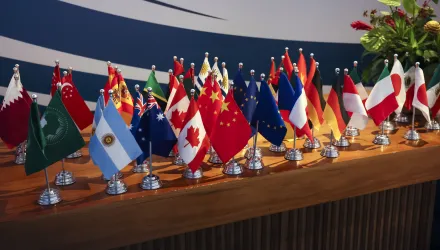
From left, Singapore's Prime Minister Lee Hsien Loong, Japanese Prime Minister Shinzo Abe, Chinese Premier Li Keqiang, Thailand Prime Minister Prayuth Chan-ocha, South Korean President Moon Jae-in, Vietnamese Prime Minister Nguyen Xuan Phuc and Brunei Sultan Hassanal Bolkiah join hands for a group photo at the Association of Southeast Asian Nations (ASEAN) Plus Three summit in Nonthaburi, Thailand on Nov. 4, 2019 (Aijaz Rahi/Associated Press).

Aijaz Rahi/Associated Press

Paper - Nuclear Threat Initiative

Regional Tools to Strengthen Nuclear Security: Asia-Pacific

| November 2019

This paper surveys the existing tools for maintaining and strengthening nuclear security in the Asia-Pacific region, identifies regional tools that currently do not play such a role, but conceivably could, and considers whether new tools might be created.

Spc. Alec Nitollama, a combat engineer with 65th Brigade Engineer Battalion, 2nd Infantry Brigade Combat Team, 25th Infantry Division, directs his squad through a breach point in the wire during a Bangalore wire breach range August 30, 2019 at Schofield Barracks, Hawaii.

US Army

Paper - Belfer Center for Science and International Affairs, Harvard Kennedy School

Urban Blind Spots: Gaps in Joint Force Combat Readiness

| November 2019

The Joint Force needs to develop capabilities, doctrine, and training that will give it an advantage in this extremely complex environment at the tactical and operational levels. Historically, the military has adapted conventional capabilities to develop advantages in an urban environment, but the size, ubiquity, and complexity of today’s urban terrain require dedicated analysis and preparation.  This paper offers military planners and policy makers a starting point for understanding the need for developing a cohesive strategy to ensure the Joint Force is able to successfully reduce its urban blind spot and effectively conduct urban operations in support of US national security interests.  Given the rapid urbanization of the 21st century and how cities are increasingly the dominant social, political, diplomatic, and economic centers, the Joint Force must take measures to address shortfalls across all services and echelons to be ready to meet future urban challenges in all warfighting domains. To continue the status quo is simply unacceptable.

Report - Global Efficiency Intelligence

Deep Decarbonization Roadmap for the Cement and Concrete Industries in California

| September 2019

Cement production is one of the most energy-intensive and highest carbon dioxide (CO2) emitting manufacturing processes. The goal of this study is to develop a roadmap for decarbonization of California's cement and concrete production. In this study, the authors look at the current status of cement and concrete production in California and develop scenarios up to 2040 to analyze different decarbonization levers that can help to reduce CO2 emissions of cement and concrete production in California.

teaser image

Report - Woodrow Wilson Center Press

SDF’s Arab Majority Rank Turkey as the Biggest Threat to NE Syria: Survey Data on America’s Partner Forces

| Oct. 07, 2019

Of all the actors in the Syrian conflict, the Syrian Democratic Forces (SDF) are perhaps the most misunderstood party. Five years after the United States decided to partner with the SDF, gaping holes remain in our knowledge about the women and men who defeated the Islamic State (IS).

From left, CIA Director Gina Haspel, Director of National Intelligence Daniel Coats, and Defense Intelligence Agency Director Gen. Robert Ashley, with (not pictured) FBI Director Christopher Wray, National Security Agency Director Gen. Paul Nakasone and National Geospatial-Intelligence Agency Director Robert Cardillo testify before the Senate Intelligence Committee on Capitol Hill in Washington Tuesday, Jan. 29, 2019.

AP Photo/Jose Luis Magana

Paper - Belfer Center for Science and International Affairs, Harvard Kennedy School

The U.S. Intelligence Enterprise and the Role of Privatizing Intelligence

    Author:
  • Sunny Jiten Singh
| September 2019

The purpose of the paper is not to suggest that outsourcing has no place in the role of government; to the contrary, the paper argues the elements of these two spheres have morphed into this modern strand of DNA which cannot be undone but to the point, DNA functions within the confines of the right environment as should outsourcing under straightforward regulation. The privatization of intelligence cannot be allowed to function in a vacuum and inadequate oversight must be called out to avoid further exploitation by industry.

Paper - Belfer Center for Science and International Affairs, Harvard Kennedy School

Building a 21st Century Congress: Improving Congress’s Science and Technology Expertise

| September 2019

While members of Congress in both chambers often produce thoughtful legislation on established science and technology issues, in legislation and high-profile hearings, Congress has appeared unprepared to reckon with emerging technologies and their effects on society. 

Paper - Belfer Center for Science and International Affairs, Harvard Kennedy School

Attacking Artificial Intelligence: AI’s Security Vulnerability and What Policymakers Can Do About It

| August 2019

The terrorist of the 21st century will not necessarily need bombs, uranium, or biological weapons. He will need only electrical tape and a good pair of walking shoes. Placing a few small pieces of tape inconspicuously on a stop sign at an intersection, he can magically transform the stop sign into a green light in the eyes of a self-driving car. Done at one sleepy intersection, this would cause an accident. Done at the largest intersections in leading metropolitan areas, it would bring the transportation system to its knees. It’s hard to argue with that type of return on a $1.50 investment in tape.

teaser image

Paper

Boston Tech Hub Faculty Working Group Annual Report 2018-2019

| September 2019

The Boston Tech Hub Faculty Working Group (FWG), hosted by former Secretary of Defense and Belfer Center Director Ash Carter and Harvard John A. Paulson School of Engineering and Applied Sciences Dean Frank Doyle, holds monthly discussion-based meetings that explore and answer the question:

How do we resolve the dilemmas posed to public good and public purpose, created by technology’s unstoppable advances?

The Boston Tech Hub Faculty Working Group Annual Report is a summary report of findings, key insights, and outstanding questions from the discussions held during the 2019-2020 academic year.