
Reports & Papers

1732 Items

A MEP walks in the mostly-vacant Plenary chamber of the European Parliament in Brussels, Tuesday, March 10, 2020.

AP Photo/Virginia Mayo

Paper

Transatlantic Dialogue: The Missing Link in Europe’s Post-Covid-19 Green Deal?

| April 2020

This policy brief emphasizes that the European Green Deal's effectiveness in a post Covid-19 world will require the involvement of strategic partners, especially the US. In the context of a potential US withdrawal from the Paris Agreement and the consequential vacuum, it will be even more important to engage the US in implementing the GD. In light of divergence between the US and the EU during past climate negotiations (e.g. Kyoto, Copenhagen, and Paris), we suggest a gradual approach to US engagement with GD initiatives and objectives.

Office workers using sticky notes on a wall

Adobe Stock

Paper

Human-Centered Policymaking

| April 2020

Human-centered design (HCD) is a complementary discipline that has its roots in industrial design, the discipline that crafts physical products like phones, guitars, and potato peelers. It leverages the qualitative research methods honed in the social sciences—such as ethnography, contextual inquiry, and targeted observations and interviews—to better understand people and interactions. HCD also considers environments, processes, systems, and tools outside of the digital realm. Practitioners often map out customer “journeys” to understand customer experiences across an entire system or ecosystem, not merely a single interface or piece of software. As in agile software development, practitioners of human-centered design iteratively develop solutions to the challenges they uncover, and they rigorously test their solutions with real “users.”

Report

Policy and Action on Plastic in the Arctic Ocean: October 2019 Workshop Summary & Recommendations

| April 2020

The Belfer Center’s Arctic Initiative and the Wilson Center’s Polar Institute co-hosted a workshop with the Icelandic Chairmanship of the Arctic Council at the Harvard Kennedy School of Government entitled, Policy and Action on Plastic in the Arctic Ocean. The event convened global thought leaders, diverse stakeholders, and subject matter experts to begin developing a framework for tackling Arctic marine plastic pollution as one of the focus areas for the Icelandic Chairmanship. 

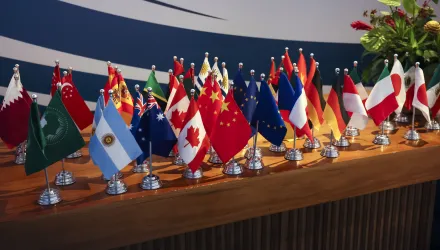
Participants attend the G20 Finance Ministers and Central Bank Governors Meeting Saturday, June 8, 2019, in Fukuoka, western Japan.

AP Photo/Eugene Hoshiko

Report

Emerging Issues in Economic Diplomacy

| April 2020

The nine issue papers contained in this report were proposed and written by graduate students at the Belfer Center for Science and International Affairs at Harvard Kennedy School. They present fact-based, nonpartisan analysis to help focus the next Administration on the key policy debates that must be resolved. And, they aim to create a platform for our students to engage with the most pressing policy issues of the day as they continue their careers in public service.

The aircraft carrier USS Ronald Reagan (CVN 76), left, and the Japan Maritime Self-Defense Force helicopter destroyer JS Hyuga (DDH 181), right, sail in formation with 16 other ships from the U.S. Navy and the Japan Maritime Self-Defense Force as aircraft from the U.S. Air Force and Japan Air Self-Defense Force fly overhead in formation during Keen Sword 2019.

U.S. Navy photo / SPC Kaila V. Peters

Paper

Asia Whole and Free? Assessing the Viability and Practicality of a Pacific NATO

    Author:
  • Aaron Bartnick
| March 2020

This report will address four questions in the Pacific NATO debate. First, is there a historical precedent for a Pacific NATO? This report does find a precedent in the Southeast Asia Treaty Organization (SEATO), though it was largely unsuccessful due to its lack of regional adoption, weak mutual defense provisions, and ultimately became tainted by the Vietnam War.

Second, would such an alliance be necessary given the plethora of existing multilateral partnerships in the region? While there is a broad multilateral landscape in the Indo-Pacific, there is currently no agreement that combines both the wide reach and deep obligations of a hypothetical Pacific NATO. However, the Quad and RIMPAC do bring together many of the key Indo-Pacific powers and serve as an important foundation for U.S.-oriented multilateral regional security.

Third, how could such an alliance be structured? This report examines three options: expanding NATO’s mandate beyond Europe, building on its Enhanced Opportunity Partner (EOP) program, and creating a new alliance system. It also uses the case of Montenegro’s NATO accession to generate a broad set of criteria for future membership.

And fourth, how would Indo-Pacific nations, including China, respond to such an alliance? This would be exceedingly difficult. China has significant economic leverage over even our closest allies, like Australia and Japan.

Intractable internal disputes abound, particularly between South Korea and Japan and four nations—Malaysia, the Philippines, Taiwan, and Vietnam—with competing claims in the South China Sea. Two of the United States’ most important partners in the region, India and Singapore, have a longstanding aversion to exactly this type of alliance system. And for newer partners, like Malaysia and Indonesia, the value proposition is even less clear. The Chinese are likely to respond to any attempts at a multilateral military alliance in its backyard with a whole-of-government effort to stop it. If that alliance includes Taiwan, it could result in even more aggressive action.

A satellite view of Shigatse, Tibet, home to the PLA’s 6th Border Defense Regiment, near the China-India border.

Maxar Technologies / CNES Airbus via Google, used with permission

Report - Managing the Atom Project, Belfer Center

The Strategic Postures of China and India: A Visual Guide

| March 2020

Fueled by aggressive rhetoric from both capitals, Indian and Chinese ground forces engaged in a standoff between June and August 2017. The Doklam crisis, as it became known, stimulated introspection among officials and experts in both states about the future of their relationship. Politically, both strategic communities largely concluded that the peaceful resolution of border disputes is now less likely, forecasting more rivalry than cooperation. Militarily, Indian discussions on the strength of its military position against China in their disputed ground frontier areas have converged on the view that China holds the conventional and nuclear edge over India in this domain.

Based on our analysis of data on the location and capabilities of Indian and Chinese strategic forces and related military units, we conclude that this assessment of the balance of forces may be mistaken and a poor guide for Indian security and procurement policies. We recommend that instead of investing in new nuclear weapons platforms that our analysis suggests are not likely to be required to deter China, New Delhi should improve the survivability of its existing forces and fill the gap in global arms control leadership with an initiative on restraint and transparency.

Military helicopters fly over the training ground during strategic command and staff exercises Center-2019 at Donguz shooting range near Orenburg, Russia, Friday, Sept. 20, 2019.

AP Photo/Sergei Grits

Paper - Belfer Center for Science and International Affairs, Harvard Kennedy School

Defense Playbook for Campaigns

    Authors:
  • Richard Kuzma
  • David Michelson
  • Jacqueline Parziale
  • Kathryn Reed
  • Ryan Solís
  • Tom Wester
  • William Wright
| March 2020

The 2018 National Defense Strategy (NDS) is predicated on a single organizing principle: America’s military pre-eminence is rapidly eroding. This is not a new concept. For years, experts have warned that the economic and technological advancements of U.S. adversaries, coupled with the 2008 financial crisis and America’s focus on peripheral conflicts, have caused a decline in America’s military dominance. 

In this context, the advances of near-peer competitors such as China and Russia have created plausible “theories of victory” in potential conflicts across Eastern Europe and East Asia. Competitors’ unaddressed improvements in strategic innovation, economic investment, and dual-use technology increases the risk of conflict and strains the U.S. alliance system. It is urgent that the United States reestablish and maintain credible deterrents against these near-peer competitors. After decades of focusing on post-Cold War ‘shaping’ operations, the American military needs to reinvigorate for full spectrum great power competition.

This report is intended as a blueprint on how to begin that process from graduate students at the Belfer Center for Science and International Affairs at Harvard University. Contained inside are 12 memorandums. Each provides a high-level overview and specific recommendations on a key issue of American defense policy. 

Russian President Boris Yeltsin, left, American President Bill Clinton, Ukrainian President Leonid Kuchma, and British Prime Minister John Major sign the Budapest Memorandum on Dec. 5, 1994 (Marcy Nighswander/Associated Press).

Marcy Nighswander/Associated Press

Paper - Managing the Atom Project, Belfer Center

Budapest Memorandum at 25: Between Past and Future

| March 2020

On December 5, 1994, leaders of the United States, the United Kingdom, and the Russian Federation met in Budapest, Hungary, to pledge security assurances to Ukraine in connection with its accession to the Treaty on the Nonproliferation of Nuclear Weapons (NPT) as a non-nuclear-weapons state. The signature of the so-called Budapest Memorandum concluded arduous negotiations that resulted in Ukraine’s agreement to relinquish the world’s third-largest nuclear arsenal, which the country inherited from the collapsed Soviet Union, and transfer all nuclear warheads to Russia for dismantlement. The signatories of the memorandum pledged to respect Ukraine’s territorial integrity and inviolability of its borders, and to refrain from the use or threat of military force. Russia breached these commitments with its annexation of Crimea in 2014 and aggression in eastern Ukraine, bringing the meaning and value of security assurance pledged in the Memorandum under renewed scrutiny.

On the occasion of the 25th anniversary of the memorandum’s signature, the Project on Managing the Atom at the Belfer Center for Science & International Affairs at the Harvard Kennedy School, with the support of the Center for U.S.-Ukrainian Relations and the Harvard Ukrainian Research Institute, hosted a conference to revisit the history of the Budapest Memorandum, consider the repercussions of its violation for international security and the broader nonproliferation regime, and draw lessons for the future. The conference brought together academics, practitioners, and experts who have contributed to developing U.S. policy toward post-Soviet nuclear disarmament, participated in the negotiations of the Budapest Memorandum, and dealt with the repercussions of its breach in 2014. The conference highlighted five key lessons learned from the experience of Ukraine’s disarmament, highlighted at the conference.

One of the parabolic mirrors arrays at the Shams-1 concentrated solar power plant in the UAE, January 2015.

IRENA photo, CC by-nc-sa 2.0

Report

Green Ambitions, Brown Realities: Making Sense of Renewable Investment Strategies in the Gulf

| March 2020

Gulf countries have hailed their investments in renewable energy, but some basic questions remain about the extent to which it makes sense for GCC states to invest aggressively in renewables. The sheer magnitude of such investments will require these countries to mobilize significant public resources.  Therefore, such an assessment requires these countries to focus on national interests, not just a desire to be perceived as constructive participants in the global transition away from carbon energy. 

This report starts by identifying four common strategic justifications for investing in renewable energy in GCC countries. Each of these rationales highlights a different aspect of renewable energy investments. In addition, each rationale is based on different assumptions about the underlying drivers of such investments, and each rationale is based on different assumptions about the future of energy. 
 

A photo of electrolysis in action. (Flickr: ca_heckler)

Flickr: ca_heckler / CC by-nc-nd 2.0

Report

Geopolitical and Market Implications of Renewable Hydrogen: New Dependencies in a Low-Carbon Energy World

| March 2020

To accelerate the global transition to a low-carbon economy, all energy systems and sectors must be actively decarbonized. While hydrogen has been a staple in the energy and chemical industries for decades, renewable hydrogen is drawing increased attention today as a versatile and sustainable energy carrier with the potential to play an important piece in the carbon-free energy puzzle. Countries around the world are piloting new projects and policies, yet adopting hydrogen at scale will require innovating along the value chains; scaling technologies while significantly reducing costs; deploying enabling infrastructure; and defining appropriate national and international policies and market structures.

What are the general principles of how renewable hydrogen may reshape the structure of global energy markets? What are the likely geopolitical consequences such changes would cause? A deeper understanding of these nascent dynamics will allow policy makers and corporate investors to better navigate the challenges and maximize the opportunities that decarbonization will bring, without falling into the inefficient behaviors of the past.